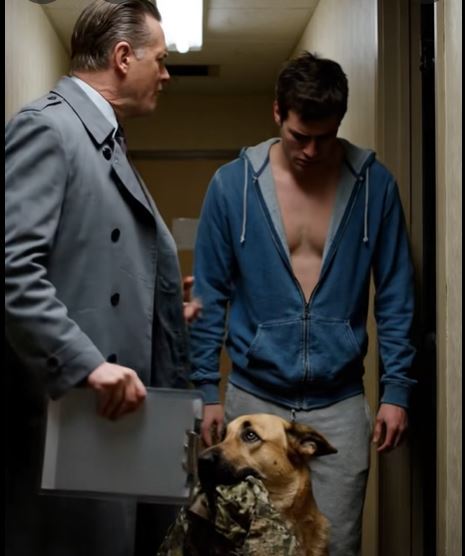
The apartment building on Elmwood Avenue smelled of fresh paint and old regrets. It was a Tuesday afternoon in early November, and the hallways were quiet except for the distant hum of a vacuum cleaner.
Sarah Mitchell stood frozen in the doorway of her third-floor unit, keys still in her hand, staring at the building manager, Mr. Harlan Graves, who had just delivered his ultimatum with all the warmth of a parking ticket.
“Forty-eight hours, Ms. Mitchell,” he said, adjusting his tie with bureaucratic precision. “The dog is a disturbance. Other tenants have complained. Service animal or not, the lease clearly states no pets that cause issues. Your brother’s dog has been howling at night and scratching at the door. Either find it a new home or you’ll both be evicted.”
Sarah’s throat tightened. At her side sat Atlas, a large, battle-scarred German Shepherd—her late brother’s military working dog. Atlas had served three tours with Sergeant Daniel Mitchell before Daniel was killed in action eighteen months earlier.
The dog had been honorably discharged due to injuries sustained in the same ambush that took her brother’s life. Since then, Atlas had become Sarah’s shadow and her only remaining connection to Daniel.
He slept at the foot of her bed, followed her from room to room, and still woke at 3 a.m. some nights with nightmares that made him whine and pace until she held him.
“He’s grieving,” Sarah said quietly, her voice cracking. “He lost his handler—my brother. He’s not just a pet. He’s family.”
Graves shrugged, unmoved. “Rules are rules. Forty-eight hours. After that, I call animal control.”
The door clicked shut behind him. Sarah sank to the floor, wrapping her arms around Atlas’s thick neck. The dog leaned heavily against her, letting out a low, heartbroken whine that seemed to echo the emptiness she felt every single day without Daniel. She had already lost her brother. Now she was about to lose the last piece of him.
That night, after crying herself raw, Sarah made one decisive call.
She dialed the number her brother had given her years ago—the emergency contact for his old unit. A deep, familiar voice answered on the second ring.
“Captain Reyes speaking.”
“Captain… it’s Sarah Mitchell. Daniel’s sister. I need help.”
The conversation was short but urgent. Sarah explained the situation—Atlas’s grief, the building manager’s ultimatum, her fear of losing the dog who had stood beside her brother through hell. Captain Reyes listened without interruption. When she finished, there was a long pause.
“Give me twenty-four hours,” he said simply. “And keep Atlas with you. Don’t surrender him to anyone.”
The next morning, the consequences began to unfold with military precision.
At 9:15 a.m., a black SUV pulled up outside the building. Three men in crisp dress uniforms stepped out—Captain Reyes and two other members of Daniel’s former unit. They were followed by a woman in a sharp business suit carrying a thick folder. By 9:30, they were standing in the building manager’s office.
Graves looked up from his desk, annoyed. “Can I help you gentlemen?”
Captain Reyes placed a copy of Atlas’s official military discharge papers, his service record, and a letter from the Department of Veterans Affairs on the desk.
“This dog is a certified former military working dog who served with honor alongside Sergeant Daniel Mitchell, who was killed in action. Under federal law and the Americans with Disabilities Act, service animals—especially those with military history—are protected.
More importantly, this building receives federal housing assistance. Any attempt to evict a veteran’s surviving family member or remove a grieving service animal could be considered discrimination and a violation of multiple statutes.”
The woman in the suit stepped forward. “I’m Attorney Laura Chen from Veterans Legal Aid. We’ve already filed a formal complaint with HUD and the VA. If you proceed with eviction or removal of the dog, we will pursue legal action—including potential loss of federal funding for this property.”
Graves’s face went pale. He stammered, “I… I didn’t realize—”
“You didn’t ask,” Captain Reyes said coldly. “You saw a grieving dog and a grieving sister and decided rules mattered more than compassion. That ends now.”
By noon, the building’s owner had been contacted. By 2 p.m., a formal apology letter was drafted and delivered to Sarah’s door, along with a new lease addendum explicitly allowing Atlas to remain as a service and emotional support animal with no restrictions.
The other tenants who had complained received polite but firm reminders about the importance of supporting veterans’ families.
But the real transformation happened that evening.