The morning sun had barely risen when I picked up the small wooden crate filled with oranges. They weren’t perfect—some had rough skin, others were smaller than usual—but to me, they were everything. Each one meant a few coins, and those coins meant medicine for my mother.
I was only nine years old, but life had already taught me things children shouldn’t have to learn. I knew how to calculate quickly, how to recognize who might buy and who would ignore me, and how to smile even when my stomach ached from hunger. My mother had been sick for months, her strength fading little by little. Some days she could barely sit up, and on those days, I would hold her hand and promise that everything would be okay—even if I didn’t know how.
“Don’t go too far today,” she whispered that morning, her voice weak but warm.
“I won’t,” I replied, though I already knew I would.
Because staying close wouldn’t bring enough money.
The streets were busy as usual. Cars passed by without slowing down, people rushed to their jobs, and I stood at the corner, holding up my crate, calling out softly, “Fresh oranges… sweet oranges…”
Some people bought out of kindness. Others bargained as if every coin they saved mattered more than the child standing in front of them. By midday, I had sold half the crate. It wasn’t enough. Not yet.
That’s when I saw it.
At the end of the street, far beyond the small shops and crowded sidewalks, stood a mansion. I had passed that road before but never dared to go closer. Tall gates, polished stone walls, and a long driveway lined with trees—it looked like a place from another world.
The kind of world where people didn’t worry about medicine.
I hesitated.
Then I took a deep breath and started walking.
Each step felt heavier than the last. My worn shoes didn’t belong on that clean pavement, and my reflection in the shiny gate made me feel even smaller. But I tightened my grip on the crate and rang the bell.
For a moment, nothing happened.
Then the gate opened slowly.
A man in a neat uniform stood there, looking down at me with a mix of confusion and caution. “Yes?” he asked.
“I… I’m selling oranges,” I said, trying to keep my voice steady. “My mom is sick. I just need to sell a few more.”
He studied me for a second, then sighed softly. “Wait here.”
But I didn’t wait.
Something inside me pushed me forward. As the gate opened wider, I stepped in, my eyes taking in everything—the garden, the fountain, the silence. It was so quiet compared to the streets I knew.
“Hey, you shouldn’t—” the man started, but stopped when another voice interrupted.
“It’s alright.”
I turned.
A tall man in an elegant suit stood at the top of the steps leading into the mansion. He looked serious, the kind of person who didn’t smile easily. But his eyes weren’t cold—just distant.
“Let her come,” he said.
I walked toward him slowly, my heart pounding.
“Sir… would you like to buy some oranges?” I asked.
He didn’t answer immediately. Instead, he looked at me closely, as if trying to understand something he couldn’t quite place.
“What’s your name?” he finally asked.
“Lina,” I said.
“And your mother?”
“Her name is Sara.”
The moment I said it, something changed in his expression.
Just slightly.
But I noticed.
“Come inside,” he said.
I hesitated again. No one had ever invited me into a place like this. But something about his voice made me follow.
The inside of the mansion was even more overwhelming—high ceilings, polished floors, walls covered in paintings. I tried not to stare, but it was impossible.
And then I saw it.
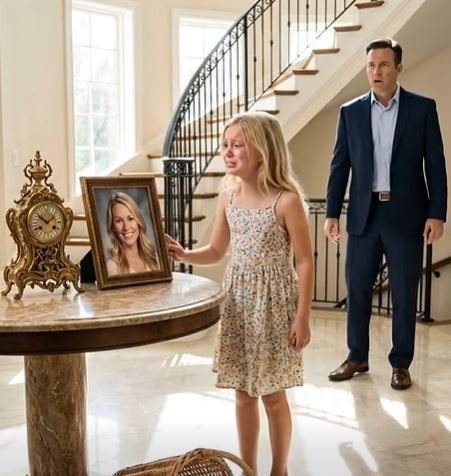
On one of the walls, framed in gold, was a photograph.
A woman stood in the center, smiling softly. She looked younger, healthier… but there was no mistake.
My breath caught in my throat.
I stepped closer, my hands trembling.
“Why… is my mom in this picture?” I asked quietly.
The room went silent.
Behind me, I heard the man take a slow breath.
“That’s not possible,” he said at first, almost to himself. But when I turned to look at him, I saw something else in his eyes now—shock, disbelief… and something deeper.
“That’s her,” I insisted. “That’s my mom.”
He walked toward the photo, his gaze fixed on it.
“That woman…” he began, his voice lower now, “her name is Sara.”
“I know,” I said. “She’s my mom.”
He shook his head slightly, as if trying to process what he was hearing.