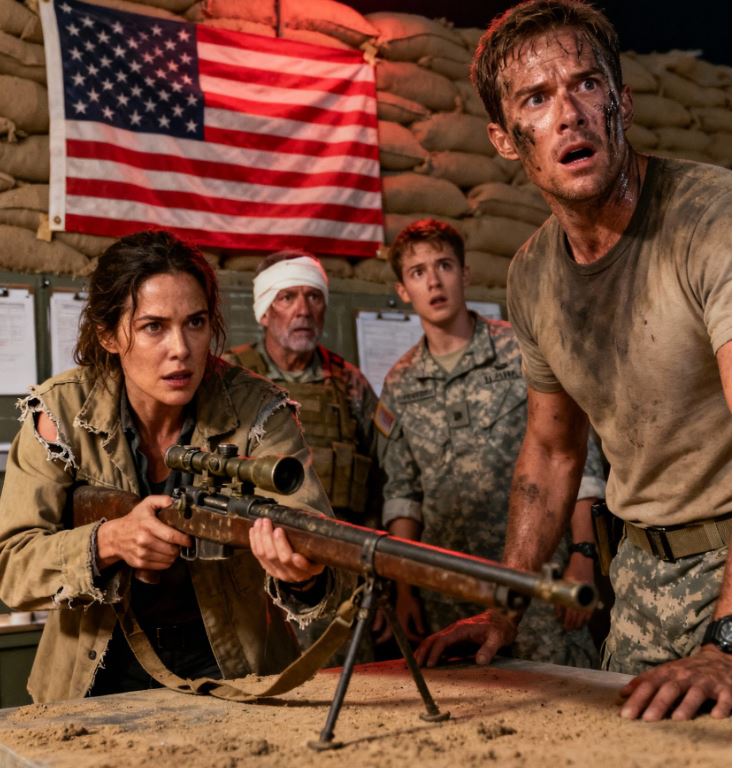
The mortar round hit 30 meters from the eastern perimeter. It was close enough that I felt the shock wave through the soles of my boots, a jarring, physical punch from the earth itself.
Dust and debris rained down on our makeshift command post. I pressed myself flat against the sandbag wall, the rough burlap scratching my cheek.
My radio crackled, a chorus of desperation.
“Contact, south wall! Multiple hostiles breaching the wire!”
“Ammunition critical on the north position! We’re down to two mags!”
“Medic! Goddammit, we need a medic at Checkpoint Three! Bennett’s hit!”
I’m Lieutenant Ryan Garrett. And Forward Operating Base Sentinel was my command. My responsibility. My graveyard.
I wiped the grit from my eyes and keyed my handset, forcing my voice to stay level.
“All positions, maintain fire discipline. Conserve ammo. Air support is inbound, ETA 20 minutes.”
The lie tasted like copper and sand in my dry mouth.
The nearest gunships were over an hour away, grounded by the same sandstorm that had swept through the valley an hour before sunset. This wasn’t a random attack; it was a coordinated siege.
FOB Sentinel had been a quiet posting until three days ago. A forgotten corner of the war. 72 Marines, a handful of Navy Corpsmen, and enough supplies for a month of routine patrols.
Now, we were surrounded. Outnumbered at least five-to-one. And I was watching my defensive perimeter collapse, one agonizing radio call at a time.
Sergeant Hayes, my rock, stumbled into the CP, blood streaming from a gash above his eyebrow. He wasn’t using a pressure dressing; he was just letting it run.
“Lieutenant,” he panted, “it’s bad. We’ve got maybe 200 rounds left. Across all positions. Total.”
My stomach clenched.
“The bunker?”
“Took a direct hit in the first wave. It’s gone, sir. All of it.”
My mind raced. Tactical options. Each one was bleaker than the last. Fall back to the central building? We’d be abandoning the wounded men still scattered at the checkpoints.
Attempt a breakout? In the dark? Through hostile territory, outnumbered, carrying our wounded? It wouldn’t be a breakout; it would be a massacre.
I made the call I never wanted to make.
“Hayes. Tell the squad leaders to pull ammunition from the wounded. Anyone who can’t fight gives up their magazines.”
I hated the order even as I gave it. This was the calculus of defeat. Rationing bullets like water in a desert. This is how units die.
The compound shook again, this time closer. The distinctive, rapid crack-crack-crack of AK-47s echoed from three directions at once, punctuated by the deeper, sickening whoosh-BOOM of rocket-propelled grenades. Through the haze of smoke and dust, I could see them—muzzle flashes creeping closer to the wire, like hungry eyes in the dark.
Corporal Bennett, the kid who’d replaced our wounded comms guy, was barely 20. He had a face that still looked like it belonged in a high school yearbook. He was gripping his M4 with white-knuckled hands.
“Sir?” His voice cracked, barely a whisper over the gunfire.
“Are we… are we gonna make it?”
I looked into his terrified, young eyes. The honest answer was no. The answer a leader has to give was different.
“We hold until dawn, Marine,” I said, my voice harder than I felt.
“We hold our ground. Marines don’t quit.”
I checked my own magazine. 15 rounds. Two more in my vest. Forty-five bullets between me and whatever came next.
The radio squawked again. It was Corporal Davis from the western bunker, the one position that hadn’t been hit hard yet.
“Sir, I’ve got movement on the supply road. Civilian vehicle approaching the gate.”
Civilian?
My blood ran cold. Out here? Three klicks from the nearest village, in the middle of a full-scale assault?
“Do not engage!” I yelled into the handset.
“Confirm it’s not a VBIED!” A Vehicle-Borne Improvised Explosive Device would punch right through our gate and end this siege in one catastrophic blast.