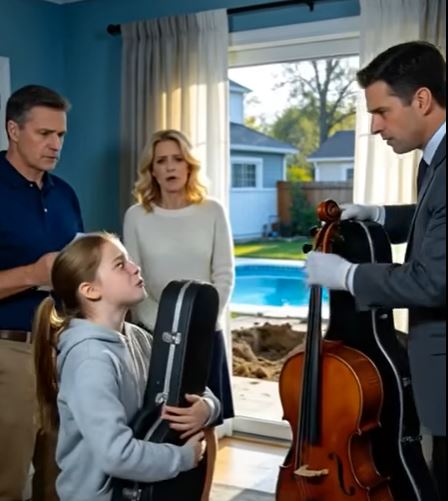
It wasn’t just any instrument. It was an 1890 Italian cello, warm honey-brown with delicate varnish cracks like fine veins beneath glass. My grandmother had kept it in a humidity-controlled case for decades. She used to say it didn’t belong to us — we belonged to it. It carried history in its wood, stories in its strings.
She gave it to my daughter, Lily, on her tenth birthday.
Not to me. Not to my parents. To Lily.
“You have the hands for it,” Grandma had told her, guiding her small fingers along the fingerboard. “And the heart.”
Lily practiced every day. Not because I forced her. Because she loved it. The sound that came from that cello was rich and deep, far beyond what you’d expect from an eleven-year-old. Her music teacher once told me, “This instrument chose her.”
So when Lily ran into the kitchen one afternoon, her face pale, I knew something was wrong.
“Mom,” she whispered, “Grandpa said the cello is gone.”
I laughed at first. “Gone where?”
“They took it,” she said, her voice trembling. “They said we weren’t using it properly.”
My parents had a key to our house. They watched Lily after school sometimes when I worked late shifts at the hospital. I trusted them.
I called my mother immediately.
“Oh, that old thing?” she said casually. “We sold it.”
My heart stopped. “You what?”
“It was collecting dust,” she replied. “And frankly, it was worth too much to sit around in a child’s bedroom. We got eighty-seven thousand dollars for it. A private collector.”
Eighty-seven thousand.
The number felt surreal.
“You had no right,” I said, my voice shaking.
“We’re her grandparents,” my father cut in sharply. “We know what’s best. Your sister’s boys have wanted a pool for years. It’s summer. They deserve something nice for once.”
The room spun.
They had sold my daughter’s inheritance — her instrument, her joy — and used the money to build my sister’s kids a backyard pool.
Because they “deserved something nice.”
Lily was sitting at the table, hugging her knees to her chest, listening to every word. Her eyes weren’t angry. They were confused.
“Why would they take it?” she asked quietly after I hung up.
I didn’t have an answer that wouldn’t shatter her.
We drove to my parents’ house that evening. And there it was — concrete freshly poured, a turquoise rectangle shimmering under the setting sun. My nephews were already splashing in ankle-deep water, laughing.
My sister stood nearby with a drink in her hand, grinning like she’d won something.
“Isn’t it amazing?” she said as we walked up. “Mom and Dad surprised us!”
“With my daughter’s cello,” I replied flatly.
She rolled her eyes. “Oh, come on. She’s eleven. It’s not like she’s Yo-Yo Ma.”
Lily flinched beside me.
That was when Grandma’s car pulled into the driveway.
No one had told her.
She moved slowly these days, leaning on her cane, but her mind was sharper than anyone gave her credit for. She looked from the half-filled pool to my face, then to Lily’s tear-streaked cheeks.
“What happened?” she asked.
My mother stepped forward quickly. “We handled something practical. Sold the cello. It was worth a fortune. Used it for something the whole family can enjoy.”
Grandma didn’t react immediately.
She just stared at them.
Then she smiled.
Not warmly.
Not kindly.
A small, knowing smile.
“The cello was never yours to sell,” she said calmly.
My father frowned. “What are you talking about? It was in our family.”
“Yes,” Grandma replied. “In our family. And I made sure it stayed protected.”
A strange silence settled over the yard. Even the boys in the pool stopped splashing.
Grandma turned to me. “Go to my car, sweetheart. Bring the folder from the glove compartment.”
I did.
Inside was a thin leather binder I’d seen before but never opened. She took it carefully and handed it to my father.
“Read,” she instructed.
His face changed as he scanned the first page.
“It’s a trust,” I said slowly, reading over his shoulder.
Grandma nodded. “I established a musical heritage trust five years ago. The cello was formally appraised, documented, and placed under legal protection. It was transferred directly to Lily as beneficiary upon my death — but until then, it remains under my ownership.”
My mother’s lips parted. “But you gave it to her—”
“I loaned it to her,” Grandma corrected. “With paperwork you clearly never bothered to understand.”
My father’s voice hardened. “We already sold it.”
“Yes,” Grandma said quietly. “Without legal authority.”
The air seemed to thicken.
“The buyer will be contacted,” she continued. “And if the instrument isn’t returned immediately, I will pursue criminal charges for unlawful sale of protected property.”