The airport never really slept. Even in the dead of night, the hum of conveyor belts, the distant rumble of planes taking off, and the intermittent beeps of scanning machines created a constant, low-level pulse that kept the entire terminal alive.
Travelers shuffled past in a blur of luggage wheels and tired faces, many moving mechanically, lost in their own worlds. In that seemingly endless stream of humanity, it was easy to miss small, extraordinary moments. But some things were impossible to ignore.
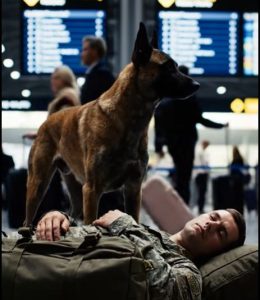
It started with a soldier, a young man in uniform, his boots echoing on the polished floors as he walked toward the gate. He moved with quiet purpose, carrying a duffel bag that had clearly seen its fair share of deployments.
His expression was calm, professional, but there was a weariness to him, the kind only someone who had been away from home for too long could carry.
Beside him, however, was something—or rather someone—equally striking: a dog. A large, golden Labrador, alert and poised, walked in step with the soldier. Its eyes were bright, intelligent, constantly scanning the surroundings, and its tail wagged ever so slightly, betraying a mixture of excitement and vigilance.
To onlookers, it seemed obvious: this was a loyal companion, a military or service dog, trained to protect and follow its handler through any environment.
But what made people stop in their tracks was not just the dog’s presence—it was the way it never left the soldier’s side. It stayed within a foot of him, moving seamlessly through the crowd, occasionally nudging him with its nose as if to make sure he hadn’t forgotten it was there.
Parents pointed their children toward the pair, whispering about loyalty and devotion. “Look at that dog,” one woman said. “He’d follow him anywhere.”
As the soldier approached the security checkpoint, the scene began to attract attention. People instinctively slowed, creating a subtle ring of observers. The dog didn’t waver.
It waited patiently as the soldier set his bags down and went through the routine of identification and metal detectors. When the officer behind the counter called the soldier’s attention, the dog sat down quietly, ears perked, watching him with unwavering focus.
Hours passed like this, and still the dog wouldn’t leave. Some travelers speculated, some smiled, others whispered to friends. Loyalty, yes—but there was something deeper here, a sense that the dog’s presence carried meaning beyond training.
It wasn’t until the boarding announcement came that the truth began to reveal itself. The soldier moved toward the gate, signaling that he would soon leave on a flight, likely to a new assignment, another deployment.
The dog followed immediately, but instead of entering the plane with him, it stopped, sitting firmly by the threshold. The soldier glanced down, and for the first time, a flicker of emotion crossed his face—a mixture of sadness, respect, and something heavier, something unspoken.
Then it became clear. This wasn’t just a story of loyalty between a handler and his dog. The dog had not traveled with the soldier as a companion or protector. It had been his constant partner through something far more personal: recovery. This dog was trained not just for obedience or protection—it was trained for therapy, trained to detect moments of emotional distress, trained to be a silent guardian in the invisible battles the soldier carried with him.
For months, the soldier had been dealing with the scars of combat, scars that weren’t always visible. Anxiety, panic attacks, sleepless nights—he had managed them with help from this dog, a living anchor that kept him grounded.
And now, at the airport, the dog’s refusal to leave his side wasn’t just devotion. It was understanding, empathy, an instinctive awareness that this man, surrounded by chaos and strangers, needed support more than ever.
The crowd watching slowly realized it wasn’t just loyalty—they were witnessing something far more profound. The dog’s eyes seemed to communicate reassurance, patience, and quiet encouragement. Each small nudge, each subtle movement, was a reminder to the soldier that he wasn’t alone.
When the soldier finally turned to board the plane, he knelt beside the dog for a brief moment, pressing his forehead to the dog’s muzzle in gratitude. He whispered something that no one else could hear, and the dog responded with a soft whine, a tiny wag, and a stillness that was both protective and loving.
The terminal, once filled with the mechanical hum of machinery and tired chatter, seemed to shift in that moment. People who had been rushing to catch flights slowed, some reaching for phones to capture the scene, others simply pausing, touched by the silent, extraordinary bond they had just witnessed.