Alejandro Salgado stopped by his truck, black and polished, one of those vehicles that shined like a mirror even on cloudy days. The engine purred quietly beneath the hood, a symbol of the life he had built—powerful, controlled, and seemingly flawless.
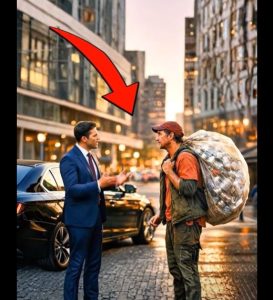
People passing by often turned their heads, impressed by the luxury, unaware of the heavy silence that followed him wherever he went.
That morning had been like any other. A quick meeting with investors, a signed contract worth millions, and a schedule packed with obligations that left no space for reflection. Success had become routine for Alejandro, almost mechanical. Yet something about that day would fracture the carefully constructed walls of his world.
As he stepped out of his truck near a busy intersection, his eyes caught a figure bending beside a row of public trash bins. A woman moved slowly, carefully collecting aluminum cans and placing them into a worn plastic bag. Her movements were deliberate, almost practiced, as if she had repeated this task countless times.
There was something familiar about the way she tilted her head, the way her dark hair fell across her face.
Alejandro paused.
A strange unease stirred within him.
He watched as she straightened slightly, brushing dirt from her coat. Her face turned just enough for him to see her features clearly, and the air seemed to leave his lungs.
“Lucía…” he whispered.
The name lingered on his lips like a ghost from another life.
Fifteen years earlier, Lucía had been everything to him—not just his partner in business, but in dreams, in struggle, in hope. Together they had started with nothing but a small workshop, a borrowed desk, and an idea they believed could change their future. They worked late nights fueled by cheap coffee and ambition, sharing every victory and every failure.
But success has a way of revealing hidden fractures.
As their company grew, pressure followed. Investors demanded control, profits became the priority, and trust slowly eroded. Alejandro had chosen expansion at any cost. Lucía had insisted on integrity, on protecting their workers, on growing carefully rather than quickly.
Their disagreements turned into arguments. Arguments became distance.
Then one day, she was gone.
She had sold her shares and disappeared without explanation, leaving Alejandro with the company they had built together—and a bitterness he never fully understood.
And now she stood before him, collecting discarded cans.
Alejandro crossed the street slowly, disbelief tightening his chest. He had imagined many possibilities for her life, but never this.
“Lucía,” he called softly.
She froze.
For a moment, she didn’t turn. When she finally did, her eyes widened in shock, then quickly hardened with something deeper—perhaps shame, perhaps resentment.
“Alejandro,” she said quietly.
The years had marked her face, but her presence remained unmistakable. There was still strength in her posture, dignity in her gaze, even as she clutched the bag of cans beside her.
He struggled to find words. “What… what are you doing here?”
A faint smile crossed her lips, tinged with irony. “Working.”
He glanced at the bag, at the worn coat, at the exhaustion in her eyes. The contrast between them—his tailored suit and her fragile condition—felt unbearable.
“You shouldn’t be living like this,” he said.
“And who decides how I should live?” she replied calmly.
Her voice held no anger, only quiet firmness.
Alejandro hesitated. “You disappeared. I tried to find you. I thought you had started something new… something successful.”
“I did start something,” she said. “Just not the kind you would understand.”
She began walking toward the recycling center at the end of the street, and after a moment’s hesitation, Alejandro followed.
They moved in silence until they reached a small building surrounded by stacks of sorted materials. Lucía handed over the cans and received a few coins in return. She slipped them carefully into her pocket, treating them with a seriousness that humbled him.
Finally, Alejandro spoke. “Tell me what happened.”
Lucía studied him for a long moment before answering.
“When I left the company, I thought I could build something meaningful—an organization that helped people without exploiting them. I invested everything I had into community programs, housing projects, education centers.”
“And it failed?” he asked.
“It struggled,” she corrected gently. “Because helping people rarely brings profit.”
She looked toward the street where families hurried past, burdened with invisible worries.
“I saw things we never noticed when we were chasing growth,” she continued. “Workers who couldn’t afford rent despite working full-time. Children who went hungry while corporations celebrated record profits. I couldn’t ignore it.”