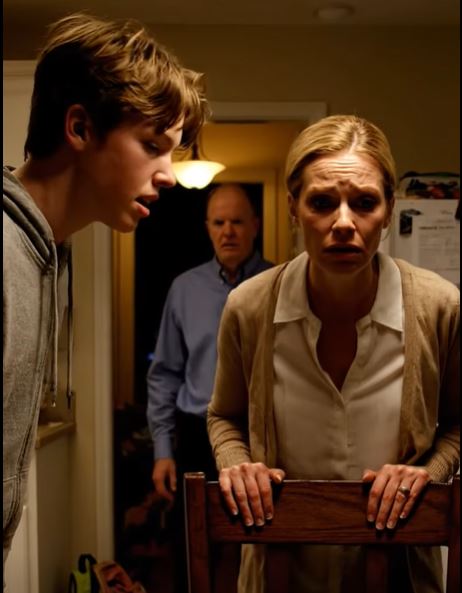
The dining room chandelier cast a warm, golden light over the mahogany table, but the atmosphere was anything but warm. It was a Thursday evening in early spring, the kind of ordinary night when families gathered to share a meal and talk about their days.

At thirty-eight, I sat at one end of the table in the home I had helped build with my husband, Thomas, our eleven-year-old son, Ethan, between us. The roast chicken I had spent the afternoon preparing sat mostly untouched on our plates. The air felt thick, charged with the kind of tension that had been building for weeks.
Ethan had been different lately—moody, withdrawn, quick to anger. At first I thought it was normal pre-teen turbulence, the kind every parent dreads. But tonight it boiled over.
He slammed his fork down, the metal clattering against the plate. “You’re not even my real mother!” he shouted, his voice cracking with raw emotion. “You’re just pretending! Dad told me the truth!”
The words hit me like a physical blow. I froze, fork halfway to my mouth, staring at the boy I had raised since he was three days old—the boy I had rocked through colic nights, taught to ride a bike, stayed up with during nightmares, and loved with every fiber of my being. My heart hammered against my ribs.
“Ethan…” My voice came out small, unsteady. “What are you talking about?”
He shoved his chair back so hard it scraped loudly against the hardwood floor. His plate—still half-full of chicken and mashed potatoes—flew across the table, shattering against the wall behind me. Food splattered across the wallpaper I had chosen with such care when we moved in.
“You lied to me my whole life!” he screamed, tears streaming down his face. “You’re not my mom! You just took me because you couldn’t have your own kids!”
I turned to Thomas, desperate for him to say something—anything—to calm our son, to reassure him, to defend the family we had built together. But my husband sat frozen in his chair, his face pale, eyes fixed on the tablecloth. He didn’t look at me. He didn’t look at Ethan. He simply stared at his own plate, jaw clenched, saying nothing.
That silence was louder than any shout.
In that moment, I knew.
The guilt written across his face wasn’t about a simple argument or a white lie told to protect a child. It was deeper. Darker. It was the kind of guilt that had been festering for years.
I didn’t scream. I didn’t cry in front of them. I simply stood up, my legs unsteady, and walked out of the dining room. Behind me, I heard Ethan’s sobs turn into angry, broken gasps, and still Thomas said nothing.
Later that night, after Ethan had cried himself to sleep in his room and Thomas had retreated to the guest bedroom without a word, I sat alone at the kitchen table with a cup of tea that had gone cold.
My hands shook as I opened the small lockbox I kept in the bottom drawer of the china cabinet—the one that held our important documents, the adoption papers, the medical records, the photographs from the day we brought Ethan home from the hospital.
The papers looked exactly as I remembered them. The official seals. The signatures. The dates. But something felt wrong. I had always trusted Thomas with the legal side of the adoption. He had handled the lawyers, the paperwork, the meetings. I had been so grateful, so focused on bonding with our newborn son, that I had never questioned the documents.
Until now.
I took the papers to the dining room table and spread them out under the brighter light. That was when I saw it.
The dates didn’t match.
The hospital discharge summary listed Ethan’s birth as March 17th. But the adoption finalization papers were dated March 12th—five days earlier. That was impossible. No adoption could be finalized before the baby was even discharged.
I pulled out my phone and began searching. I called the hospital records department the next morning, using the emergency contact number I still had from Ethan’s birth. After a long conversation with a sympathetic records clerk, I received scanned copies of the original intake forms.
The truth was worse than I had imagined.
Ethan had not been given up for adoption by a birth mother who couldn’t care for him, as Thomas had always told me. He had been taken from his biological mother— a young woman named Rebecca who had been in a violent relationship and had tried to leave with her newborn.