
A Scene That Silenced the Restaurant
The elegant restaurant was nearly full when Victoria Harrington arrived, dressed in a designer coat and carrying an expensive handbag.
She expected immediate attention, the best table, and service that matched her social status.
Her waitress, Emily Carter, greeted her politely and presented the menu with a professional smile.
Emily had worked at the restaurant for three years, often covering extra shifts to help support her young daughter.
Although she was exhausted from a long afternoon, she remained patient with every customer.
Victoria, however, seemed determined to find something wrong.
She complained about the temperature, criticized the table setting, and sent her drink back twice.
When Emily returned with the corrected order, Victoria abruptly pushed her glass aside.
It toppled over, spilling water across the table and onto the polished floor.
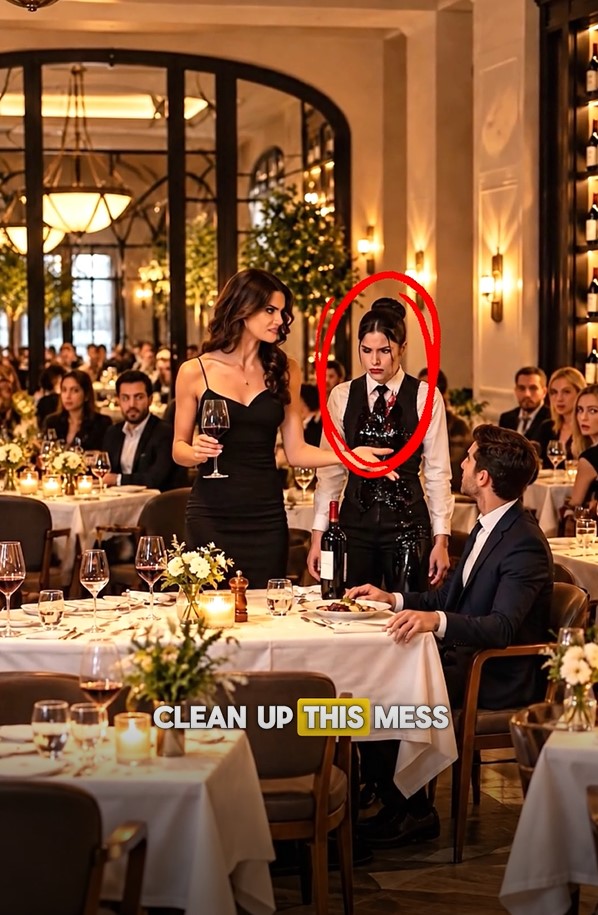
Victoria immediately stood and stared at Emily with open irritation.
“Look at this mess,” she announced loudly. “Clean it up. That’s what you’re paid for.”
Nearby conversations faded as several diners turned toward them.
Emily looked at the broken glass scattered beneath the table, then quietly reached for a cloth.
Before she could kneel, a firm voice interrupted from behind her.
“Excuse me. Nobody speaks to my employees that way.”
The Waitress Tries to Keep Her Composure
The speaker was Daniel Brooks, the restaurant’s owner.
He had built the business over twelve years, starting with a small neighborhood café before opening the elegant dining room.
Daniel knew most of his employees personally and understood how difficult restaurant work could become during busy evenings.
He had been checking an order near the kitchen when he heard Victoria’s raised voice.
Now he stood beside Emily, watching as she tried to collect the broken glass without drawing further attention.
Victoria crossed her arms.
“I don’t see what your problem is,” she replied. “I asked your waitress to clean up something she should have prevented.”
Daniel glanced at the overturned glass.
“Did you see her knock it over?” he asked calmly.
Victoria hesitated for half a second.
“No, but she was standing right here.”
Emily remained silent, unwilling to escalate the confrontation.
Daniel turned toward her.
“Emily, are you hurt?”
“No, sir. I’m fine,” she answered, although her hands trembled slightly.
“Please step away from the glass. I’ll have someone bring the proper equipment.”
Victoria gave an impatient laugh.
“Unbelievable. Now the owner is protecting an incompetent waitress?”
Several customers exchanged uncomfortable looks.
Daniel did not raise his voice.
“Accidents happen in restaurants. They don’t give anyone permission to humiliate another person.”
Victoria’s expression hardened.
She had expected the owner to apologize for the inconvenience, not challenge her behavior.
And she clearly wasn’t prepared to let the matter end there.
The Customer Demands Special Treatment
Victoria pulled a chair back and sat down again.
“I’ve spent thousands of euros at restaurants like this,” she announced. “I know what proper service looks like.”
Daniel nodded politely.
“We appreciate every customer who chooses to dine with us.”
“Then prove it,” she snapped. “Bring me a different waitress, remove the drinks from my bill, and make sure this woman understands her responsibilities.”
Emily lowered her eyes.
She had heard similar remarks before, but never quite so publicly.
Her rent was due the following week, and her daughter’s school expenses had recently increased.
Losing her job would create problems she couldn’t easily solve.
Daniel noticed the worry on her face.
He also noticed that several customers were now watching the exchange rather than their meals.
“Emily has served hundreds of guests here,” he said. “Her record speaks for itself.”
Victoria scoffed.
“Are you saying I’m lying?”
“I’m saying we should establish what happened before blaming someone.”
A nearby diner, an older gentleman named Peter, quietly spoke up.
“I was sitting here when the glass fell,” he explained. “Your hand knocked it over when you moved your bag.”
Victoria turned sharply toward him.
“Excuse me?”
Peter remained seated, looking uncomfortable but determined.
“I saw it happen. The waitress wasn’t touching the table.”
A woman at the next table nodded.
“I saw it too.”
Victoria’s cheeks flushed as she realized that the room had heard more than her accusations.
For the first time, she had to consider that the people around her might not accept her version of events.
The Owner Draws a Clear Boundary
Daniel thanked the customers for speaking up, then turned back to Victoria.
“I don’t expect you to enjoy every aspect of your dining experience,” he said. “If something is wrong, we will do our best to fix it.”
He paused before continuing.
“But I will not allow an employee to be insulted simply because a customer is unhappy.”
Victoria reached for her handbag.
“You’re making a terrible business decision.”
“Perhaps you believe that,” Daniel replied. “But treating people with respect is part of how we run this restaurant.”
She looked toward Emily.
“Then perhaps she should learn how to do her job.”
Daniel stepped slightly between them, keeping his tone controlled.
“Emily knows her job. And even if she had made a mistake, she would deserve the same courtesy as anyone else.”
The restaurant grew quiet again.
Victoria seemed especially offended by the fact that Daniel wasn’t intimidated by her expensive clothing or confident manner.
She leaned closer to him.
“Do you have any idea who I am?”
Daniel shook his head.
“No, and it doesn’t change how we treat people.”
A few diners exchanged approving smiles.
Emily finally looked up.
For three years, she had worked hard to remain professional, even when customers treated her unfairly.
She had never expected her employer to defend her so openly.
Daniel turned to the restaurant supervisor and asked him to arrange the cleanup safely.
Then he invited Emily to take a short break in the staff room.
“You don’t have to stand here and listen to this,” he told her.
Emily nodded, visibly relieved.
But Victoria had not finished.
She stood abruptly, grabbed her handbag, and announced that she wanted the restaurant’s general manager.
Daniel looked directly at her.
“You’re speaking with the owner.”

An Unexpected Discovery Changes the Conversation
Victoria froze.
She had assumed Daniel was a floor manager because he wore a simple black shirt and moved comfortably between the tables.
She looked around the restaurant, apparently expecting someone more senior to appear.
“You own this place?” she asked.
“Yes,” Daniel replied.
Victoria’s confidence faltered, but she quickly recovered.
“Then you should understand the importance of keeping wealthy customers satisfied.”
Daniel folded his hands in front of him.
“I understand the importance of running a successful business. I also understand that my employees are the reason this restaurant succeeds.”
He explained that many guests returned because the staff made them feel welcome.
Emily remembered regular customers’ birthdays, accommodated dietary requests, and often stayed late when coworkers needed help.
Those efforts mattered to Daniel far more than the size of a customer’s bill.
Victoria glanced toward the other diners.
Several had stopped eating, while others watched with expressions of clear disapproval.
Peter, the older gentleman who had witnessed the accident, spoke again.
“My wife and I have eaten here every Friday for six years,” he said. “The staff have always treated us wonderfully.”
The woman beside him added, “That’s why we keep coming back.”
Other guests quietly agreed.
Daniel didn’t use their comments to embarrass Victoria further.
Instead, he gave her a straightforward choice.
“She can finish her shift without being mistreated, and you can continue your meal respectfully. Or, if you’re unhappy with our standards, I can arrange your bill.”
Victoria looked stunned.
She had expected an argument she could win through pressure.
Instead, Daniel had made the restaurant’s expectations unmistakably clear.

A Sincere Apology Matters More Than Money
For several moments, Victoria said nothing.
Then she looked down at the broken glass, which had already been cleared away by a staff member.
Her anger had begun to give way to embarrassment.
She glanced at Emily, who had returned from the staff room and was standing near the service counter.
“I suppose I could have handled that differently,” Victoria muttered.
Daniel waited.
Victoria took a breath.
“Emily, I’m sorry I spoke to you that way. I shouldn’t have blamed you for something I caused.”
Emily looked surprised.
“Thank you for saying that,” she answered quietly.
Victoria then asked whether she could still order dinner.
Daniel explained that she was welcome to stay as long as she treated the staff respectfully.
He did not offer special privileges, but neither did he attempt to punish her beyond what the situation required.
Victoria agreed and completed her meal without further complaints.
Before leaving, she placed a generous tip on the table.
Emily thanked her politely, but Daniel later reminded his staff that no tip was worth accepting humiliation.
What mattered was that the apology had been made directly and without excuses.
After the restaurant emptied, Daniel checked on Emily in the kitchen.
Owner Steps In After a Customer Treats an Employee Unfairly https://t.co/0gxjDODr5i
— Animal Rescue Stories (@AnimalStory5) October 16, 2026
A Restaurant Built on Respect
The following week, the restaurant returned to its usual rhythm.
Customers filled the tables, servers carried plates between the dining room and kitchen, and Daniel continued greeting guests personally.
Emily arrived for her shift feeling lighter than she had in months.
She had attended her daughter’s school performance, sitting proudly in the front row while the little girl searched the audience for her mother.
At work, her colleagues had heard what happened and quietly thanked Daniel for standing up for their team.
He reminded everyone that they deserved the same respect they were expected to give customers.
Meanwhile, Victoria’s visit had become a private lesson she could not easily dismiss.
A few days later, she returned to the restaurant alone.
This time, she greeted the host politely and waited to be seated.
When Emily approached her table, Victoria offered a small, sincere smile.
“It’s good to see you again,” she said. “And I really am sorry about the other night.”
Emily accepted the apology without pretending the incident had never happened.
“Thank you. I hope you enjoy your dinner.”
Victoria ordered her meal and thanked Emily when it arrived.
There were no dramatic speeches, no public announcement, and no attempt to turn the evening into a spectacle.
Just two people sharing a table-side conversation with a little more understanding than before.
From across the dining room, Daniel noticed the exchange and returned to his work.
He knew that respect wasn’t proven by one confrontation alone.
It was built through the small decisions people made when they had the power to treat others poorly.
That evening, Emily finished her shift, collected her belongings, and headed home to her daughter.
She felt proud of her work, grateful for her employer, and more confident that her dignity mattered.
A person’s worth is never measured by their wealth or job title, but by how they choose to treat the people around them.