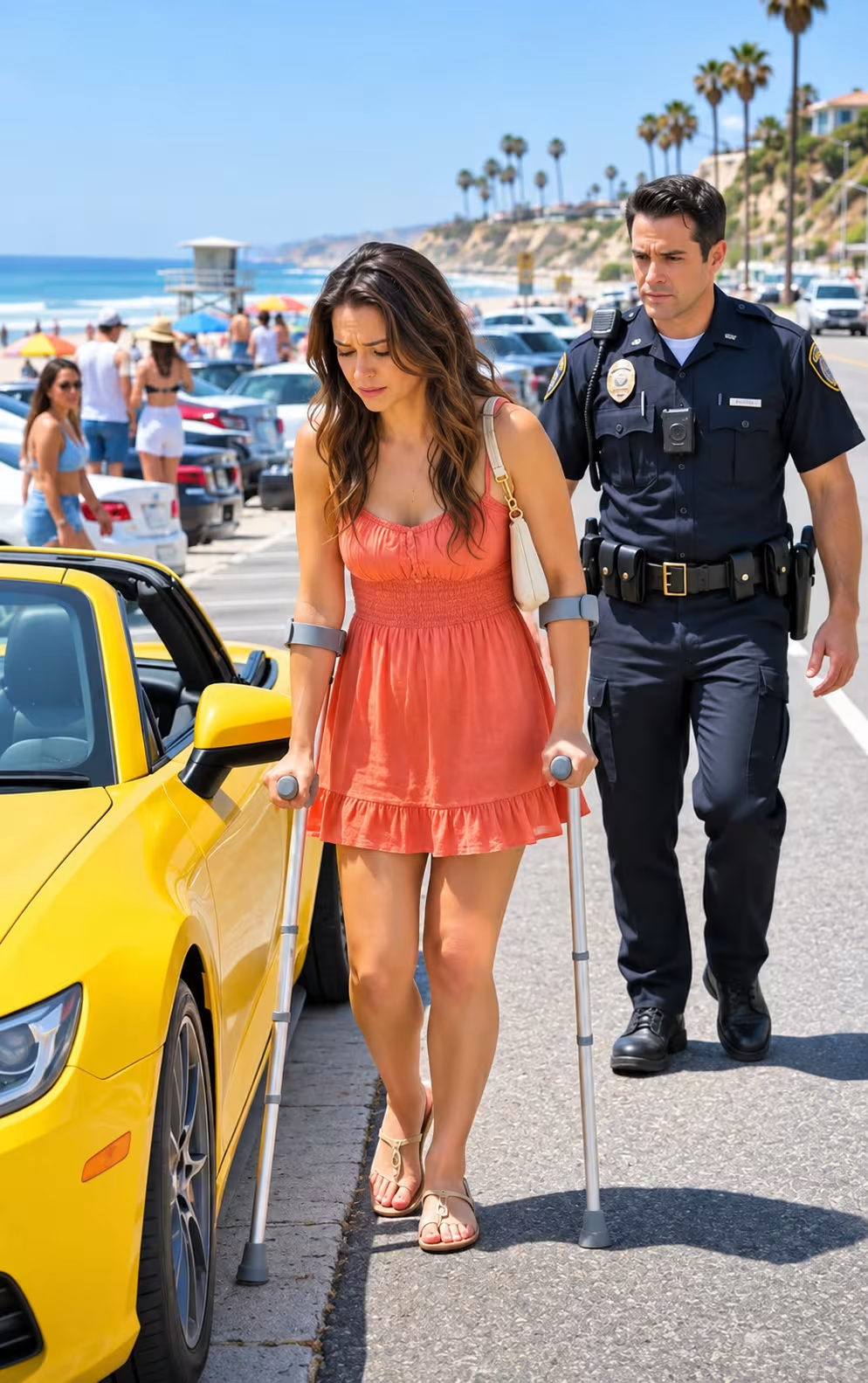
The woman stood beside her yellow car, supporting herself with a crutch while speaking with a police officer.
She had stopped near a neighborhood shopping center to collect several essential items.
However, a conversation about her parking location had developed into an uncomfortable misunderstanding.
The officer took the crutch from her hand while examining the circumstances surrounding her vehicle.
The woman immediately expressed concern about standing without her usual mobility support.
Several people nearby noticed their conversation but continued along the sidewalk.
Another police officer soon arrived and approached the pair.
His attention turned toward the woman’s mobility needs as he listened to her explanation of what had happened.
A Routine Visit to the Neighborhood Shopping Center
Fifty-six-year-old Margaret Wilson lived in a quiet residential neighborhood outside the town center.
She had recently undergone a medical procedure that temporarily affected her ability to walk comfortably.
Although her recovery was progressing, she still relied on a crutch for additional support.
Margaret remained determined to manage her everyday responsibilities whenever possible.
That afternoon, she drove her yellow car to a familiar neighborhood shopping center.
She needed to collect a prescription and purchase several household essentials.
The parking area was unusually busy because of nearby construction work.
Several spaces had been temporarily closed, leaving fewer convenient options for visitors.
Margaret eventually found a space near the entrance and displayed her accessible parking permit.
She carefully stepped out of her vehicle and retrieved her crutch.
Before she could continue toward the pharmacy, a uniformed police officer approached her.
He explained that he wanted to discuss the location of her parked vehicle.
Margaret stopped and listened carefully to his concerns.

A Conversation About the Parking Arrangements
The officer, named Christopher, had been assigned to monitor traffic around the shopping center.
Temporary changes to the parking arrangements had caused confusion among several motorists.
Christopher explained that certain spaces were being reserved for vehicles requiring access to the construction area.
Margaret pointed toward the accessible parking sign beside her yellow car.
She explained that she had selected the space because of her limited mobility.
Christopher examined the sign and noticed a temporary notice attached beneath it.
However, part of the notice was obscured by another sign.
Margaret explained that she had not seen any clear indication restricting accessible parking.
She also showed Christopher the permit displayed inside her vehicle.
The officer acknowledged the permit but continued asking questions about the parking arrangements.
Margaret shifted her position slightly while maintaining her balance with the crutch.
She hoped the conversation would conclude soon because standing for extended periods was uncomfortable.
Unfortunately, their misunderstanding continued as Christopher attempted to clarify the situation.
The Officer Takes Margaret’s Crutch
During their conversation, Christopher noticed that Margaret was adjusting the rubber tip of her crutch.
She mentioned that it had recently become loose and sometimes moved unexpectedly.
Christopher offered to examine it, believing he might identify the problem.
Margaret briefly handed him the crutch while supporting herself against her yellow car.
However, she quickly realized that standing without it was more difficult than anticipated.
She asked Christopher to return the crutch so she could maintain her balance.
The officer was still examining the rubber attachment when another police vehicle arrived nearby.
A second officer named Robert stepped out and approached them.
He immediately noticed Margaret leaning against the vehicle while Christopher held her mobility aid.
Robert politely asked whether Margaret needed assistance.
She explained that she relied on the crutch and was becoming uncomfortable without it.
Robert encouraged Christopher to return it immediately before continuing their discussion.
Margaret gratefully accepted the crutch and adjusted her position.
The second officer then asked both individuals to explain the circumstances surrounding their conversation.

Another Officer Helps Clarify the Situation
Robert listened carefully as Margaret described her arrival at the shopping center.
She explained her medical recovery, accessible parking permit, and difficulty walking longer distances.
Christopher shared his concerns regarding the temporary parking restrictions.
Robert examined the signs beside the yellow car and reviewed the current traffic arrangements.
He discovered that the accessible parking space remained available to eligible motorists.
The temporary restrictions applied only to several neighboring spaces.
Unfortunately, the positioning of the additional notice had created unnecessary confusion.
Robert explained the distinction to Christopher and confirmed that Margaret could remain parked there.
He also acknowledged that her mobility aid should have been returned as soon as she requested it.
Christopher recognized that his attempt to examine the crutch had unintentionally caused discomfort.
He apologized to Margaret and asked whether she needed somewhere to sit.
Margaret appreciated his acknowledgment and explained that she simply wanted to complete her errands.
Robert offered to accompany her toward the shopping center entrance if she wished.
The conversation gradually became more relaxed as the misunderstanding was resolved.

A Thoughtful Resolution Outside the Shopping Center
Margaret thanked Robert for taking the time to review the parking arrangements.
She also accepted Christopher’s apology and explained the importance of having her crutch available.
Christopher listened attentively and acknowledged that mobility aids were essential to their users’ independence.
He offered to contact the shopping center’s management regarding the confusing temporary signs.
Robert agreed that clearer information could prevent similar misunderstandings.
Before Margaret continued toward the pharmacy, the officers asked whether she required any further assistance.
She explained that she was comfortable walking independently with her crutch.
Both officers respected her decision and allowed her to continue at her own pace.
Margaret entered the shopping center and collected her prescription without further difficulty.
Meanwhile, Christopher contacted the property manager to discuss the signage.
The manager arranged for the temporary notices to be repositioned more clearly.
When Margaret returned to her yellow car, she noticed that the officers were assisting other motorists nearby.
She exchanged a friendly wave with them before preparing to leave.
A Reminder About Accessibility and Everyday Respect
Several weeks later, Margaret returned to the same shopping center during another afternoon outing.
She noticed that the parking signs had been updated and were considerably easier to understand.
The accessible spaces were clearly marked, with temporary restrictions displayed separately.
Her recovery had also progressed, although she continued using her crutch when necessary.
Margaret appreciated being able to complete her errands without unnecessary complications.
Christopher and Robert continued their responsibilities throughout the neighborhood.
Their earlier conversation had provided an opportunity to reflect on the importance of accessibility awareness.
Christopher became more attentive to the individual needs of people using mobility equipment.
In this fictional story, a police officer took a crutch from a woman standing beside a yellow car before another officer joined their conversation.
The second officer helped clarify the parking arrangements and ensured that the woman’s mobility needs were respected.
Their encounter demonstrated how attentive communication, accountability, and practical understanding could resolve an everyday misunderstanding.
For Margaret, the experience reinforced the importance of being heard and maintaining her independence.
A simple conversation beside a yellow car became a meaningful reminder that respecting someone’s independence begins with understanding the support they need.