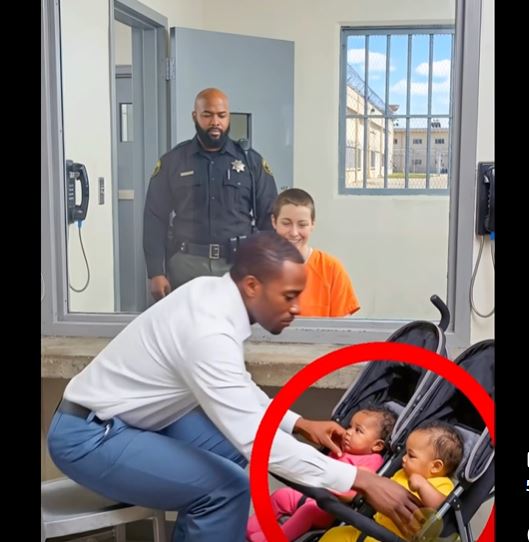
The visiting hall was quiet except for the low hum of fluorescent lights and the muffled echoes of distant voices. A long row of thick glass panels divided the room, forming an unyielding barrier between two worlds — one filled with waiting families, the other with those they longed to hold.

Conversations passed through telephones mounted on the walls, and emotions were confined to silent gestures, trembling smiles, and hands pressed against the cold surface.
It was a place where touch was forbidden.
Where love had to exist without closeness.
That afternoon, a woman stood alone on one side of the glass, her hands shaking as she adjusted her scarf. Her eyes were swollen from crying, and exhaustion lined her face. She had traveled hundreds of miles, crossing cities and borders, waiting months for this moment. Yet even now, the thick transparent wall between her and her family felt heavier than any distance she had endured.
On the other side stood the people she loved most in the world.
Her husband pressed his palm gently against the glass, his expression filled with both joy and sorrow. Beside him stood their two children — a little boy who barely remembered his mother’s embrace and a teenage daughter struggling to hold back tears. They had rehearsed what they would say, prepared themselves for the separation, yet nothing could ease the pain of seeing one another without the ability to touch.
The woman slowly raised her hand and placed it against the barrier, aligning it with her husband’s palm. A thin layer of glass was all that separated them — inches that felt like an eternity.
Her lips trembled as she spoke into the phone.
“I missed you so much.”
Her voice broke, and she turned her head slightly, trying to hide the flood of emotion. On the other side, her young son pressed both hands against the glass and whispered, “Mom, can you come home now?”
The question pierced the room with heartbreaking innocence.
She tried to smile, but the effort only brought more tears. “Soon,” she said softly. “I promise.”
Nearby, an officer stood quietly observing the scene. He had witnessed countless visits like this — brief reunions filled with longing, conversations carried through wires, families separated by rules designed for security and order. Over time, he had learned to remain composed, to keep a professional distance from the emotional weight of the room.
But something about this family was different.
Perhaps it was the child’s desperate plea.
Perhaps it was the mother’s trembling hands.
Or perhaps it was the overwhelming silence that surrounded their pain.
He noticed how the woman leaned closer to the glass, as if hoping sheer willpower could dissolve the barrier. He saw how the husband’s shoulders shook as he tried to remain strong for their children. And he saw the teenager, quietly wiping her tears, pressing her forehead against the cold surface.
The glass stood firm — unfeeling, unyielding.
Yet the officer could feel the depth of their love pressing against it.
Minutes passed, and the time for the visit began to run out. A quiet announcement echoed through the hall, reminding visitors that the session would soon end. The family’s voices grew more urgent, their words rushed, trying to compress months of love into a few remaining moments.
The woman’s breathing quickened.
“No… please,” she whispered, her eyes wide with desperation. She placed both hands against the barrier, as though trying to memorize the shape of her family through touch she could not feel.
The officer watched her closely. He saw something no regulation could fully capture — the raw human need for connection, the silent suffering of separation, the universal language of love.
In that moment, he made a decision.
He approached the supervising desk and spoke quietly with his colleagues. The request was unusual, almost unheard of. Rules existed for a reason. Procedures were rarely bent.
But compassion, too, has its place.
After a brief exchange and a moment of hesitation, permission was granted.
The officer walked slowly toward the family. The woman looked up, confused, her tear-filled eyes searching his face. He spoke gently, his voice calm and reassuring.
“Ma’am,” he said, “please step back for a moment.”
Her heart pounded with uncertainty. Had she done something wrong? Was the visit ending early?
Instead, the officer reached for a secure door beside the glass barrier.
With a soft mechanical sound, the lock released.
The door opened.
For a second, no one moved. The family stared in disbelief, unable to comprehend what was happening. The invisible boundary that had separated them for so long had suddenly disappeared.
The officer nodded gently. “You may hug your family.