The park was quiet, draped in the golden hue of a late autumn afternoon. On a weathered wooden bench sat Silas, a man whose spine was slightly curved by the weight of eighty years, though his posture remained remarkably intentional.
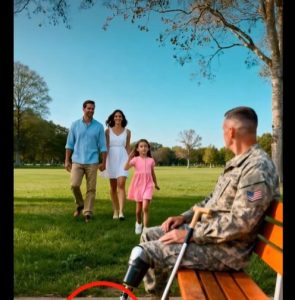
He wore his old dress blues—a uniform that fit a little loosely now, but was pressed with a precision that bordered on the sacred. His chest was adorned with a modest row of ribbons, their colors faded like old memories, and his cap sat squarely on his head.
Silas often came here to watch the world rush by. To most, he was a relic of a bygone era, a silent statue in a world of digital noise. People jogged past him with glowing screens strapped to their arms; children shrieked as they chased pigeons; and busy professionals marched by, their eyes fixed on the pavement. Silas didn’t mind the invisibility; he lived in the quiet dignity of a life well-served.
The Small Shadow
Then, the rhythm of the afternoon changed. A young girl, perhaps no more than seven years old, stopped her bicycle a few yards away. She was wearing a bright yellow windbreaker and a helmet that seemed a size too large. Her mother, standing several paces behind, watched with a curious smile as the girl stared at Silas.
She didn’t stare with the gawking curiosity children usually have for strangers. She looked at the uniform, then at Silas’s face, which was etched with the deep lines of a thousand stories. She walked toward him, her steps slow and deliberate, until she stood directly in front of his boots.
Silas looked down, his blue eyes softening behind his spectacles. He expected a question about his medals or perhaps a request for a coin. Instead, the girl took a deep breath, stood as straight as her small frame allowed, and raised her right hand to her brow in a sharp, crisp salute.
The Silent Language
The gesture was simple, but in that setting, it carried the weight of a mountain. It was a sign of recognition—not just of a man, but of the sacrifice and the history he represented. The park seemed to grow even quieter, as if the wind itself had paused to witness the encounter.
Silas’s breath hitched. For a moment, he wasn’t an old man on a park bench; he was twenty-one again, standing on a deck in the middle of a vast ocean, surrounded by brothers-in-arms. He felt the phantom pressure of the years lift from his shoulders.
With a grunt of effort, Silas placed his hands on the armrests of the bench. His knees popped, and his breath came in a shallow whistle, but he pushed himself upward until he stood at full height. He smoothed the front of his jacket, tucked his chin, and returned the salute with a precision that had been burned into his muscle memory decades ago.
The Smile of Two Generations
They stood there for a long moment—the old warrior and the young dreamer—locked in a silent exchange of respect that bridged a seventy-year gap. The girl’s eyes sparkled with a sudden, shy joy. She dropped her hand, and Silas lowered his, his fingers trembling slightly from the exertion of standing.
“Thank you for your service, sir,” the girl whispered, the words clearly practiced but delivered with genuine warmth.
Silas leaned forward, a slow, radiant smile breaking across his face, transforming his features into something youthful and bright. “And thank you, young lady, for remembering.”
The girl beamed, turned on her heel, and ran back to her bicycle. Her mother offered Silas a respectful nod before they disappeared down the winding path.
The Echo of the Encounter
Silas sat back down, but he didn’t slouch. He felt a warmth in his chest that the autumn sun couldn’t provide. He realized that while the world moved fast, the values that mattered—honor, gratitude, and the simple act of seeing another human being—were still anchored in the hearts of the next generation.
He adjusted his cap, looked at the empty space where the girl had stood, and for the first time in a long while, he didn’t feel like a relic. He felt like a link in a chain that would never be broken. The girl hadn’t just given him a salute; she had given him the assurance that the stories he carried would have a place to live long after he was gone.