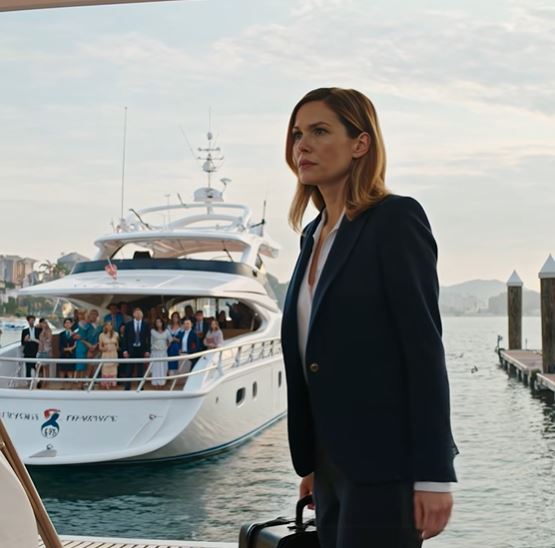
The invitation arrived like a slap disguised as a smile. It was polished, elegant, and dripping with exclusivity—an embossed card announcing a weeklong luxury yacht trip along the Mediterranean coast. Champagne sunsets, private coves, and carefully curated guest lists. At the bottom of the message, in neat cursive, was the host’s name: Vanessa Clarke.

Vanessa and I had known each other for years. Not as close friends, but close enough. Business partners once. Allies, at least on paper. We had built something together from the ground up—a tech logistics company that now serviced half the ports in southern Europe. I handled infrastructure and compliance. She handled branding, investors, and public image. On the surface, it worked.
Two days before the trip, my phone buzzed with a short message. No call. No explanation.
“Hey. Change of plans. The yacht is at capacity, so I had to trim the list. You understand. We’ll catch up after.”
I stared at the screen, reading it again and again. Trim the list. After five years of partnership, late nights, shared risks, and mutual dependence, I was suddenly expendable. Cut. Like excess weight.
At first, I felt anger. Then disbelief. Then something colder.
Because Vanessa had forgotten one very important detail.
She had forgotten why the yacht existed in the first place.
The trip was more than a vacation. It was a floating negotiation table. On board were three foreign investors, a shipping magnate from Greece, a private equity rep from Dubai, and a government liaison whose approval would unlock port access for the next decade. This wasn’t leisure—it was strategy. And the yacht? The yacht was registered under a shell company.
I hadn’t mentioned it because it had never mattered before. Vanessa liked being the face. I preferred being the spine. The unseen structure holding everything upright.
I didn’t reply to her message. I didn’t argue. I didn’t protest. I simply let her believe she had won.
The day of departure came. I watched from my office window as her social media exploded with curated excitement. Photos of designer luggage. Sunglasses. Champagne flutes. Hashtags about freedom and success.
“Sir,” the officer said cautiously, “we have an issue with the vessel Aurora Blue. Its operational clearance has been flagged. We’re showing missing compliance documentation tied to ownership authorization.”
I leaned back in my chair. “That’s correct,” I replied calmly. “The authorization was revoked this morning.”
Silence. Then, “The yacht is already underway.”
“Yes,” I said. “But not legally.”
What Vanessa didn’t know—what she had never bothered to understand—was that the yacht’s license renewal, fuel contracts, crew insurance, and international docking permissions all ran through my department. Through my signature. Through systems I had built quietly, efficiently, without applause.
At 1:12 p.m., the yacht was forced to halt just beyond territorial waters. No docking. No refueling. No clearance to proceed.
At 1:18 p.m., my phone lit up with Vanessa’s name.
I didn’t answer.
She called again. And again. Messages followed. The tone shifted rapidly—from confusion, to irritation, to panic.
“What’s going on?”
“Why are we being stopped?”
“This is embarrassing. Fix it.”
At 1:31 p.m., I finally replied with one sentence.
“You said you trimmed the list. I assumed that included my responsibilities.”
Ten minutes later, the investors disembarked at the nearest port. No deal. No celebration. Just awkward apologies and tight smiles. The shipping magnate left without a word. The government liaison declined further contact.
By evening, Vanessa’s social media went silent.
The next morning, she showed up at my office. No makeup. No confidence. Just desperation.
“You did this on purpose,” she said, voice shaking.
I looked at her calmly. “No. You did. I just didn’t stop you.”
She tried to argue. Tried to remind me of our history. Of everything we’d built together.
“I know,” I said. “That’s why this hurts. You didn’t just cut me from a trip. You cut me out of respect.”
Within weeks, the fallout spread. Investors questioned her leadership. Board members demanded answers. Our partnership dissolved—not with drama, but with paperwork. Clean. Final.
I walked away with my systems intact, my reputation untouched, and my integrity preserved. Vanessa kept the spotlight—for a while.
Months later, I received a message from one of the investors who had been on the yacht.
“We didn’t know your role back then. We do now. Interested in talking?”
The truth is, power doesn’t always sit at the front of the boat, raising a glass for the cameras. Sometimes, it’s quietly ensuring the boat can move at all.