Tasha stood near the lounge area of the hotel lobby with one hand resting lightly on the handle of her small travel bag. The lobby around her was polished and quiet in the way expensive places often were, all marble floors, warm lighting, soft chairs, and the low hum of people who had somewhere important to be. A couple crossed toward the elevators. A man in a suit rolled a carry-on past the reception desk. Somewhere behind her, glass clinked softly from the hotel bar.
She had arrived ten minutes early, just as she always did.
She preferred having a few quiet moments before meetings, especially the kind that involved people who liked to make decisions quickly and explain them slowly. In her hand was a slim folder containing numbers, notes, and a list of questions she intended to ask upstairs. She had been told to wait in the lounge area until Maya came down for her, and that was exactly what she was doing.
She had barely looked up from the folder when she noticed someone approaching.
He was in his early thirties, neatly dressed, wearing the careful expression of someone who believed he was in control of the room. His name tag identified him as Brian, front-desk supervisor.
He stopped a few feet away from her and gave her a professional smile that didn’t quite reach his eyes.
“Ma’am, this lounge is for hotel guests only.”
Tasha looked up calmly.
“I know.”
For a second, Brian seemed thrown off by the answer. Then he recovered.
“Then I’ll need your room key.”
Tasha closed the folder without any rush.
“I’m waiting for someone.”
Brian glanced toward the seating area, then back at her travel bag, then at the reception desk as if already anticipating inconvenience.
“Guests normally wait in the public lobby,” he said.
Tasha let her eyes move across the wide open room around them.
“This is the lobby.”
He gave a small smile that carried more impatience than politeness.
“You know what I mean.”
Tasha met his expression evenly.
“I really don’t.”
A couple walking past slowed just slightly before continuing on. At the desk behind Brian, one of the reception employees kept typing but clearly heard every word.
Brian lowered his voice, the way people do when they are trying to appear reasonable while becoming less so.
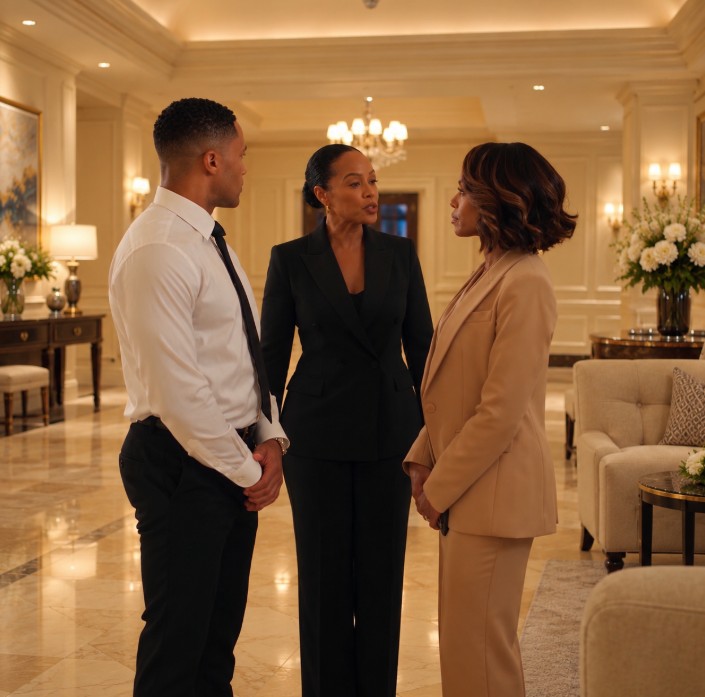
“Please don’t make this difficult.”
Tasha straightened a little but did not move.
“I’m not making anything difficult.”
“Then move away from the private area.”
“I was told to wait right here.”
Brian folded his hands in front of him.
“By who?”
“The person running this hotel.”
There was no attitude in Tasha’s voice. If anything, that made the answer sharper. Brian blinked once, clearly deciding whether to take her seriously.
Instead of asking another question, he chose skepticism.
“I’m sure there’s been some misunderstanding,” he said.
Tasha said nothing.
Brian tried again.
“This section is reserved for guests and VIP meetings.”
She held his gaze.
“Yes.”
The silence between them lasted only a second, but it was enough to make his confidence feel less certain.
Tasha had encountered this type of interaction before. She recognized the rhythm of it. A person looked at her, made a decision about who she probably was, and then treated that decision like a fact. Usually, she found it more tiring than insulting. It was the familiarity that exhausted her.
Brian, meanwhile, seemed to grow more uncomfortable with the fact that she was not responding the way he expected. She was not apologizing, not overexplaining, not becoming flustered. She was simply standing there, calm and composed, as if she knew something he did not.
He took half a step closer.
“Ma’am, if you’re waiting for someone, you can do that near the front entrance.”
Tasha tilted her head slightly.
“And if I’m exactly where I was told to be?”
Brian opened his mouth to answer, but before he could, a woman’s voice cut cleanly across the lobby.
“Ms. Harris, I’m so sorry you were kept waiting.”
Both of them turned.
Maya, the hotel’s general manager, was walking toward them quickly from the direction of the administrative corridor. She was dressed with the effortless precision of someone used to being obeyed without having to raise her voice. Her attention went directly to Tasha.
“I came down as soon as I finished with the board,” Maya said. “I hope you haven’t been waiting long.”
Tasha’s expression softened only slightly.
“Not too long.”
Brian looked from one woman to the other.
“You know her?”
Maya turned to him, and in the silence that followed, the answer became obvious before she even spoke.
“Of course I know her,” she said. “She’s here for the ownership meeting.”
Something in Brian’s face changed instantly.
“Ownership meeting?”
Maya’s voice remained calm, but there was now a clear edge beneath it.
“Yes. Ms. Harris represents our majority investors.”
For a moment, Brian just stared.
The certainty he had been wearing since he approached her disappeared so completely that it almost looked physical, like a coat being pulled off his shoulders.
“I didn’t know,” he said.
Tasha looked at him for a brief moment.
“That seems to be the problem.”
No one spoke after that.
The receptionist behind the desk suddenly became very busy with a computer screen. The man crossing the lobby with a briefcase no longer bothered hiding that he had heard everything.
Maya turned back to Tasha with composed professionalism.
“The board is waiting upstairs,” she said. “Whenever you’re ready.”
Brian’s voice came out quieter now.
“Ms. Harris, I apologize.”
Tasha rested one hand on the handle of her travel bag.
“Next time, ask before assuming.”
Maya gestured toward the elevators, and the two women began to walk across the lobby together. The elevator doors opened with a soft chime just as they approached. Before stepping inside, Tasha glanced back only once.
Brian was still standing there, silent now, behind all the confidence he had started with.
Inside the elevator, Maya exhaled.
“I’m embarrassed that happened.”
Tasha gave a small shrug.
“I’ve experienced worse.”
“That doesn’t make it acceptable.”
“No,” Tasha said. “It doesn’t.”
The elevator doors closed, cutting off the lobby and its polished quiet, and for a moment there was only the low mechanical hum as they moved upward.
Maya looked at her.
“I can assure you that is not the standard I want for this hotel.”
Tasha gave her a measured look.
“I believe you. The question is whether the culture below you matches the standards above you.”
Maya didn’t answer right away. She knew that was exactly why Tasha was there.
When the elevator opened again, the boardroom was only a short walk down the corridor. Inside, a long glass table overlooked the city skyline, and half a dozen people were already seated with laptops, reports, and coffee cups in front of them. The conversation in the room quieted as soon as Tasha entered.
The chairman stood to greet her.
“Ms. Harris, thank you for coming.”
Tasha shook his hand.
“Of course.”
She took her seat, placed her folder on the table, and looked around the room. These were the people who wanted growth figures, performance metrics, occupancy trends, guest satisfaction data, cost controls, brand positioning, and an action plan for the next quarter. She had all of that.
But before opening the folder, she said, “I had a useful experience downstairs.”
A few of them looked up.
Maya said nothing.
Tasha continued. “I was stopped in the lobby by a supervisor who assumed I didn’t belong in the guest lounge.”
The chairman frowned.
“I’m sorry to hear that.”
“So was he,” Tasha replied. “Eventually.”
A few restrained smiles appeared around the table, but she did not smile back.
“The reason I mention it is because it reflects something larger than one awkward interaction. Hotels don’t lose reputation only through major failures. Sometimes they lose it through repeated small judgments made too quickly by people who think they already understand the guest in front of them.”
Now everyone was listening closely.
She opened the folder.
“Your numbers show that the property is stable. Revenue is respectable. Occupancy is strong. Event bookings are up. But premium guest retention is weaker than it should be, and repeat executive bookings have softened. That usually doesn’t happen because the rooms are bad. It happens because people remember how they were made to feel.”
No one interrupted her.
Tasha moved smoothly through the report. She spoke about service training, internal communication, escalation procedures, VIP handling, staff confidence versus staff judgment, and the hidden financial impact of assumptions made at the front line. She pointed out that luxury was not just chandeliers, marble, or expensive furniture. Luxury was precision. It was discretion. It was knowing how to ask a question before making a conclusion.
“The guests and partners who bring the most long-term value to a business do not always arrive wearing their importance in obvious ways,” she said. “Sometimes your biggest opportunity is the person an untrained employee dismisses in the first thirty seconds.”
Across the table, the chairman leaned back slowly.
“Are you saying the problem is service culture?”
“I’m saying service culture is where the financial issue begins,” Tasha answered. “When staff make assumptions instead of observations, and conclusions instead of questions, that affects experience. Experience affects reputation. Reputation affects retention. And retention affects revenue.”
Maya glanced down at her notes, then up again.
“That can be corrected.”
Tasha nodded.
“Yes. If you’re willing to correct it consistently.”
The meeting lasted nearly two hours. By the end of it, the board had agreed to changes in training, reporting, and guest-service oversight. New protocols would be introduced. Managers would be required to coach staff more actively. Supervisors would be reminded that professionalism did not mean controlling a room by deciding who belonged in it. It meant understanding the room well enough to respond appropriately.
When the meeting finally ended, people gathered their papers and laptops and began filtering out. Maya remained behind.
“Thank you,” she said.
Tasha closed her folder.
“For the report?”
“For being direct.”
“That’s what I was hired for.”
Maya hesitated.
“Brian asked if he could apologize again before you leave.”
Tasha considered that for a moment.
“If he wants to apologize, I’ll listen.”
When she came back down to the lobby later that afternoon, Brian was waiting near the reception desk. This time there was no trace of the polished certainty he had approached her with earlier.
“Ms. Harris,” he said, “I wanted to say I’m sorry again. I handled that badly.”
Tasha stopped in front of him.
“Yes, you did.”
He nodded, accepting it.
“I made an assumption before asking a simple question.”
“That’s usually how these things happen.”
He looked genuinely ashamed.
“I didn’t mean to be disrespectful.”
“I know,” Tasha said. “Most people don’t mean to be. That doesn’t mean the result is harmless.”
Brian let out a slow breath.
“You’re right.”
For the first time, Tasha allowed her tone to soften.
“The good news is that moments like this can teach you something, if you let them.”
He looked up.
“They already have.”
Tasha gave a small nod.
“Then don’t forget it the next time someone stands somewhere you don’t expect.”
A faint, embarrassed smile crossed his face.
“I won’t.”
She reached for the handle of her travel bag again.
“Good.”
As she walked toward the doors, the hotel lobby looked much the same as it had when she arrived. Guests moved in and out. Luggage wheels rolled softly across the polished floor. Conversations rose and faded. The elevators chimed in the distance. Everything appeared elegant, orderly, expensive.
But Tasha knew better than most people that what made a place valuable was not how it looked when everything was calm. It was how people inside it treated others when they thought no one important was watching.
Outside, the late afternoon light had begun to soften across the street. Tasha paused for just a moment before stepping toward the waiting car.
Behind her, somewhere inside the lobby, a supervisor who had been certain he knew exactly who she was had learned how costly a simple assumption could be.
And upstairs, a board of executives had been reminded of something just as important: in business, the smallest moments often reveal the biggest problems.