The rain had begun softly, tapping against the cobblestone streets like hesitant fingers. In the heart of the city, luxury boutiques and cafes gleamed under the dim glow of street lamps, reflecting the orderly world of those who had everything they could want. But not everyone belonged in that world. Not everyone even wanted to.
Clara Whitmore walked along the sidewalk, her posture straight, her eyes wide, taking in the world she had lived behind glass walls her entire life. At eighteen, Clara was already considered a socialite, the only daughter of one of the wealthiest men in the country. She had jewels, parties, tutors, and etiquette instructors, yet for all her advantages, there was one thing she lacked: her own voice. Clara had been born mute. Doctors had called it a rare condition, psychologists had called it limiting, and society—well, society often didn’t know how to speak to her at all.
She had grown accustomed to silence, to words typed on screens or written in careful cursive. Her father, a shrewd man with little patience for weakness, often worried about how she would survive in a world that demanded charm and speech. Clara herself had never thought of it as weakness. She observed. She listened. And she noticed everything.
That evening, after another gala that felt hollow and scripted, Clara wandered the streets alone, ignoring the umbrellas and chatter of other late-night walkers. She needed something real, something untamed and raw to break the monotony of her life. That was when she saw her.
The girl was small, barely more than twelve or thirteen, her clothes ragged, her hair tangled with the residue of the city streets. She crouched near a pile of discarded cardboard boxes, holding a small, dark bottle in her hands.
Clara paused, curiosity prickling her like electricity. She had never seen anyone so unafraid of being ignored. The girl’s eyes met hers—sharp, fearless, ancient in their intensity despite her youth.
“Are you thirsty?” the girl asked abruptly. Her voice was raspy, but there was a strange authority in it. “It’s… a drink. A little magic, if you want it.”
Clara blinked. “Magic?” she typed quickly on her small tablet, holding it out to the girl.
The girl shook her head. “Not the kind you read about. The kind you feel.” She extended the bottle toward Clara, who hesitated. It looked strange, an amber liquid that glimmered even in the streetlight, almost alive. A warning sounded in Clara’s mind, a whisper about danger, yet something in the girl’s gaze seemed to say, trust me.
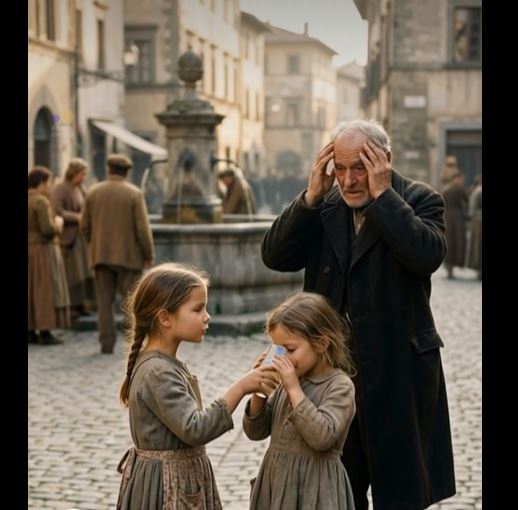
She took the bottle. The liquid smelled faintly of honey and earth. She raised it to her lips and drank.
It burned at first, warm and strange, moving down her throat like a current of fire and light. She felt dizzy, and the city tilted for a moment, but then something extraordinary happened.
Clara opened her mouth—and a sound came out.
It was rough, strange, unformed at first, but it was her own. The first word she had spoken in eighteen years slipped past her lips. “What…” she gasped, her hands flying to her throat as if the words might vanish if she didn’t catch them.
The girl smiled, calm, almost knowing. “Keep going,” she said softly.
Clara tried again, words forming like raindrops gathering into a stream. Sentences, questions, laughter, even a scream of astonishment. She was speaking. Real words, not typed letters. The city around her seemed to hold its breath as she discovered the sound of her own voice, trembling, high, and impossibly hers.
“Who… who are you?” she finally managed.
The girl shrugged, enigmatic. “Just someone who knows how to listen. And sometimes, the world needs a voice it forgot existed.”
Clara stared at her, overwhelmed. The streets, the rain, the neon signs—they all felt different now. She felt alive in a way she never had, as if the years of silence had been only the dark before dawn.
Over the next few minutes, the girl explained nothing. She simply handed Clara a small, tattered notebook. In it were strange sketches, cryptic symbols, and phrases written in looping, uneven handwriting. Clara understood instinctively: it was a guide, a way to control the magic she had just tasted.
By the time Clara returned home, her father was waiting in the grand hall, eyebrows raised in concern. “Clara? Where have you been? It’s late—”
She stopped, looking at him, and smiled. Then she spoke, clearly, without hesitation: “I can talk now. I can really talk.”