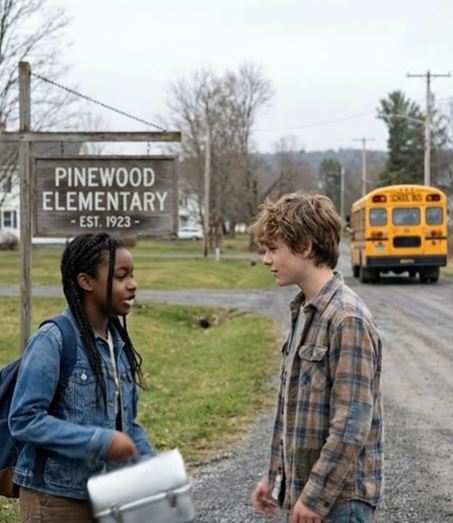
I was just a little girl who couldn’t stand seeing that white boy sitting on the ground in front of the school, with a lost gaze and an empty stomach. He looked at me surprised, as if no one had ever offered him anything good.
I remember how tightly I held my lunch box that morning. It was bright pink, decorated with little cartoon flowers my mother had carefully chosen for me before the school year began.
Inside was my favorite sandwich, a small apple, and two cookies she had baked the night before. I had been thinking about that lunch all morning, waiting eagerly for the bell to ring. But when I saw him sitting there alone, something inside me shifted.
He didn’t look like the other children. His clothes were wrinkled and too thin for the chilly autumn air. His shoes were worn, the laces unevenly tied, and his hands were red from the cold. But what struck me the most was his face — not dirty or angry, just empty, like someone who had stopped expecting kindness from the world.
“Here, it’s my lunch box… you can eat it,” I said quietly, extending it toward him.
For a moment, he didn’t move. His blue eyes widened, and he looked at me as if I had spoken a language he didn’t understand. Then, slowly, he reached out with trembling fingers and took the box.
“Are you sure?” he whispered.
I nodded, suddenly feeling shy. “My mom can make another one.”
That wasn’t entirely true. My mother worked two jobs and barely had time to rest, let alone prepare extra meals. But at that moment, it felt like the only right thing to say.
He opened the lunch box carefully, almost reverently, as if he were afraid it might disappear. When he saw the sandwich, his eyes filled with tears. He tried to hide them, turning his head away, but I noticed.
“Thank you,” he said, his voice barely audible.
That was the first day we spoke.
His name was Daniel. He had just transferred to our school after moving to the town with his father. His mother had passed away the year before, and since then, life had been difficult. His father worked long hours, and sometimes there wasn’t enough food at home. Daniel never complained. He simply learned to stay quiet.
From that day on, I began sharing my lunch with him whenever I could. Sometimes it was half a sandwich. Sometimes a piece of fruit. Sometimes just a cookie wrapped in a napkin. We would sit together under the big oak tree near the playground, talking about simple things — cartoons, homework, dreams about the future.
Children can be cruel, though. Some classmates whispered when they saw us together. They questioned why I would give away my food. A few even mocked Daniel for accepting help. But none of that mattered to me. His smile when he ate, the way his eyes lit up with gratitude, made everything else seem unimportant.
Weeks passed, and our friendship grew stronger. Daniel began to laugh more, to participate in class, and even to play with other children. The quiet sadness that once surrounded him slowly began to fade.
One cold winter morning, I noticed he wasn’t at school. The empty space beside me under the oak tree felt heavier than usual. Days passed, then weeks, and still he did not return. I asked our teacher, but she only said his family had moved away suddenly.
I was heartbroken.
For years afterward, I wondered what had happened to him. I often thought about that little boy with the lost gaze and hoped he had found happiness somewhere. As time went on, life carried me forward. I grew up, finished school, and eventually became a teacher myself. Yet the memory of Daniel and that simple act of sharing my lunch never left me.
Nearly twenty years later, on an ordinary afternoon, something unexpected happened.
I was organizing books in my classroom when the principal knocked on the door. “There’s someone here to see you,” she said with a curious smile.
Standing in the hallway was a tall man in an elegant suit. His hair was neatly combed, and his posture confident, but there was a familiar softness in his eyes. For a moment, I couldn’t place him.
Emotion overwhelmed me. The small, quiet boy I once knew now stood before me as a successful, self-assured man. He explained that after leaving our town, his father had found stable work, and their lives slowly improved. Daniel had studied hard, eventually earning a scholarship to a prestigious university. Now he was a doctor, specializing in child nutrition.