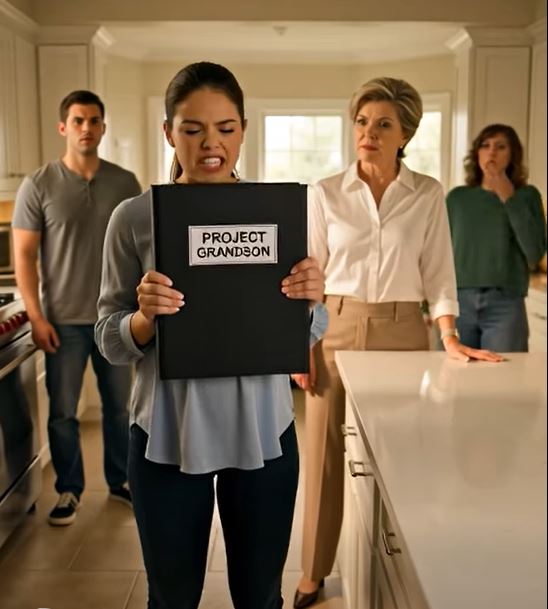
My ankles were swollen, my back ached constantly, and sleep had become a distant memory. Every movement required effort, every breath carried exhaustion, yet I pushed myself daily to meet the expectations of the one person who never seemed satisfied—my mother-in-law, Margaret.

From the moment she arrived three months earlier, she had taken control of everything. She reorganized my kitchen, criticized my cooking, dictated what I should eat, how I should walk, and even how I should speak to my unborn child. She claimed it was all for the baby’s well-being, but her constant supervision felt suffocating.
“Posture matters,” she would remind me sharply whenever I slouched.
“You must think positively. The baby senses weakness,” she’d insist if I showed fatigue.
My husband, Daniel, dismissed my concerns. “She’s just excited about her first grandchild,” he would say with a shrug. “Try to understand her.”
So I tried. I endured the lectures, the controlling routines, and the overwhelming presence in my home. I convinced myself her behavior came from love.
Until the night I found the binder.
It was a rainy evening, and Margaret had gone out to meet an old friend. Daniel was working late, leaving me alone in the house with only the sound of thunder and my restless thoughts. I was searching for a heating pad in the guest room—Margaret’s temporary domain—hoping to ease the persistent ache in my lower back.
Her suitcase lay open on the bed.
I had no intention of snooping. But as I reached into the closet, something thick and heavy slipped from beneath the suitcase and fell onto the carpet with a dull thud.
A black leather binder.
Across the front, in neat gold lettering, were two chilling words:
PROJECT GRANDSON
A cold sensation spread through my chest.
With trembling hands, I opened it.
Inside were detailed documents, meticulously organized in labeled sections. My medical records—copies of ultrasounds, prenatal reports, even private notes from doctor visits I had attended alone. There were highlighted passages discussing my blood pressure, my stress levels, and potential complications.
My heart pounded as I turned the pages.
There was a section titled Custody Strategy.
My breath caught.
Typed paragraphs outlined legal pathways for obtaining emergency guardianship. There were notes about my “emotional instability,” references to fabricated incidents suggesting I might be unfit to care for a child. Dates, plans, contact information for attorneys—all carefully arranged.
I flipped to another section.
Post-Birth Transition Plan.
It described how Margaret intended to “assist” immediately after delivery, gradually establishing primary caregiving responsibilities. It suggested encouraging my exhaustion, documenting my mistakes, and persuading Daniel that the baby would be safer under her supervision.
My hands began to shake uncontrollably.
She wasn’t trying to help me.
She was planning to replace me.
The next page held hospital information—my scheduled delivery date, room preferences, and visitor arrangements. There was even a checklist labeled Immediate Removal Protocol, outlining steps to take if I resisted.
A wave of nausea surged through me.
Then I reached the final section.
Photographs.
Pictures of a fully prepared nursery—in Margaret’s house. A pristine crib, blue walls, tiny clothes neatly arranged in drawers. On the wall hung a framed name: Lucas.
She had already chosen my baby’s name.
I collapsed onto the edge of the bed, my heart racing so violently it hurt. The room spun around me as the horrifying truth settled in.
Margaret didn’t see me as the baby’s mother.
She saw me as an obstacle.
Tears streamed down my face as memories suddenly took on new meaning—her constant criticism, her insistence on attending every medical appointment, her habit of documenting my moments of exhaustion. The way she insisted I rest while she “practiced” caring for the baby using dolls. Her subtle comments about my “fragile condition.”
It had all been preparation.
The front door opened downstairs.
Margaret had returned.
Panic surged through my body. I quickly closed the binder and tried to slide it back beneath the suitcase, but my trembling hands made it impossible to move quietly.
Her footsteps approached.
“Oh,” she said from the doorway, her voice calm but sharp. “I see you found it.”
I froze.
She stood there, composed as ever, her expression unreadable. There was no embarrassment, no apology—only a quiet certainty that sent chills down my spine.
“You went through my things,” she stated.
“You were planning to take my baby,” I whispered, clutching my stomach protectively.
Margaret sighed, stepping into the room. “Take is such an unpleasant word. I prefer protect.”
“Protect from what?”
“From you,” she answered simply.