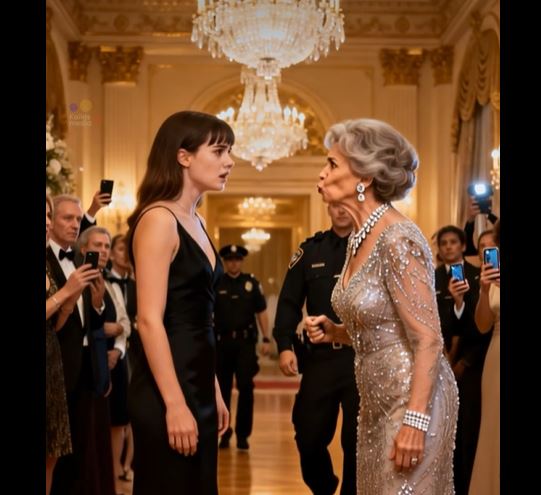
The night air was crisp, carrying the faint scent of roses from the manicured gardens surrounding the mansion. Inside, chandeliers glistened like captured stars, and the sound of crystal glasses clinking filled the expansive ballroom.

It was one of those galas that seemed designed not just to impress, but to intimidate—every detail meticulously curated to display wealth and power. And at the center of it all was her, Marissa DeLacroix, a socialite whose reputation was as sharp as the diamonds she wore. Tonight, she had invited the city’s elite, but she had another, less advertised agenda: to make sure everyone knew exactly who ruled this world.
I had arrived somewhat reluctantly. Invitations like hers were rare, and turning one down wasn’t easy when you ran a business that depended on connections and perception. But I also knew the game she played.
Marissa loved the theater of superiority, the subtle cuts and whispered taunts that only the highly attuned could detect. She had made it clear weeks ago, through a carefully worded message, that she expected me to attend. I suspected then that her true intention was not friendship or networking, but humiliation—a public demonstration of social pecking order.
The moment I entered, I could feel the eyes. Not the curious glance of someone meeting a new face, but the measuring gaze of someone sizing you up, calculating your worth against her invisible scale. I spotted her immediately: poised, flawless, wearing a gown that shimmered with every movement, hair perfectly arranged, a smile that didn’t quite reach her eyes.
She saw me too, of course. And her smile sharpened slightly, like a blade hidden in silk. That subtle shift told me everything I needed to know—she had planned this, and she intended to make me the centerpiece of her little social experiment.
The first exchange was a series of polite smiles and hollow pleasantries, each word carefully chosen, each pause deliberate. She made the mistake of assuming I would shrink under her gaze, that I would bend to the weight of her wealth and status.
She did not know me. By the time the first course arrived, she had already begun her performance: a few pointed comments about my so-called “background,” the slightly outdated model of my car, the city neighborhood where I lived. Each remark was designed to sting, to provoke a blush or a stumble. But I remained calm, a quiet force amidst the sparkling chaos, letting her words wash over me without reflection, without panic.
Her final move came during the main course. She invited me to speak before a group of guests, framing it as a compliment but laced with ridicule. “We’d love to hear about your recent ventures,” she said, her tone sweet, almost syrupy, but beneath it, there was a trap.
I took the microphone with a calm, steady hand, meeting her gaze directly, and began to speak—not of me, but of her guests, their successes, their visions, and how their contributions shaped the industries we all worked in. I acknowledged their achievements with sincerity, weaving a narrative that celebrated everyone in the room while subtly turning the focus away from her orchestrated hierarchy.
I saw the flicker of surprise in her eyes as the crowd leaned in, captivated by the words. The room had been charged with her intended power dynamics, but now the energy shifted. People laughed, nodded, and whispered to one another, fully engaged.
Marissa tried to interrupt, to regain control, but every attempt was deftly countered with grace and composure. The very traits she had underestimated—my confidence, my awareness, my ability to read the room—now worked against her.
By dessert, the atmosphere had completely changed. Guests who had been whispering politely about her now spoke animatedly about the points I had made, about the ideas I had shared, about the subtle insights into the industry and philanthropy that seemed to come naturally in conversation.
Marissa was still there, smile intact, but there was an unmistakable tension, a realization dawning that her carefully constructed illusion of control was no longer absolute. The power she thought she wielded was slipping, not because of wealth or glamour, but because influence is not bought—it is earned through respect and perception.
The final moment of the evening came unexpectedly. A prominent investor approached me, thanking me for my insights and asking to discuss a potential collaboration.
At the same time, others began to introduce themselves with genuine interest, rather than the customary performative civility expected at such gatherings. Marissa, for all her planning, could do nothing. She had underestimated the one thing she could never quantify: presence, confidence, and the ability to engage on a level deeper than social standing.