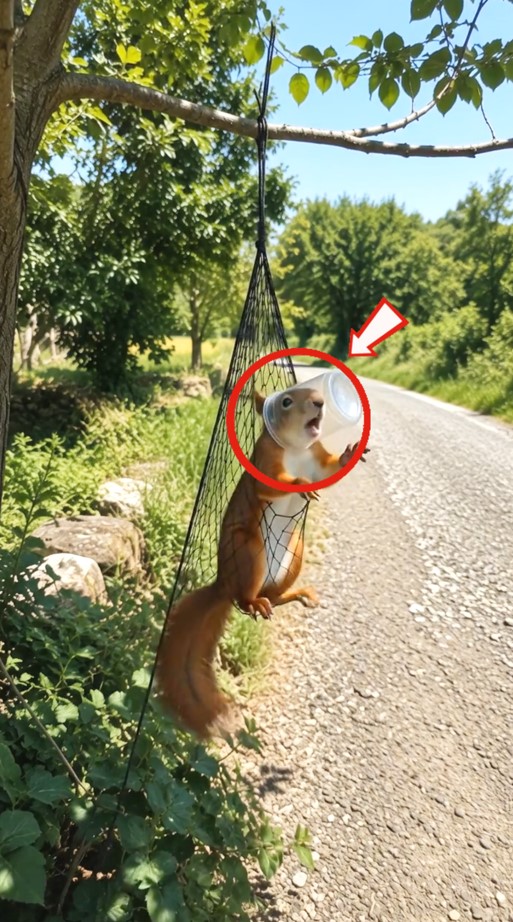
The late afternoon sun filtered through the trees of a quiet suburban neighborhood, casting long shadows across a narrow backyard.
Near an old wooden fence, a small gray squirrel struggled to move between two closely spaced slats.
A discarded plastic cup was stuck over its head, covering its eyes and catching against the sides of the fence.
The frightened animal twisted its body, trying to pull free, but every movement pushed the cup more firmly against the wood.
Its tiny paws scraped at the fence as it struggled to find an opening.
A few dry leaves scattered beneath its feet.
The squirrel stopped for a moment, breathing quickly, then tried again.
From the other side of the yard, a man named Michael Turner heard a faint scratching sound.
He had been watering his garden when the noise caught his attention.
At first, he assumed a branch had become tangled in the fence.
Then he heard another frantic rustle.
Michael set down his watering can and walked toward the sound.
When he reached the fence, he noticed something moving between the slats.
He leaned closer and saw a little squirrel trapped with a plastic cup covering its head.
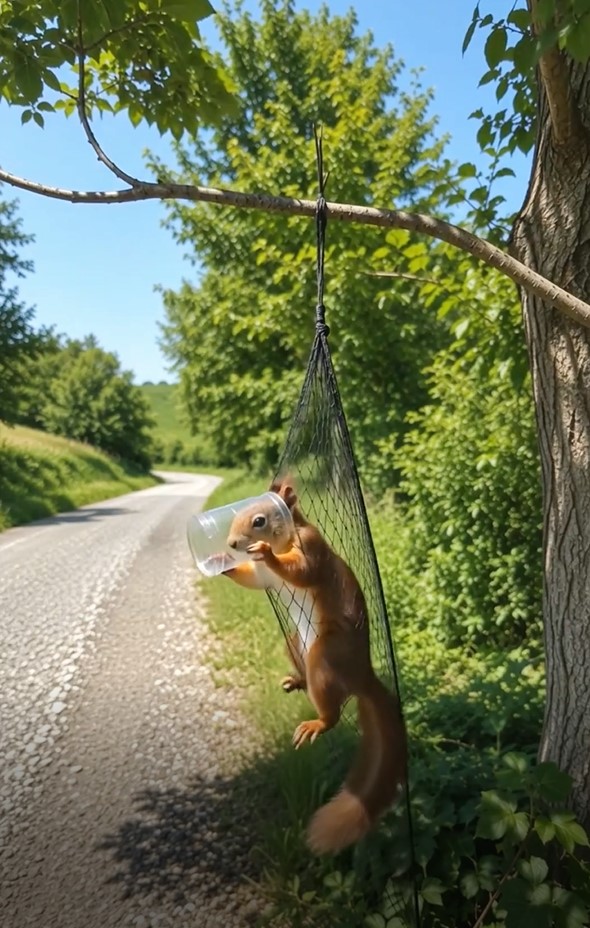
A Frightened Animal Cannot Find Its Way Out
Michael crouched several feet away and watched the squirrel carefully.
The animal could not see where it was going, and the fence prevented it from turning around.
Each time it tried to back away, the rim of the plastic cup caught against the wood.
Michael immediately understood that pulling the squirrel directly through the gap could hurt it.
He kept his hands away from the frightened animal and spoke softly, hoping his calm presence would prevent further panic.
The squirrel twisted again, then stopped when its body pressed against one of the wooden slats.
Its tail flicked rapidly behind it.
Michael looked along the fence for a wider opening, but the boards were firmly secured.
He considered loosening one of the slats, although he worried that sudden movement might frighten the animal further.
The plastic cup had probably been discarded nearby before the squirrel accidentally pushed its head inside.
Now the same lightweight object was preventing it from seeing and moving normally.
Michael glanced toward his garden shed, where he kept basic tools.
He decided that the safest approach would be to create more space rather than force the squirrel through the narrow opening.
Before leaving, he checked that the animal was still breathing normally and had not become caught by one of its legs.
The squirrel gave another small tug.
The cup shifted slightly, but it remained firmly lodged against the fence.
Michael hurried toward the shed to find a solution.
A Careful Plan to Free the Squirrel
Inside the shed, Michael collected a screwdriver and a small pair of pliers.
He also brought a thick garden towel, intending to use it only if necessary to protect himself and the animal during a controlled rescue.
He returned slowly, avoiding sudden movements that might cause the squirrel to struggle harder.
The animal was still trapped in the same position.
Michael placed the tools on the ground and examined the fence from both sides.
One wooden slat had a loose screw near its lower edge.
If he could remove that screw, he might be able to move the board just enough to create a wider gap.
He started turning the screwdriver carefully.
The faint scraping sound made the squirrel jerk backward.
Michael immediately stopped and waited until it became still again.
He did not want the animal to injure itself while he worked.
After a few minutes, the screw came free.
Michael gently tested the board, discovering that it could move outward slightly without breaking.
He widened the opening by a small amount, then paused to check the squirrel’s position.
The animal could now shift its shoulders more comfortably, but the plastic cup remained caught.
Michael knew that pulling the fence apart too quickly could cause the board to snap back.
He steadied it with one hand and kept the other away from the squirrel’s head.
The next step required patience.
He needed enough room for the animal to move without dragging the cup painfully against the wood.
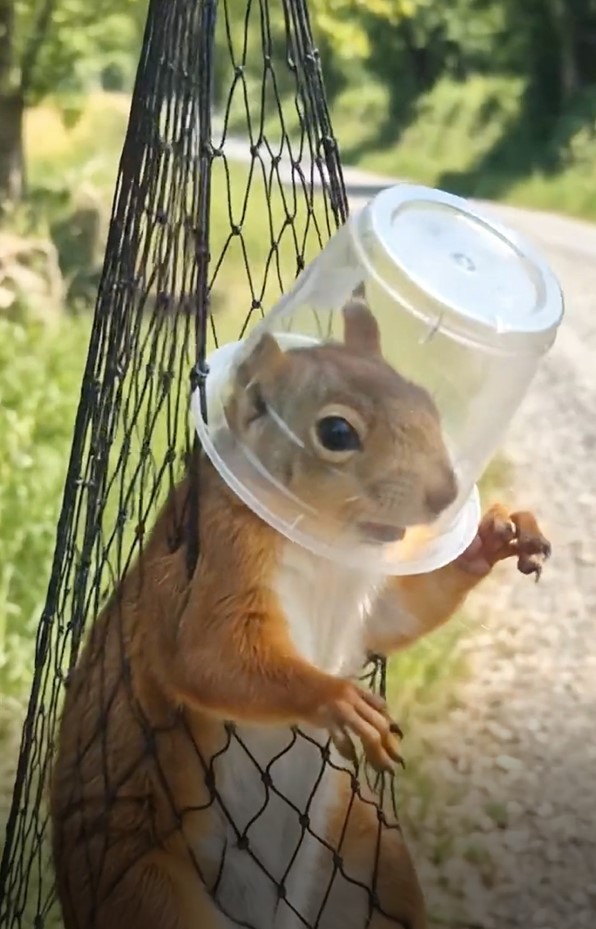
The Moment the Cup Finally Moves
Michael carefully widened the gap by another inch.
The squirrel shifted forward, then paused when the cup touched the edge of the loosened board.
For a moment, it seemed that the effort had changed nothing.
Michael resisted the urge to grab the cup and pull.
Instead, he adjusted the board’s angle and gave the animal time to move on its own.
The squirrel pushed its front paws forward.
The plastic rim slipped past one wooden edge, allowing its head to move slightly.
Michael kept the fence steady as the animal wriggled backward.
Then the cup tilted.
A narrow strip of gray fur appeared beneath its rim.
With one final movement, the squirrel pulled its head free of the fence.
It stumbled onto the ground, still wearing the plastic cup over its face.
Michael immediately moved his hands away, giving the animal room to retreat.
The squirrel shook its head repeatedly, but the cup did not come loose.
It ran a short distance before bumping against the base of a garden planter.
Michael realized that the fence was no longer trapping its body, but the plastic cup still prevented it from seeing.
He followed at a careful distance, keeping the path clear.
The squirrel paused beside the planter, its tiny paws pressed against the ground.
Michael knelt nearby and assessed the situation.
He needed to remove the cup without squeezing the animal or pulling on its head.
The squirrel was frightened, and one sudden movement could send it darting into another dangerous place.
Michael reached for the garden towel and prepared for the final part of the rescue.
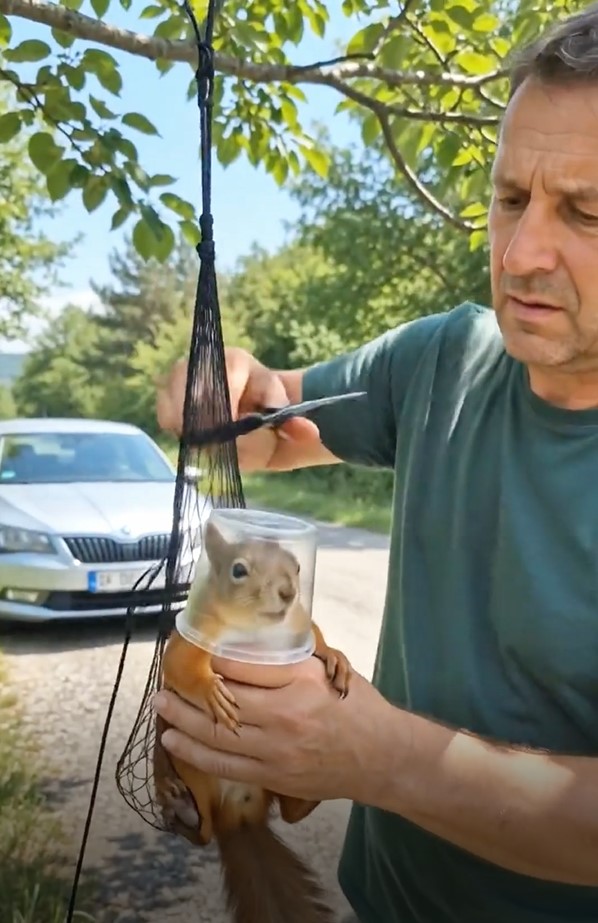
A Gentle Effort to Remove the Plastic Cup
Michael approached slowly, keeping his movements deliberate.
He used the towel to create a soft barrier around the squirrel, avoiding pressure on its chest and allowing it to breathe freely.
Once the animal was briefly and safely contained, he examined the plastic cup.
The rim had become wedged around the squirrel’s neck fur, although it had not completely tightened.
Michael avoided cutting close to the animal’s skin.
Instead, he used the pliers to carefully deform the thin plastic rim, creating a wider opening.
He worked in small increments, checking the squirrel’s position after each adjustment.
The animal shifted beneath the towel, and Michael paused until it settled.
Finally, the cup loosened enough to slide away without being forced over the squirrel’s ears.
Michael placed the plastic on the ground and immediately released the towel’s hold.
The squirrel darted a short distance toward a nearby shrub.
Michael remained still, watching from several feet away.
The animal stopped beneath the leaves and lifted its head.
Its eyes were visible again, and it looked around as if trying to understand its sudden freedom.
Michael did not attempt to pick it up again.
He simply cleared the remaining tools from the ground and gave the squirrel a quiet path toward the trees.
After a few moments, it climbed onto the lower trunk of a small tree.
It paused there, gripping the bark with all four paws.
Then it climbed higher, disappearing among the branches.
Michael finally let out the breath he had been holding.
The little animal was free.
Squirrel Gets Trapped in a Fence With a Plastic Cup Stuck on Its Head https://t.co/6t6ndgZVKP
— Animal Rescue Stories (@AnimalStory5) October 13, 2026
Back Among the Trees
Michael watched the branches for several minutes, making sure the squirrel continued moving normally.
He could hear faint rustling above him, followed by the sound of leaves shifting in the breeze.
The squirrel appeared briefly on a sturdy branch before disappearing behind the tree’s thick foliage.
There was no need to chase it or attempt to bring it closer.
Wild animals generally recover best when they can return to their natural surroundings without unnecessary handling.
Michael collected the plastic cup and placed it in a recycling container where appropriate.
He also checked the nearby grass for other discarded items that could pose similar hazards.
The fence remained slightly loosened, so he secured the wooden slat again after confirming that no animal was nearby.
Later, he inspected the rest of the backyard and found a few scraps of packaging caught beneath the bushes.
He removed them before they could become another danger.
The incident had lasted only a short time, but it left him thinking about how easily ordinary litter could become a trap for wildlife.
A plastic cup might seem harmless when it lay on the ground.
For a small animal that investigated it with its nose and paws, however, the same object could block its vision and movement.
Michael returned to watering his garden, glancing occasionally toward the tree where the squirrel had disappeared.
He hoped the animal would continue its day without further trouble.
The fictional story highlights how patience, caution, and responsible handling of litter can help protect wildlife.
Sometimes, a small act of kindness is all it takes to give a frightened creature its freedom back.