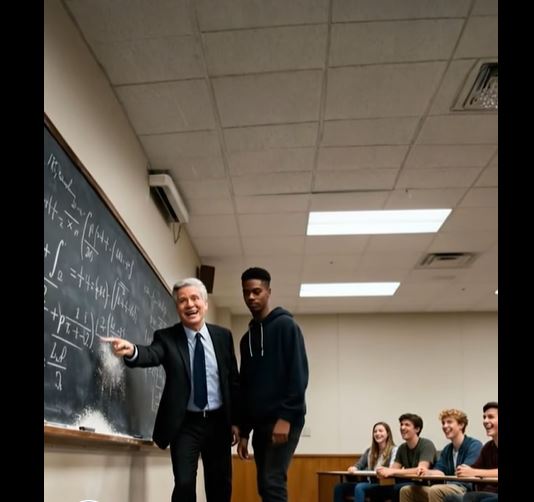
The classroom buzzed with the low, restless energy of a Friday afternoon. Sunlight poured through tall windows, dust motes floating lazily in the air as students shifted in their seats, counting the minutes until the final bell. On the whiteboard, half-erased equations hinted at a lesson that had long since lost their attention.
At the front of the room stood Mr. Howard, the senior mathematics teacher. He was known throughout the school for two things: his unquestionable mastery of math and his sharp tongue. He believed strongly in “pressure builds excellence,” though many students simply felt intimidated by him. He expected discipline, quick thinking, and absolute focus—and he had little patience for those he believed didn’t measure up.
Near the back of the room sat Malik Johnson.
Malik was quiet. He rarely raised his hand, rarely spoke unless spoken to. He wore the same hoodie most days, kept his head down, and filled his notebooks with neat, careful writing. To most teachers, he was invisible. To Mr. Howard, he was worse—he was a student Mr. Howard had already decided wasn’t “math material.”
“Johnson,” Mr. Howard said suddenly, snapping the marker cap back on. “You look bored.”
Malik looked up, startled. “No, sir.”
“Oh?” Mr. Howard arched an eyebrow. “Then perhaps you’d like to participate.”
A few students exchanged glances. This rarely ended well.
“Come up here,” Mr. Howard said, gesturing to the board. “Let’s see how well you’ve been paying attention.”
Malik hesitated, then stood and walked to the front. He could feel eyes on his back, hear whispers behind him. He’d learned long ago that attention usually came with assumptions.
Mr. Howard turned to the board and, instead of writing a standard problem, began filling it with symbols—nested radicals, exponents stacked on fractions, variables raised to irrational powers. The equation grew more complex with each stroke, stretching across the board like a puzzle designed to intimidate rather than teach.
By the time he finished, even the strongest students were staring wide-eyed.
“This,” Mr. Howard said, stepping back, “is not in your curriculum. In fact, most college students would struggle with it.”
A few students chuckled nervously.
“Go ahead, Malik,” Mr. Howard said, a faint smirk tugging at his lips. “Show us what you can do.”
The implication was clear. This wasn’t a challenge—it was a setup.
Malik stared at the equation. His face remained calm, but inside, something old and familiar stirred. Not fear. Not embarrassment.
Focus.
He picked up the marker.
At first, the room stayed restless. Someone coughed. A chair creaked. Mr. Howard folded his arms, already confident in the outcome.
Then Malik began to write.
He didn’t rush. He rewrote the equation carefully, reorganizing terms, factoring expressions that others hadn’t even noticed were factorable. He paused once, then substituted a variable transformation that made the tangled structure suddenly cleaner.
A student in the front row leaned forward.
“What is he doing?” someone whispered.
Malik continued. He simplified a radical. Canceled terms. Applied an identity most students had never seen, let alone understood.
The marker squeaked softly as he worked.
Five minutes passed.
The room was silent now.
Mr. Howard’s smirk faded. He straightened, eyes narrowing, stepping closer to the board. Malik wasn’t guessing. He wasn’t stalling. His steps were precise, deliberate—confident.
Ten minutes passed.
Malik reached the final line and boxed the solution.
He set the marker down and stepped aside.
“I’m done,” he said quietly.
For a long moment, no one spoke.
Mr. Howard stared at the board. He walked closer, scanning each line, his expression shifting from skepticism to confusion… then to disbelief.
“That’s not possible,” he muttered.
He grabbed another marker and began checking the steps. One by one. Slowly. Carefully.
Each line was correct.
Not just correct—elegant.
The solution wasn’t brute-forced. Malik had taken a higher-level approach, one that simplified the equation in a way Mr. Howard himself hadn’t initially considered.
A murmur rippled through the class. Someone whispered, “No way.” Another student shook his head in disbelief.
Mr. Howard turned to Malik, his face flushed.
“Where did you learn this?” he asked.
Malik shrugged slightly. “I like math.”
“That’s not an answer,” Mr. Howard snapped—then stopped himself. He exhaled slowly. “That’s graduate-level problem solving.”
Malik hesitated. “I read a lot. Online lectures. Old textbooks. I… I compete sometimes. Under a different name.”
“You solved that like it was nothing!”
Malik returned to his seat, heart pounding now—not from fear, but from something unfamiliar: being seen.
Mr. Howard stood silently at the front of the room. The authority he usually carried felt different now. He cleared his throat.