It was a gray, drizzly morning when we arrived at the airport. The terminal buzzed with announcements, rolling suitcases, and travelers hurrying to catch flights. I clutched my backpack straps tightly, glancing around nervously. I was ten years old, old enough to notice things most adults assumed I wouldn’t. And today, I would notice something that would stay with me for the rest of my life.
My parents were distracted, arguing quietly over tickets and luggage. My grandpa, a gentle man with silver hair and a warm, weathered face, walked slowly beside us, leaning slightly on his cane. He had been having trouble with his knees lately, and I had suggested bringing a foldable chair, but my parents waved off my concerns.
“Grandpa can manage,” Dad said. “Don’t worry about it.”
I frowned. I knew Grandpa could manage short walks, but the airport was huge, filled with long corridors, security lines, and waiting areas. My instincts screamed that he would need a break. But no one seemed to be listening.
We passed through security, and I stayed close to Grandpa, holding his hand as he shuffled along. Finally, we reached the gate area. There, my parents made a surprising decision.
“Grandpa,” Mom said briskly, “you can sit here. We’re going to get a coffee and check on the tickets.”
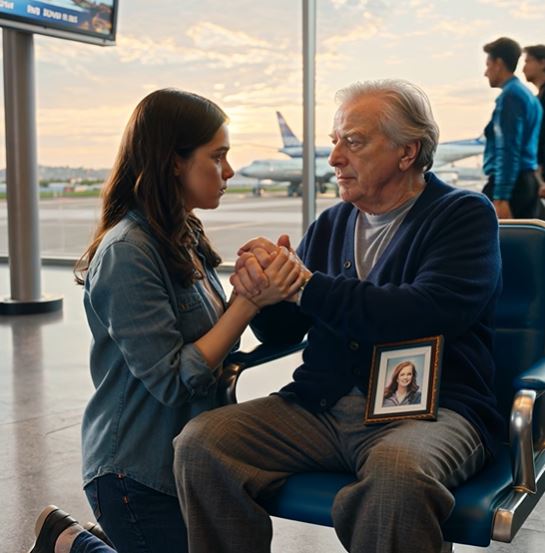
Before Grandpa could protest, they turned and walked away, leaving him alone in a hard, metallic airport chair. My chest tightened. Something about the scene felt wrong, and I couldn’t just sit quietly.
“Grandpa?” I asked, kneeling beside him. “Are you okay?”
He smiled faintly, but I could see the worry in his eyes. “I’ll be fine, kiddo,” he said softly. “It’s just a chair.”
I knew it wasn’t “just a chair.” It was a symbol of how little my parents were thinking about him, about his comfort, his dignity. I looked at them across the terminal. They didn’t even glance back. They assumed I hadn’t noticed—that I was too young to understand. But I had noticed.
I sat beside Grandpa, holding his hand. “You don’t have to sit here alone,” I said firmly. “I’ll stay with you.”
He chuckled, a quiet, amused sound that made my heart ache. “You’ve always been observant,” he said. “Thank you.”
The next thirty minutes passed slowly. I watched planes take off, travelers rushing by, and the faces of strangers—some indifferent, some kind—and I realized how lonely the world could feel when no one stopped to notice. Grandpa shifted in his chair, wincing slightly. I reached over and rubbed his shoulder, trying to ease his discomfort.
When my parents finally returned, coffees in hand, I felt a mixture of relief and frustration. They smiled at us, oblivious to the tension that had been simmering in the few minutes they were gone.
“See, all fine!” Dad said.
I didn’t respond. Instead, I helped Grandpa to his feet. “We’re leaving now,” I said softly. “I’ve been keeping him company.”
Mom frowned. “You didn’t need to sit there the whole time, sweetheart. We thought he’d be okay.”
I met her gaze steadily. “You thought wrong,” I said. “He needed someone who noticed him. And I did.”
The moment hung in the air, and for a brief second, I saw my parents realize that their neglect, even if unintentional, had been noticed. Grandpa squeezed my hand and smiled. “You’ve got a good heart, kiddo,” he whispered. “Better than mine, sometimes.”
We boarded the plane, Grandpa leaning on me as I guided him to his seat. I could still feel the memory of the airport chair, a reminder of how small acts—or the lack of them—can hurt. But I also felt a quiet pride. I had chosen to notice. I had chosen to act. And that made all the difference.
During the flight, Grandpa and I sat side by side, watching clouds drift past the window. He told me stories of his youth, of battles and travels, of moments when someone noticing him had changed the course of his day—or even his life. I realized that attention, care, and presence were as valuable as any ticket or plan.
By the time we landed, the airport chair was just a memory, but the lesson remained vivid. I had learned that noticing someone—truly seeing them, understanding their needs, and acting on them—was powerful. It could protect them, comfort them, and remind them that they were valued.
And it all began with a chair, a ten-year-old who refused to look away, and a grandpa who trusted him enough to let him lead.