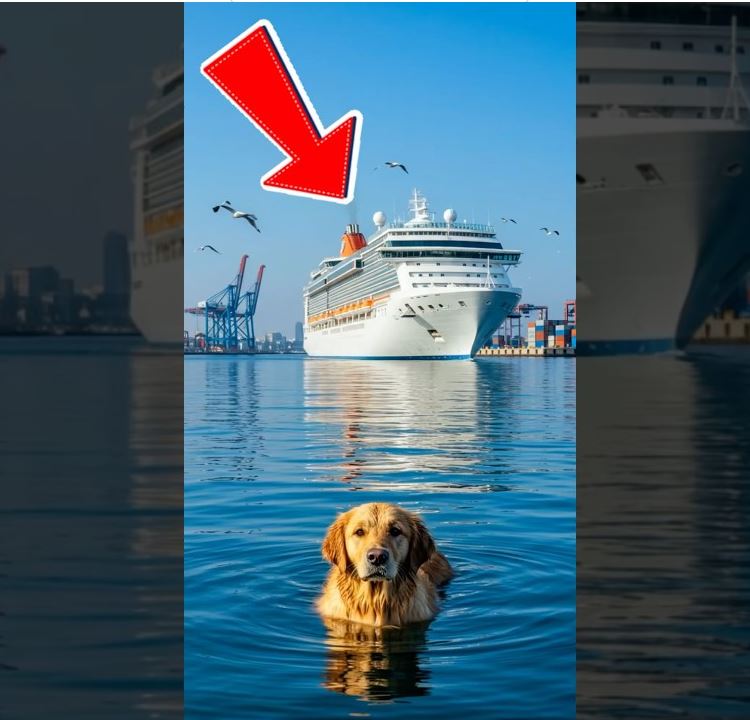
His name was Sunny, and officially, he didn’t exist in the ship’s manifest. He belonged to an elderly widower named Thomas Hale, a quiet man who had spent most of his life as a volunteer search-and-rescue worker.
Sunny was more than a pet—he was trained, disciplined, and deeply attuned to human distress. After Thomas’s wife passed away, Sunny became his reason to wake up every morning.
Thomas had begged the cruise company to allow Sunny aboard as an emotional support animal. After weeks of paperwork, hesitation, and one sympathetic manager, they were allowed on—with conditions. Sunny was to remain calm, leashed, unobtrusive. No one expected him to become a hero.
The cruise itself was meant to be uneventful: a peaceful journey across calm waters, sunsets over the horizon, laughter echoing across decks. Families relaxed. Couples danced. Children ran barefoot, unaware of how thin the line between safety and disaster truly was.
On the third night, the sea changed.
It began with a strange stillness, the kind sailors fear more than storms. The wind died suddenly. The air grew heavy. Sunny, lying at Thomas’s feet near the railing, lifted his head and began to whine softly. His ears twitched. His body stiffened.
Thomas noticed immediately.
“What is it, boy?” he whispered, running a hand along Sunny’s back.
Sunny stood up, tail rigid, eyes fixed toward the lower deck stairwell. Then he barked—once, sharp and urgent. Heads turned. People frowned. Someone muttered about dogs not belonging on ships.
Moments later, the smell came.
Gas.
A faint hiss followed by panic. Somewhere below deck, a ruptured pipe had begun leaking. One spark—just one—would turn the ship into a floating inferno.
Before alarms could sound, before crew could react, Sunny broke free.
He sprinted down the stairs, barking wildly, weaving through confused passengers. He scratched at doors, lunged at pant legs, pulled people backward with his teeth when they tried to move forward. Panic spread, but so did awareness.
“Something’s wrong!” someone shouted.
Sunny led them—dozens at first, then hundreds—away from the lower decks, toward open air. Crew members followed the chaos, radios crackling as they realized what was happening. Emergency protocols kicked in seconds later, but by then, Sunny had already done the impossible.
He had cleared the danger zone.
The leak was contained. No explosion. No deaths. No headlines—yet.
But Sunny wasn’t finished.
As evacuation procedures continued, a sudden wave rocked the ship. A child—no more than six—lost his balance and slipped near the railing of the aft deck. Before anyone could scream, Sunny launched himself forward, jaws clamping gently onto the back of the boy’s jacket, pulling him to safety just as another wave slammed against the hull.
That was when the ship erupted into applause, tears, and disbelief.
Sunny became a legend overnight. Videos flooded social media. News crews waited at the next port. “Hero Dog Saves Cruise Passengers,” the headlines read. Thomas smiled through interviews, insisting it wasn’t training alone.
“He listens,” Thomas said quietly. “To people. To God.”
But heroes don’t always survive their stories.
In the chaos of the following day, after hours of stress and adrenaline, Sunny collapsed. His breathing became shallow. His body trembled. Vets onboard tried everything they could, but the truth emerged slowly and painfully—Sunny had an undiagnosed heart condition. The strain had been too much.
Thomas held him as the sun dipped into the sea, hands shaking, tears falling freely.
“You did good, boy,” he whispered. “You did more than good.”
Passengers gathered silently around them. Some prayed. Some cried. Some simply watched, hearts breaking for the dog who had saved them.
That night, the ship was quieter than it had ever been. No music. No laughter. Only grief—for a dog who had become family to strangers in a single day.
But this is where the story refuses to end.
As Thomas sat alone in the small chapel onboard, clutching Sunny’s collar, he whispered words he hadn’t spoken aloud in years.
“Jesus… I don’t ask for miracles. I never have. But if You can hear me—please. He gave everything.”
Passengers later said the lights flickered. Others said they felt a sudden peace wash over them, unexplainable and overwhelming. One woman swore she smelled fresh grass. Another claimed she heard a heartbeat that wasn’t hers.
A gasp tore from Thomas’s throat as he dropped to his knees. Crew members rushed in. Medics confirmed it again and again—pulse restored. Heart stabilizing. Alive.
Doctors would later call it spontaneous recovery. Adrenaline. Misdiagnosis.
But no one who was there believed that.
Sunny survived.
He never returned to active rescue work. His heart required care now, gentler days. But he lived—surrounded by love, celebrated wherever he went.