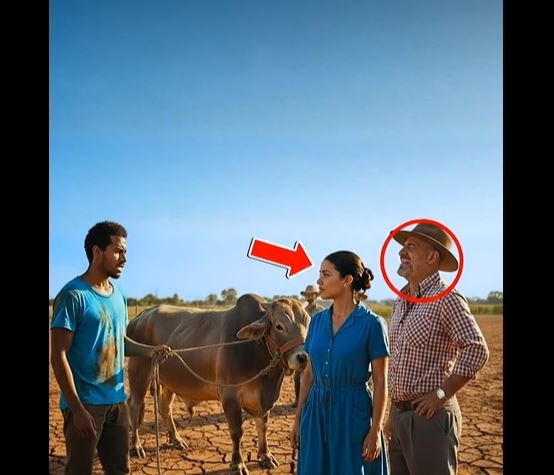
Brutus was not an ordinary animal. He was massive, broad-shouldered, with a dark, glossy coat and calm, intelligent eyes. Years of selective breeding had turned him into the crown jewel of Anton Grayson’s farm. Buyers came from other regions just to look at him. Some offered numbers that made people whistle under their breath. Anton always refused. Brutus wasn’t just livestock—he was legacy.
So when the bull escaped, the entire valley panicked.
It happened just before dawn. A storm had rolled through the night before, fierce and unexpected, knocking down part of the old eastern fence. By the time Anton reached the field, the gap was wide open and Brutus was gone. Tire tracks, hoof prints, broken wire—everything pointed toward the forest road that led far beyond the farmland.
Anton’s face turned pale.
“Do you have any idea what that bull is worth?” he snapped at the workers gathering around.
Everyone did.
Phones came out. Neighbors were called. A reward was announced before the sun had fully risen. At first it was generous. Then it doubled. By noon, it had become absurd—enough money to change someone’s life.
Search parties spread out across fields, roads, and wooded hills. Drones buzzed overhead. Trucks drove slowly along dirt paths. People who had never cared about cattle suddenly became expert trackers overnight.
But the person who found Brutus wasn’t part of any search team.
His name was Elias.
Elias had worked on the farm for nearly eight years. He was quiet, reliable, and mostly invisible. He cleaned stalls, fixed fences, hauled feed. He never complained and never asked for more hours. When people talked about the farm, they talked about Anton, the land, and the animals—never about Elias.
That morning, Elias had noticed the broken fence before anyone else. He didn’t report it immediately. Not because he wanted trouble, but because he knew animals. A panicked chase would only push Brutus farther away.
So Elias did what he always did.
He followed calmly.
He tracked the bull through damp soil, broken brush, and flattened grass. He read signs others missed: bent reeds, snapped twigs, disturbed birds. He didn’t carry a phone or a drone—just a rope, an apple, and patience.
Hours later, deep near the edge of the old quarry woods, he found Brutus.
The bull stood knee-deep in tall grass near a stream, calm and unbothered, chewing slowly. When Elias approached, Brutus lifted his head but did not charge. He recognized him. Elias was the one who fed him most mornings, the one who spoke softly instead of shouting.
Elias didn’t rush.
He sat on a fallen log. Tossed the apple gently onto the ground. Waited.
It took nearly an hour, but eventually Brutus stepped closer. Elias looped the rope, secured it carefully, and led the bull back toward the farm the long way around—avoiding roads, crowds, and noise.
By the time they emerged near the western fields, the farm was buzzing with people.
Anton rushed forward, his face breaking into relief when he saw Brutus safe and unharmed. Applause followed. Phones came out. Someone clapped Elias on the back hard enough to knock him forward.
The number he announced caused a murmur to ripple through the crowd. It was more money than Elias had ever held in his life. Enough to buy land. Enough to leave. Enough to change everything.
One of the neighbors spoke up. “He works for you. Isn’t that just his job?”
Another added, “If employees get rewards like that, what about the rest of us who searched?”
Someone else muttered, “He probably knew where the bull was the whole time.”
Elias felt heat rise in his face. He hadn’t asked for the reward. He hadn’t even thought about it. All he wanted was to keep the bull safe.
“I don’t need—” he began.
Anton raised a hand. “You don’t get to refuse something you earned.”
That was when Elias did something no one expected.
He stepped forward.
“I’ll take the reward,” he said quietly. “But not like this.”
The crowd fell silent.
Elias looked around—at the workers, the neighbors, the people who had judged him without knowing him.
“I’ll accept it on one condition,” he continued. “That it doesn’t belong only to me.”
Anton frowned. “Explain.”
Elias swallowed. “Use it to fix the fences properly. Improve the shelters. Raise wages for the workers who keep this place running. And… set aside a fund for emergencies, so no one has to panic like this again.”
“Because this farm gave me work when no one else would. Because animals don’t lie. And because not everything valuable needs to be owned.”