Marcus had been traveling since before sunrise, and by the time he reached the premium lounge entrance, all he wanted was somewhere quiet to sit, answer a few emails, and collect his thoughts before his next meeting.
The terminal behind him was busy with the usual airport rhythm. Rolling suitcases passed in every direction. Boarding announcements echoed overhead. Families clustered near departure screens while business travelers moved quickly between gates with phones pressed to their ears.
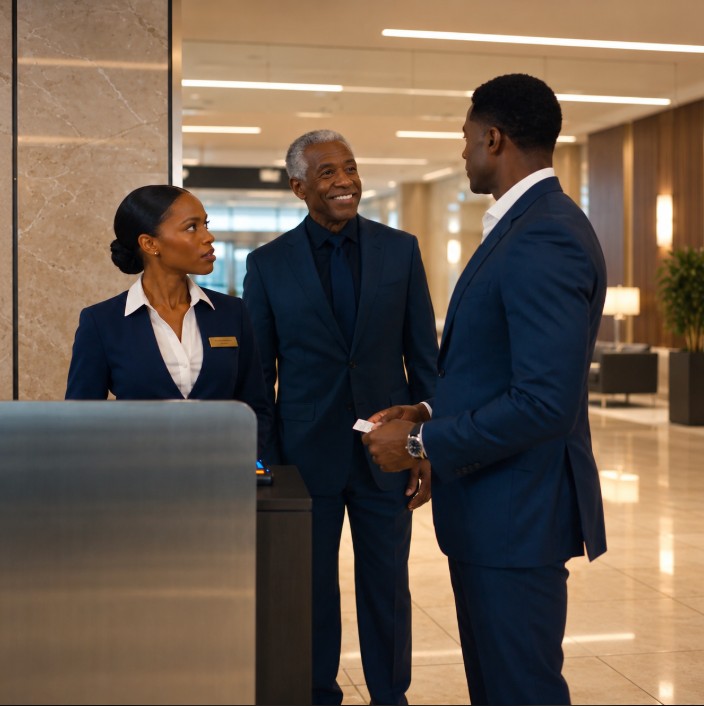
Marcus walked up to the lounge desk and handed over his boarding pass.
The attendant, Lena, scanned it and looked at the screen.
Then she looked back at him.
“Sir, this lounge is for premium passengers.”
Marcus remained calm.
“I know.”
She handed the boarding pass back.
“Your gate is down the hall.”
“And my lounge is here.”
Lena’s expression tightened slightly.
“Do you have elite status?”
“Yes.”
She checked the screen again.
“I’m not seeing it.”
Marcus glanced toward the monitor.
“Try the other screen.”
Lena looked up immediately.
“I know how to do my job.”
Marcus paused.
“I didn’t say you didn’t.”
A couple standing a few feet behind him shifted quietly as they waited.
Lena typed something else into the system.
Her fingers moved quickly across the keyboard.
“Still nothing.”
Marcus reached toward his wallet.
“Would you like my membership number?”
“That won’t change anything.”
“It normally does.”
There was no anger in his voice.
That seemed to bother Lena more than if he had argued.
She looked at him again as if trying to decide whether he was confused, difficult, or simply refusing to understand what she had already decided.
“Sir, if the system doesn’t recognize your access, I can’t let you into the lounge.”
Marcus nodded.
“I understand how access systems work.”
“Then you understand why I can’t make an exception.”
“I’m not asking for one.”
Lena folded her hands.
“Then I’m not sure what else you want me to do.”
Marcus looked toward the screen.
“I want you to check the information correctly.”
Her expression changed again.
This time the professional politeness became noticeably colder.
“I already checked it.”
Marcus said nothing for a moment.
He had spent enough time in airports to know that technical mistakes happened. Membership profiles failed to sync. Boarding passes were issued incorrectly. Reservation systems missed information.
None of that bothered him.
What bothered him was the certainty.
Lena had moved almost immediately from checking his boarding pass to explaining why he did not belong there.
She had not asked for his membership number.
She had not asked whether the reservation was connected to another account.
She had not called anyone.
She had simply reached a conclusion and begun defending it.
Marcus leaned lightly against the handle of his carry-on.
“There should be a secondary profile attached to my account.”
Lena sighed.
“Sir, I’ve already told you what the system says.”
“And I’ve told you there’s another profile.”
“I handle these accounts every day.”
Marcus nodded.
“I’m sure you do.”
Something about his answer made her even more defensive.
“Then please stop telling me how to use the system.”
Marcus looked directly at her.
“I’m trying to help you find the information.”
“I don’t need help.”
“All right.”
For a second, neither of them spoke.
The lounge doors opened behind Lena as another traveler exited. Marcus could see the quiet seating, polished tables, charging stations, and coffee service inside.
He had been in that lounge more times than he could remember.
In fact, years earlier, he had spent weeks sitting in conference rooms discussing what the lounge program should look like before the first redesigned locations ever opened.
That made the situation almost amusing.
Almost.
Then he heard a familiar voice behind him.
“Marcus?”
He turned.
A tall man in a dark suit was walking quickly toward the entrance.
Marcus smiled slightly.
“David.”
David extended a hand.
“You made it.”
Marcus shook it.
“Barely.”
David laughed, but Lena was no longer smiling.
She looked between them.
“You know this passenger?”
David’s expression shifted.
“Of course.”
He looked back at Marcus.
“We were beginning to think your connection had been delayed again.”
“It was.”
Lena glanced toward the computer screen.
Then back at David.
“Who is he?”
There was something almost too blunt about the question.
David hesitated for half a second.
“He’s on our advisory board.”
Lena froze.
“Advisory board?”
David nodded.
“He helped design this lounge program.”
The silence that followed felt much louder than the airport announcements around them.
Marcus looked at Lena.
“And apparently we have some training work to do.”
The confidence drained from her face.
“Sir, I apologize.”
Marcus did not respond immediately.
He was not interested in embarrassing her.
He was not interested in using his title as a weapon.
That would have missed the point completely.
David stepped toward the access panel and opened the lounge entrance.
“Your meeting is inside.”
Marcus nodded.
“Thanks.”
Then he turned back toward Lena.
She looked genuinely uncomfortable now.
“I really am sorry,” she said.
Marcus studied her for a moment.
“Treat the next person well before you know who they are.”
Lena lowered her eyes briefly.
“Yes, sir.”
Marcus picked up his carry-on and walked through the lounge entrance with David beside him.
The doors closed behind them.
Inside, the atmosphere changed immediately. The terminal noise softened. Travelers sat quietly with laptops open. A few people spoke in low voices near the windows. Staff moved carefully between tables.
David glanced toward Marcus as they walked.
“What happened?”
Marcus gave him a measured look.
“Exactly what it sounded like.”
David frowned.
“She refused your access?”
“That’s not really the issue.”
David slowed slightly.
“What is?”
Marcus looked around the lounge.
“The issue is that she decided I didn’t belong before she finished checking.”
David’s expression became more serious.
Marcus continued.
“If it had only been a system error, I wouldn’t care. Systems fail. But she stopped investigating the moment the result matched what she had already decided.”
David nodded slowly.
“That’s different.”
“Yes.”
They continued toward a private meeting room at the far end of the lounge.
David opened the door.
Several people were already inside around a conference table, reviewing presentation screens and financial reports.
One of them stood.
“Marcus, good to see you.”
Marcus greeted the group and took the empty chair nearest the window.
The meeting had been scheduled to review the airline’s premium customer strategy for the next year. They were discussing membership growth, traveler retention, service standards, lounge capacity, staffing, and the experience of high-value customers across major airports.
Marcus listened for the first several minutes.
Then one executive brought up customer satisfaction scores.
“Our facilities are testing well,” she said. “Food and beverage scores are up. Seating complaints are down. Access processing is also improving.”
Marcus glanced at David.
David knew immediately what was coming.
Marcus leaned forward.
“What does access processing measure?”
The executive checked her notes.
“Wait times, scanning speed, entry failures.”
“Does it measure how people are treated when the system fails?”
She paused.
“Not specifically.”
“Then you’re not measuring the full experience.”
The room became quieter.
Marcus continued.
“I was almost turned away ten minutes ago.”
A few people looked surprised.
He explained the interaction without naming Lena at first.
He described how quickly the conversation had shifted from verification to dismissal.
How the employee had rejected additional information.
How she had treated confidence as proof that she was correct.
One of the executives frowned.
“That should never happen.”
Marcus nodded.
“But it does.”
He leaned back slightly.
“And this is why premium service cannot be reduced to furniture, food, faster Wi-Fi, and expensive finishes.”
He gestured lightly around the lounge.
“All of this matters. But none of it can repair a bad first interaction.”
Someone across the table asked, “What would you change?”
Marcus answered immediately.
“Train people to stay curious for ten seconds longer.”
The room stayed silent.
He continued.
“Ask for the membership number. Check the secondary profile. Confirm the reservation. Call a supervisor if needed. The technical solution is usually simple.”
He paused.
“The human problem is harder. People like being certain.”
David nodded.
Marcus looked toward the screen showing customer retention numbers.
“And certainty becomes expensive when it makes customers feel like they have to prove they deserve basic respect.”
That shifted the meeting.
The discussion moved away from only lounge features and toward service behavior.
They reviewed complaint patterns.
They looked at situations involving account mismatches, international memberships, partner-airline status, technical failures, and travelers whose access had eventually been confirmed after uncomfortable interactions.
The data existed.
No one had been looking at it as a culture problem.
Marcus asked them to do exactly that.
By the end of the meeting, the group agreed to expand training around access disputes and service recovery. Employees would be encouraged to verify before refusing entry. Supervisors would receive more authority to investigate unusual accounts without immediately escalating the interaction into confrontation.
They also agreed to change one part of the internal training language.
Instead of teaching staff to determine whether someone “belongs” in the lounge, the new language would focus on determining whether an account qualifies for access.
The difference sounded small.
Marcus knew it was not.
One phrase focused on the system.
The other focused on the person.
That distinction mattered.
Nearly two hours later, the meeting ended.
David gathered his papers.
“I’m going to speak with Lena.”
Marcus closed his laptop.
“Don’t make an example out of her.”
David looked surprised.
“You don’t think there should be consequences?”
“I think there should be correction.”
Marcus stood.
“If she learns from it, that matters more than humiliating her.”
David nodded.
“Fair.”
Marcus picked up his carry-on again and walked back toward the lounge entrance.
When he reached the desk, Lena was still there.
This time she stood as soon as she saw him.
“Mr. Marcus?”
He stopped.
“Yes?”
“I checked the account after you went inside.”
Marcus waited.
“You were right,” she said. “Your membership was linked through the secondary system. I should have checked it when you told me.”
Marcus nodded.
“That would have helped.”
She looked embarrassed.
“I also shouldn’t have spoken to you the way I did.”
“No.”
“I thought you were trying to get access you didn’t have.”
Marcus looked at her carefully.
“That’s the part you should think about.”
She was quiet.
He continued.
“Why did you think that before you had all the information?”
Lena looked down toward the desk.
“I don’t have a good answer.”
“That’s probably where the useful work starts.”
She looked back up.
For the first time since he had met her, there was no defensiveness in her expression.
“I’m sorry.”
Marcus nodded.
“I accept your apology.”
She seemed relieved, but Marcus was not finished.
“Just remember something.”
She waited.
“The person standing in front of you should not need to be on an advisory board before you decide they deserve patience.”
Lena nodded.
“I understand.”
Marcus gave her a small, polite smile.
“Good.”
He turned and began walking back toward the terminal.
His next flight would begin boarding soon.
Around him, the airport continued exactly as before.
Announcements echoed overhead.
Travelers hurried toward gates.
Luggage rolled across polished floors.
People checked phones, searched for signs, and stood in lines.
Most of them would never know what had happened at the lounge entrance that afternoon.
But Marcus knew the real lesson had very little to do with elite status, membership levels, or advisory boards.
Those details had only exposed the problem.
The real question was much simpler.
How do you treat someone before you know their title?
Before you know what they earn?
Before you know who they know?
Before someone important walks over and tells you they matter?
Anyone can become polite after learning a person has influence.
That requires almost nothing.
Respect matters most when you believe the person in front of you has nothing to offer you in return.
Marcus reached his gate, found an empty seat, and set his carry-on beside him.
A few minutes later, his phone buzzed.
It was a message from David.
“We’re changing the training.”
Marcus read it once.
Then he smiled and put the phone back in his pocket.
One uncomfortable conversation would not transform an entire company.
He knew that.
But sometimes change began with something much smaller.
A question asked instead of an assumption.
A second screen checked instead of ignored.
A person treated well before anyone explained why they were important.
And for Marcus, that was more valuable than any premium lounge could ever be.