The siren cut through the afternoon air with sharp urgency, echoing down the narrow street as neighbors stepped outside their homes, drawn by instinct more than curiosity. The ambulance doors slammed shut, and the engine roared to life. For most people watching, it was just another emergency, another moment that would pass and fade into memory.
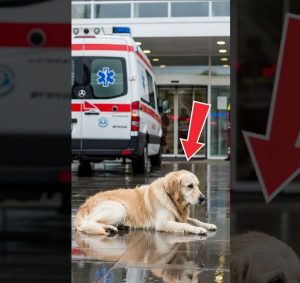
He stood frozen for a split second, ears perked, eyes wide, watching the vehicle that carried the only person he had ever trusted. Then, without hesitation, he ran.
His paws hit the pavement hard as the ambulance began to move. He barked once, sharp and panicked, then sprinted after it, his body stretching to its limits as he tried to keep up. His leash dragged behind him, bouncing wildly, forgotten in the chaos. He did not understand sirens or emergencies. He only understood that his owner was leaving, and he was not supposed to be left behind.
The paramedic riding in the back glanced through the small rear window and frowned. “There’s a dog chasing us,” she said.
The driver looked in the side mirror and shook his head. “Poor thing,” he muttered, easing his foot off the accelerator just enough to avoid losing the dog completely. “We can’t stop.”
Inside the ambulance, the man on the stretcher was unconscious. His breathing was shallow, his skin pale. One hand twitched slightly, as if reaching for something that wasn’t there. If he had been awake, he would have been calling a name. He always did.
Rusty had been with him for nine years. Since the day the man had found him shivering behind a grocery store, ribs showing, eyes dull with hunger and fear. Back then, Rusty had been nothing but a scruffy puppy with too much fur and not enough hope. The man had knelt down, offered half a sandwich, and spoken softly, as if the world wasn’t such a dangerous place after all.
They walked the same routes every morning. They sat on the same bench at the park every afternoon. Rusty learned his owner’s moods before any human ever could. When the man was tired, Rusty walked slower. When he was sad, Rusty pressed his head into his knee until the sadness softened.
And now, as the ambulance picked up speed, Rusty ran harder than he ever had before.
His breathing grew ragged. His legs burned. Cars slowed, horns blaring as drivers noticed the dog weaving dangerously close to traffic. Someone shouted for him to stop. Someone else tried to grab the leash as he passed, but Rusty slipped free, eyes locked on the flashing red lights ahead.
He stumbled once, skidding across the asphalt, scraping his paw. He yelped, then scrambled back to his feet without even looking down. Pain meant nothing. Distance meant everything.
He stopped, spinning in a frantic circle, panic overtaking him. His tail dropped. His ears flattened. He let out a sound that was not quite a bark and not quite a whine, something broken and desperate. Then he saw it again, just ahead, and ran with everything he had left.
Inside the ambulance, a paramedic adjusted the man’s oxygen mask. “We’re losing his pressure,” she said.
The other paramedic nodded, focused. “Stay with me, sir,” he said, even though the man couldn’t hear him. “You’re not alone.”
When the ambulance finally pulled into the hospital bay, Rusty collapsed just short of the entrance. His chest heaved, his tongue hung out, and his scraped paw left a faint smear of blood on the concrete. But when the doors opened, he forced himself back up and limped forward, tail wagging weakly despite everything. Rusty tried to push past her, desperate to get closer, to see, to smell, to make sure his owner was still there. Security hesitated, unsure what to do. Dogs weren’t allowed inside. Rules were rules.
Then one of the paramedics spoke up. “He followed us the entire way,” she said quietly. “Didn’t stop once.”