The lunch rush had barely ended when the kitchen began preparing for dinner.
Stainless-steel counters were covered with trays, knives, pans, and half-finished prep work. Steam rose from stockpots. Chefs moved quickly between stations while orders from the dining room continued to print near the pass. Metal clattered against metal, burners hissed, and voices crossed over one another in the controlled chaos of a busy upscale restaurant.
Near the back entrance, an elderly woman stepped quietly into the kitchen.
Her name was Evelyn Carter.
She was in her late sixties, with short curly gray hair and a clean white chef jacket buttoned neatly to the collar. In one hand, she carried an old leather folder worn smooth along the edges from years of use.
She paused just inside the doorway and looked around.
The kitchen had changed since the last time she had worked in one like this.
Equipment was newer.
Screens had replaced paper tickets at some stations.
Young cooks moved faster than they needed to.
But the sounds were familiar.
The smell of stock, butter, garlic, hot steel, and fresh herbs brought back decades of memories in an instant.
Before she could take another step, a sharp voice cut across the room.
“Who let you back here?”
Evelyn turned.
The restaurant manager was walking quickly toward her.
He wore a black suit despite the heat of the kitchen, and his face showed immediate irritation.
He pointed toward the exit.
“Get out of my kitchen.”
Several cooks looked up.
Evelyn remained calm.
“I was told to report here today.”
The manager looked her up and down.
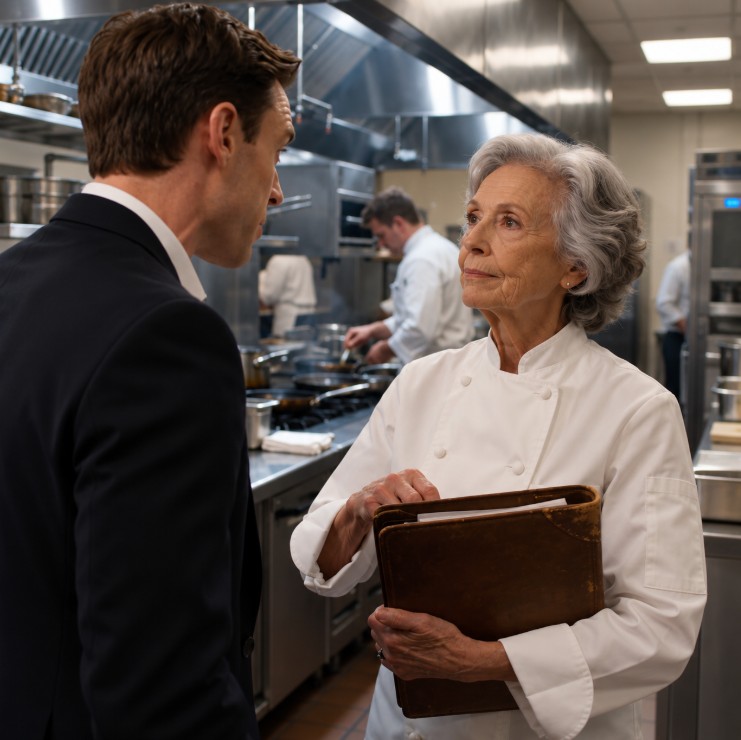
“For what?”
“I have an appointment.”
He gave a short laugh.
“With who?”
“The executive office.”
His expression became even more dismissive.
“We need professionals back here, not someone’s grandmother.”
The kitchen seemed to quiet around them.
Not completely.
The burners were still running.
Pans still moved.
But enough people had heard him that several heads turned.
Evelyn held the leather folder a little closer to her chest.
She had been spoken to rudely before.
Age had taught her something useful about moments like this.
The quickest response was not always the strongest one.
Sometimes the best thing to do was let people finish revealing themselves.
She opened the folder.
“If you’d like, you can read this.”
The manager sighed.
Evelyn pulled out a résumé.
He took it from her more roughly than necessary.
“What is this supposed to prove?”
“My experience.”
He glanced down.
At first, his expression barely changed.
Then his eyes slowed.
He read the first section again.
The dismissive look faded slightly.
“Forty-two years…”
He looked up at her.
Then back down.
“Executive chef?”
Evelyn said nothing.
The manager kept reading.
His face changed more noticeably now.
He scanned the list of restaurants.
Cities.
Positions.
Awards.
Training programs.
Kitchen openings.
Consulting work.
He looked up again.
“Paris?”
Evelyn nodded.
He looked back at the résumé.
“London?”
Another nod.
Then he stopped.
“Three Michelin-star kitchens?”
The young sous-chef working nearby turned fully toward them.
Another cook raised his eyebrows.
The manager read more carefully now.
It was obvious he no longer wanted anyone to see how quickly his confidence was disappearing.
Evelyn watched him in silence.
For years, she had worked in kitchens where mistakes cost reputations, money, and sometimes entire careers. She had trained chefs who later ran restaurants of their own. She had opened hotel kitchens, redesigned menus, rescued struggling dining rooms, and worked service nights where hundreds of plates had to leave the pass with near-perfect consistency.
She had nothing to prove to the man in front of her.
He simply had not known any of that when he looked at her.
That was the point.
Before the manager could speak again, another voice came from behind them.
“There you are.”
Everyone turned.
A senior restaurant executive stepped into the kitchen.
He smiled when he saw Evelyn.
“We’ve been waiting upstairs.”
The manager looked confused.
“You know her?”
The executive glanced at him.
“Of course.”
Then he raised his voice slightly so the nearby staff could hear.
“Everyone, meet our new executive chef.”
The kitchen fell almost completely silent.
The manager turned pale.
For a moment, even the busiest cooks stopped what they were doing.
The senior executive continued.
“Chef Carter will be overseeing the entire culinary operation starting today.”
The manager looked back at Evelyn.
His mouth opened, but no words came out at first.
Finally, he managed to say, “I didn’t realize…”
Evelyn gently reached for the résumé still in his hand.
He gave it back immediately.
She slipped it into the leather folder.
“Experience doesn’t always look the way you expect.”
No one laughed.
No one needed to.
The sentence landed exactly where it was supposed to.
The executive looked toward the manager.
“Is there something I should know?”
Evelyn glanced at him.
“Nothing we can’t fix.”
The manager looked at her, surprised.
She could have embarrassed him completely.
She could have repeated every word he had said in front of the executive.
She could have asked for him to be removed from the kitchen.
Instead, she closed the folder and looked toward the line.
“Dinner service starts soon?”
The sous-chef nodded.
“Yes, Chef.”
Evelyn smiled.
“Then we should probably get ready.”
The kitchen staff began moving again.
But this time, when Evelyn stepped farther inside, they made room for her.
Not because of her age.
Not because of her résumé.
Because now they knew who she was.
The manager stood where she had left him, suddenly aware of how much he had decided in only a few seconds.
Later that afternoon, Evelyn sat in the executive office reviewing the restaurant’s numbers.
Food costs were too high.
Ticket times were inconsistent.
Several dishes had been receiving complaints.
Staff turnover in the kitchen was worse than expected.
The restaurant looked successful from the dining room, but behind the scenes, the operation had been struggling for months.
That was why she had been hired.
The senior executive sat across from her.
“I want to apologize for what happened downstairs.”
Evelyn looked up from the report.
“You didn’t say it.”
“I hired the person who did.”
“That’s different.”
He leaned back.
“You’re taking it better than I would.”
Evelyn gave a faint smile.
“At my age, you learn to choose which battles deserve energy.”
He nodded.
“But it bothered you.”
“Of course it did.”
She closed the report.
“What bothered me more was how quickly he became certain.”
The executive waited.
“He didn’t ask my name.”
“No.”
“He didn’t ask why I was there.”
“No.”
“He looked at me and decided I didn’t belong.”
The executive sighed.
“I’ll deal with it.”
Evelyn studied him.
“Deal with the behavior, not just the person.”
“What do you mean?”
“If he thinks like that, others probably do too.”
She gestured toward the kitchen below.
“You can’t run a serious hospitality business if people confuse appearance with competence.”
The executive nodded slowly.
“That sounds like something we need to address more broadly.”
“It does.”
Evelyn reopened the report.
“Now, about these food costs.”
Within an hour, she was back in the kitchen.
This time, no one questioned why she was there.
The staff gathered around the prep table while she introduced herself.
“I know some of you have already heard parts of my résumé.”
A few cooks smiled.
Evelyn looked around the group.
“Forget it.”
They seemed surprised.
“A résumé tells you where someone has been. It doesn’t tell you how they work.”
She placed both hands on the counter.
“You’ll decide what you think of me after service.”
That earned a few more smiles.
Then she began asking questions.
Who ran the grill station?
Who handled sauces?
Who checked deliveries?
Who approved prep quantities?
Who was responsible for waste logs?
Who tasted dishes before service?
The answers revealed more than the reports upstairs had.
Responsibility was unclear.
Communication was inconsistent.
Several cooks were talented but frustrated.
The sous-chef was doing the work of three people.
And the manager who had insulted Evelyn earlier had been interfering with kitchen decisions without understanding enough about the operation.
She noticed him standing near the door.
“Come here.”
He hesitated.
Then he approached.
“Yes, Chef.”
The title sounded very different now.
Evelyn looked at him.
“What’s your name?”
“Daniel.”
She nodded.
“Daniel, what’s the biggest complaint you hear from the dining room?”
He seemed caught off guard by the question.
“Ticket times.”
“What else?”
“Inconsistent portions.”
“What else?”
He thought.
“Sometimes temperature.”
Evelyn nodded.
“Good.”
Daniel looked confused.
“You’re not angry?”
“I’m working.”
He lowered his eyes.
“About earlier…”
“We’ll talk later.”
“Yes, Chef.”
She pointed toward the service station.
“For now, show me how communication works between the dining room and the kitchen.”
Daniel immediately moved into explanation mode.
For the next half hour, Evelyn listened.
She asked questions.
She watched.
And she noticed something important.
Daniel was arrogant.
But he was not incompetent.
He understood the front of the restaurant well.
He cared about speed.
He cared about guest complaints.
What he lacked was judgment.
He moved too quickly.
Spoke too quickly.
Decided too quickly.
The same problem that had caused him to judge Evelyn was affecting the operation.
During service, she watched him interrupt cooks before they finished explaining delays.
She watched him pressure the pass when the problem actually came from inaccurate table timing.
She watched him assume carelessness when the issue was poor coordination.
By the end of the night, Evelyn understood exactly what needed to change.
After the last major dinner rush passed, she found Daniel near the service station.
“Walk with me.”
He followed her toward the quieter prep area.
Evelyn placed the leather folder on the counter.
Daniel looked nervous.
“I want to apologize again.”
She nodded.
“Go ahead.”
He took a breath.
“What I said to you was disrespectful.”
“Yes.”
“I judged you because of your age.”
Evelyn waited.
“And because you didn’t look like who I expected an executive chef to be.”
She nodded.
“That’s more honest.”
Daniel looked down.
“I’m embarrassed.”
“You should be.”
He accepted that.
Then Evelyn continued.
“But embarrassment isn’t useful unless it changes something.”
Daniel looked at her.
“I understand.”
“Do you?”
He was quiet.
Evelyn leaned lightly against the counter.
“You made the same mistake with me that you make with this kitchen.”
Daniel frowned.
“What do you mean?”
“You decide what’s happening before you ask enough questions.”
He stared at her.
She continued.
“When ticket times increase, you assume the line is slow.”
Daniel said nothing.
“When a server complains, you assume the kitchen made the mistake.”
His expression changed.
“When a cook tries to explain a problem, you interrupt because you already believe you know the answer.”
Daniel looked toward the floor.
Evelyn tapped the leather folder gently with one finger.
“You did exactly the same thing when I walked in.”
For the first time, Daniel seemed to understand that the incident had been bigger than a rude comment.
“It’s the same habit,” he said.
“Yes.”
Evelyn nodded.
“And habits like that become expensive.”
Daniel looked toward the kitchen.
“I never thought about it that way.”
“That’s why I’m telling you.”
He looked back at her.
“Why are you helping me after what I said?”
Evelyn smiled slightly.
“Because I’ve fired people before.”
Daniel swallowed.
“And?”
“Sometimes they deserved it.”
A small nervous smile appeared on his face.
“But I’ve also watched people change.”
She picked up the folder.
“I’d rather see which one you are.”
Daniel nodded.
“I won’t waste the chance.”
“We’ll see.”
Over the next several weeks, Evelyn transformed the kitchen slowly.
She did not arrive with dramatic speeches.
She changed systems.
Prep schedules became clearer.
Waste dropped.
Recipes were standardized where they needed consistency.
Cooks were given more responsibility at their stations.
Communication between the dining room and kitchen improved.
Ticket times fell.
Complaints became less frequent.
Food costs began moving in the right direction.
More importantly, the atmosphere changed.
People stopped shouting over problems they had not understood yet.
They asked questions first.
Daniel changed too.
At first, it was obvious he was trying.
Then, gradually, it became natural.
When something went wrong, he stopped demanding explanations before gathering facts.
He began asking the sous-chef what support was needed instead of immediately blaming the line.
He started listening longer.
One evening, a young prep cook made a costly mistake with an order of seafood.
Daniel approached him.
The young cook looked terrified.
Evelyn watched from across the kitchen.
Months earlier, Daniel would have reacted immediately.
Instead, he asked, “Walk me through what happened.”
The young cook explained.
The delivery labels had been incorrect.
Daniel checked.
The cook was right.
The error had started with the supplier.
Daniel looked across the kitchen toward Evelyn.
She gave him a small nod.
He smiled.
Later that night, he found her cleaning down her station.
“I almost did it again.”
“I saw.”
“I thought he’d messed up.”
“You asked.”
Daniel nodded.
“And the answer was different from what I expected.”
Evelyn smiled.
“That happens often when you actually let people answer.”
He laughed.
Then he became serious.
“Chef?”
“Yes?”
“I’m glad you didn’t ask them to fire me.”
Evelyn continued wiping the counter.
“So am I.”
“You are?”
“Yes.”
She looked at him.
“You’re less annoying now.”
Daniel laughed louder than he expected.
Several cooks turned toward them.
For the first time, the kitchen felt less like a place where everyone was waiting for the next mistake and more like a team.
Months later, the restaurant received its strongest internal performance review in years.
Costs were down.
Guest satisfaction was up.
Staff turnover had slowed.
The kitchen had become more consistent.
The senior executive stopped by during one dinner service and stood near the pass watching Evelyn work.
“You made quite a difference.”
She did not look up from the plate she was inspecting.
“The team did.”
“You built the team.”
“I listened to them.”
He smiled.
“That sounds suspiciously simple.”
“It usually is.”
Across the kitchen, Daniel was helping a new cook understand the station setup.
The new employee was older than most of the staff and moved a little more slowly.
Daniel did not rush him.
He did not judge.
He explained the process, answered questions, and waited until the man was comfortable.
Evelyn noticed.
The executive followed her eyes.
“That’s Daniel?”
“Yes.”
“He’s changed.”
Evelyn smiled.
“So have the numbers.”
The executive laughed.
“Always back to business.”
“Always.”
Near the end of the night, Daniel approached her.
“Chef, do you remember your first day here?”
Evelyn looked at him.
“You mean when you tried to throw me out?”
He winced.
“I was hoping you’d forgotten that part.”
“Not likely.”
He smiled.
Then he looked around the kitchen.
“I think about what you said sometimes.”
“Which part?”
“Experience doesn’t always look the way you expect.”
Evelyn nodded.
“That’s a useful thing to remember.”
Daniel looked at the younger cooks working around them.
“I think I understand it differently now.”
“How?”
He considered his answer.
“It’s not just about age.”
Evelyn waited.
“It’s about not deciding someone’s value before you understand what they know.”
She smiled.
“That’s much closer.”
The kitchen continued around them.
Pans moved across burners.
Tickets printed.
Plates left the pass.
Young cooks worked beside older ones.
People with different backgrounds, personalities, and levels of experience moved through the same small space, each bringing something the others did not have.
Evelyn looked around and felt something she had not expected when she first walked through that door.
Belonging.
Not because someone had introduced her as important.
Not because a résumé listed famous kitchens.
Not because the staff had finally learned her title.
She belonged because she had earned trust through the work.
And Daniel had learned something too.
The most dangerous mistake was not failing to recognize an impressive résumé.
It was believing you could recognize a person’s value before giving them the chance to show it.