I returned home after twelve years officially declared “dead,” carrying a passport with a different name and a face the world no longer recognized. The car slowed as iron gates opened, revealing the mansion I had bought with my own hands before everything collapsed.
I remembered signing the papers, laughing with my wife about the absurd size of the place, promising our son that one day he’d race his bike down the long driveway.
I hadn’t seen it since the night I disappeared—since the fire, the offshore accounts frozen, the enemies who wanted me erased. I had survived by becoming someone else. But the house remained, standing like a witness that never forgot.
Inside, a charity gala was in full swing. Crystal lights shimmered, a string quartet played softly, and the air smelled of expensive perfume and old money. I stayed near the entrance, anonymous in a dark suit, my heart pounding harder with every step. I told myself I was prepared. I told myself twelve years was enough time to bury hope. I was wrong.
I saw her across the room.
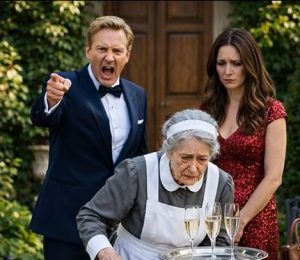
My wife—Elena—moved between guests with a silver tray balanced on her palm, her posture straight, her expression calm and distant. She wore a waiter’s uniform, simple and neat, nothing like the elegant dresses she once favored.
For a moment my mind refused the truth, insisting it was a cruel coincidence. But then she tucked a loose strand of hair behind her ear in that familiar way, and my breath left me. This was not a look-alike. This was the woman I married. The woman who had buried me.
She stopped beside a group of laughing donors and offered drinks with practiced grace. One of them snapped his fingers impatiently; she didn’t flinch. She smiled politely, poured champagne, and moved on. Each step she took felt like a step through my ribs.
I wanted to call her name. I wanted to grab her hand and prove I was real. But fear—old, disciplined fear—kept me still. I needed answers before I shattered what little stability she had built.
Then I saw my son.
He stood near the center of the room, taller than I remembered, his shoulders squared in a suit too expensive for a boy who once scraped his knees on our front steps. His hair was darker, his jaw sharper. Twelve years had turned my child into a young man.
He clapped along with the music as a toast concluded, smiling at something a donor said. He looked happy. Alive. And that nearly broke me more than Elena’s uniform.
A host announced the next segment, praising the mansion’s “generous benefactor,” a name that was not mine. Applause followed. I understood then: the house had changed hands on paper. The world believed I was dead. Elena had not been living off my fortune; she had been surviving in the shadow of it.
I watched her work. She never lingered. She never met my eyes. When a guest made a joke at her expense, she absorbed it with a quiet dignity that cut deeper than anger ever could. This woman had endured twelve years of whispers, of lowered expectations, of explaining absence to a child who deserved answers she didn’t have.
At one point, Elena paused near the balcony doors, adjusting her grip on the tray. My son approached her, lowering his voice so others wouldn’t hear. He said something that made her smile—small, tired, proud.
He clapped his hands once, playfully, as if cheering her on for getting through another long night. That single clap echoed in my chest. My son applauding his mother for serving drinks in the house I bought to protect them.
I stepped outside to breathe.
Rain misted the city below, lights blurring into ribbons. I leaned against the stone railing and counted to ten, then twenty, then failed. Twelve years of silence rose like a tide. I had vanished to keep them safe, convinced distance was mercy. I had let the world mourn me. I had let my wife become a widow while I learned to live with a different name.
Footsteps sounded behind me.
“Elena,” a voice said—mine.
She froze. The tray trembled, glasses clinking softly. Slowly, she turned. Her eyes scanned my face with professional politeness first, then with something else—confusion, curiosity, and finally a sharp, breathless recognition she tried desperately to bury.
“No,” she whispered. “That’s not funny.”
“I know,” I said, my voice rough. “I wouldn’t joke about this.”