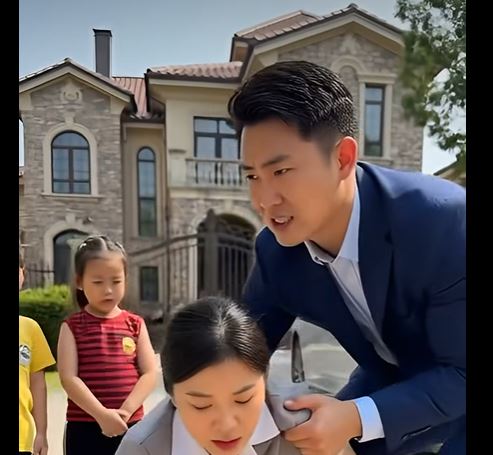
The iron gates of the Hawthorne estate had not been opened by hand in years. They glided silently on sensors, separating the immense wealth inside from the ordinary world outside.

On a cold autumn morning, as mist clung to the hedges and the marble driveway gleamed with dew, the gates opened just long enough for the cleaning crew to enter. No one expected that a single misstep there would uncover a truth buried for years.
Eleanor Hawthorne, the millionaire widow, stood at the tall window of her study, a porcelain cup of tea cooling in her hands. Since her husband’s death three years earlier, mornings were the hardest.
Silence had replaced the constant activity that once filled the mansion. She often watched people instead—gardeners, drivers, cleaners—because movement reminded her she was still alive. That morning, her gaze caught something unusual near the gate.
A man had stumbled.
He was one of the new cleaners, thin, poorly dressed, carrying a heavy bucket in one hand. His foot caught on the uneven stone just inside the gate, and he went down hard, the bucket clattering, dirty water spilling across the pristine driveway. Eleanor’s breath caught. What startled her most was not the fall, but the way no one else reacted. Cars passed. A guard looked away. The world moved on.
Without thinking, Eleanor set down her tea and hurried outside.
By the time she reached the gate, the man was struggling to sit up, his face pale with pain and embarrassment. “I’m sorry, ma’am,” he muttered the moment he saw her, trying to stand again and failing. “I’ll clean it up. Please don’t fire me.”
Eleanor knelt beside him, ignoring the cold stone beneath her knees and the shocked expressions of the staff nearby. “Stop,” she said gently. “You’re hurt. Don’t move.”
No one had spoken to him like that in a long time.
She noticed his hands—rough, scarred, trembling—not the hands of a careless man, but of someone who worked endlessly. She helped him sit properly, took off her own coat, and folded it beneath his head. A guard finally rushed forward, flustered, offering excuses. Eleanor silenced him with a glance.
“Call an ambulance,” she said firmly.
The man tried to protest again, but then two children came running through the open gate.
They couldn’t have been more than ten and twelve, breathless, eyes wide with fear. “Papa!” the younger one cried, dropping his schoolbag and kneeling beside the fallen man. The older child stood protectively in front of him, staring at Eleanor with a mix of suspicion and desperation.
“He didn’t do anything wrong,” the older child said quickly. “Please don’t punish him. He slipped because his shoes are broken.”
Eleanor felt something tighten in her chest.
She had not noticed the children before—how thin they were, how carefully their clothes were mended, how the girl’s shoes were clearly too small. She looked from the children to their father and back again. “Why are you here?” she asked softly. “This is a work site.”
The man closed his eyes. “They wait for me after school,” he admitted quietly. “I can’t afford childcare. They sit by the gate. They don’t disturb anyone.”
The younger child grabbed Eleanor’s sleeve. “He works very hard,” she said, her voice trembling. “Even when he’s sick. He says we must never beg. We must always tell the truth.”
Those words landed harder than any accusation.
The ambulance arrived, and Eleanor insisted on accompanying them to the hospital. The staff murmured in disbelief as the widow of one of the city’s wealthiest men sat beside a cleaner, holding his hand while his children clung to each other across the aisle.
During the ride, she learned his name was Daniel. He had been a schoolteacher once, before his wife died and debt swallowed his life whole.
They told Eleanor everything.
They told her how their father cleaned offices at night and estates by day. How he often skipped meals so they could eat. How he lied to them about being “not hungry” or “not tired.”
They told her how he once taught literature, how he used to read to them every night, even when his voice shook from exhaustion. They told her the real truth: that the man everyone ignored was the strongest person they knew.
Eleanor listened, tears silently slipping down her face.
When Daniel was released hours later with a fractured rib and strict instructions to rest, he looked terrified—not of pain, but of losing his job. He apologized again, over and over. Eleanor stopped him.