“Sir… my father had a watch just like yours.”
The boy’s voice was soft, almost lost beneath the quiet clatter of silverware and the low hum of conversations. Yet those simple words carried enough weight to stop Robert Mitchell cold.
His fork slipped from his hand and tapped against the porcelain plate. The sound felt louder than it should have in The Grand Oak, one of Manhattan’s most exclusive restaurants. It was the kind of place where reservations were booked weeks in advance and every table sparkled under soft, golden lights.
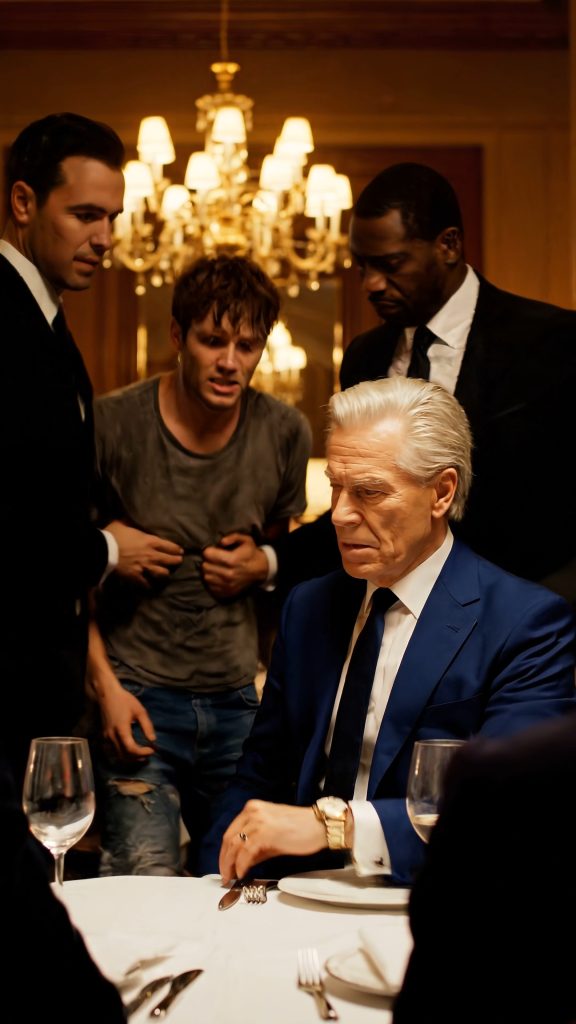
Robert remained still, his eyes fixed on the teenage boy near the entrance. Two security guards stood beside him, holding his arms to keep him from moving closer.
The boy looked no older than fifteen.
He wore worn-out jeans and a faded shirt that hung loosely from his thin frame. His hair was messy, and his shoes were missing. But his eyes were what caught Robert’s attention—deep brown, alert, and filled with a mix of fear and determination.
It was the look of someone who knew he didn’t belong there, yet had come anyway because he had no other choice.
Robert Mitchell was fifty-eight years old and known across the country as a powerful construction magnate. His company had built luxury towers, hotels, and office buildings in several major cities. His name appeared in business magazines, financial reports, and industry headlines.
He was respected, but also known as a tough, uncompromising businessman.
That afternoon, he had been meeting two partners to discuss a major contract. On his wrist was the watch he never took off—a gold timepiece with a deep blue face and custom engraving. It was expensive, rare, and deeply personal.
It was also supposed to be one of only three in existence.
Robert knew this because he had ordered all three himself more than two decades earlier, during a time in his life he rarely allowed himself to remember.
One watch rested on his wrist.
The second was locked inside a safe at his home.
And the third…
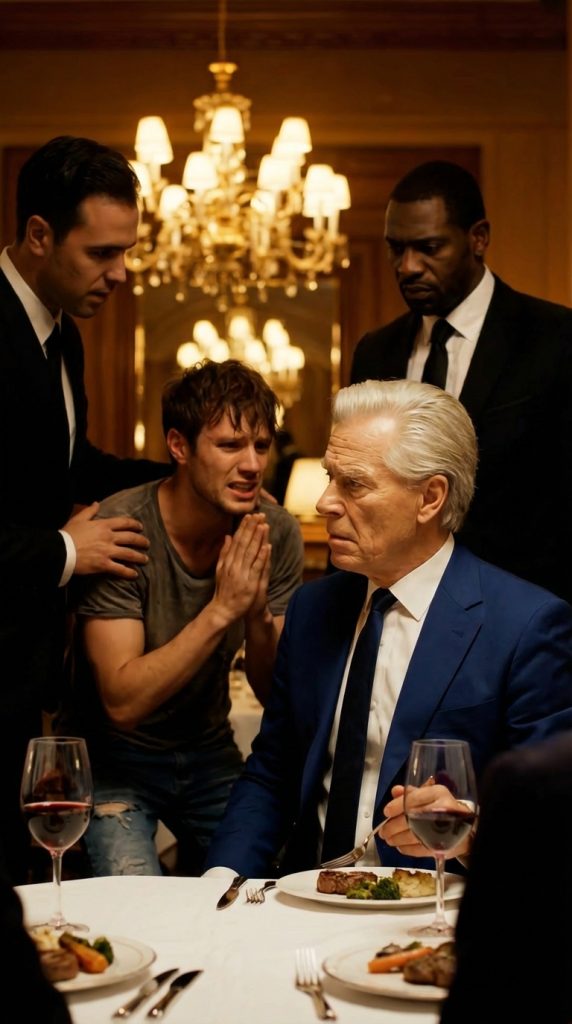
The third had disappeared the same day his son Michael walked out of his life, twenty-two years ago.
After a painful argument.
After words Robert had regretted ever since.
“What did you say?” Robert finally asked, his voice quieter than usual.
The boy tried to take a step forward, but the guards held him in place.
“I said my father had a watch just like yours,” the boy repeated. “I saw it when you walked past outside. It’s the same… even the letters on the back.”
The room grew unusually quiet.
“What letters?” Robert asked.
“RMM,” the boy answered. “Robert Mitchell for Michael. My dad showed it to me many times. He said it was the most important gift he ever got.”
Robert felt the air leave his chest.
“Let him go,” he said.
The guards released the boy immediately. Robert motioned toward the empty chair beside him.
“Come here,” he added.
The boy approached slowly. Up close, Robert noticed the small details—the worn clothes, the tired posture, and a faint scar above his eyebrow.
“What’s your name?” Robert asked.
“Daniel,” the boy replied. “Daniel Mitchell.”
The last name echoed in Robert’s mind.
“Where is your father now?” he asked gently.
Daniel lowered his eyes.
“He passed away three months ago, sir.”
Robert swallowed hard. “What happened?”
“Lung cancer,” Daniel said. “He worked construction for years. Dust, chemicals, long hours. He didn’t have insurance, so he didn’t see a doctor until it was too late.”
Robert felt a wave of emotion rise inside him. His own company had employed thousands of workers over the years.
“Sit down,” Robert said, pulling out the chair. “And let’s get you something to eat.”
Daniel quietly nodded. When the waiter asked for his order, he softly said anything simple would be fine. Robert, however, asked for a full meal.
As the boy ate, Robert listened.
He heard stories about long days carrying heavy materials, about job sites without proper safety measures, and about a modest apartment where Daniel had grown up. He heard about Daniel’s mother, Rosa, who ran a small food stand, and about a life that had little money but plenty of love.
“My dad wanted to be an architect,” Daniel said. “He used to talk about designing buildings. But he said his father wanted him to take over the business instead. They argued about it.”
Robert’s chest tightened. He knew that story too well.
“I made mistakes,” Robert said quietly.
Daniel reached into his pocket and carefully placed a cloth-wrapped object on the table.
It was the watch.
Robert removed his own and placed it beside the one in front of him.
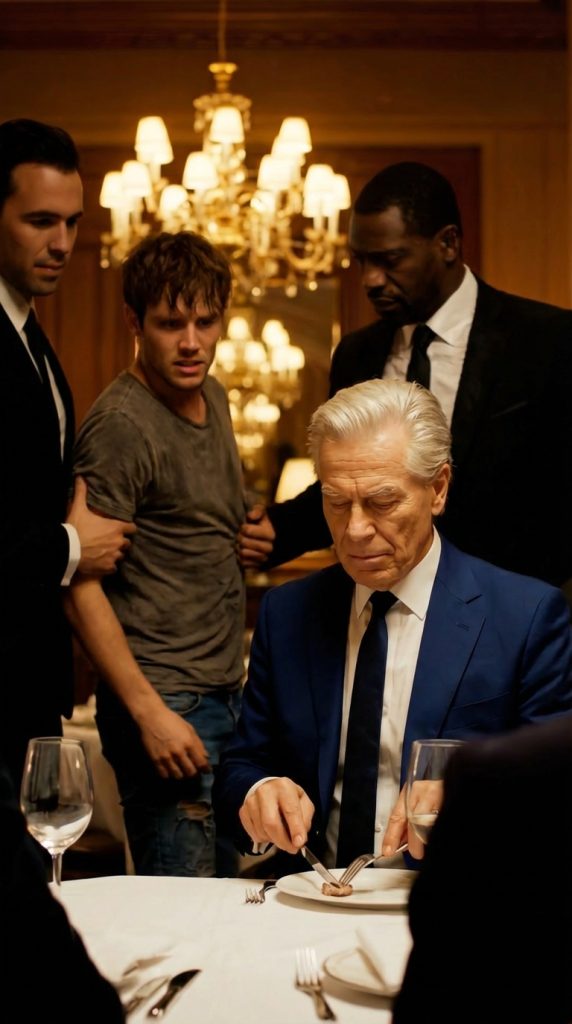
Two identical watches, side by side.
Two lives that had taken very different paths.
“You’re my grandson,” Robert said softly. “And you’re not alone anymore.”
In the weeks that followed, tests confirmed what Robert already felt in his heart. Daniel moved into Robert’s home and returned to school. Inspired by his father’s dream, he chose to study architecture and engineering.
Together, they later supported projects focused on building affordable housing—homes meant for families who needed them most.
Years later, on Daniel’s graduation day, Robert handed him the third watch.
This one carried a new engraving:
RMD — Second Chance
Robert Mitchell for Daniel
Because some legacies are not measured in money or skyscrapers.
They are built with humility, forgiveness, and the courage to make things right while there is still time.
Note: This is a fictional story created for inspirational purposes. Names, characters, and details have been adapted, and any resemblance to real individuals or events is purely coincidental.