The ocean was calm that morning, its endless blue surface stretching toward the horizon like a living, breathing mirror. The gentle rhythm of the waves against the boat created a peaceful silence — the kind that allows you to hear your own thoughts.
We were sailing across the waters of the Pacific Ocean, expecting nothing more than a quiet day surrounded by nature. The sky was clear, the air warm, and the world felt perfectly balanced.
None of us knew that within hours we would witness a moment that would stay with us forever.
It started as a small shape drifting in the distance.
At first, we thought it was debris — perhaps a floating piece of wood or a cluster of seaweed carried by the tide. But as our boat moved closer, the object shifted slightly, struggling against the water.
Then we saw it.
A sea turtle.
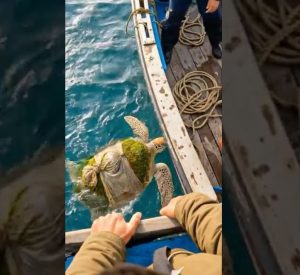
Its movements were slow and unnatural, its body trapped in something wrapped tightly around its shell and flippers. With each attempt to swim, the creature only became more entangled.
The sight immediately filled us with urgency.
We cut the engine and carefully guided the boat closer.
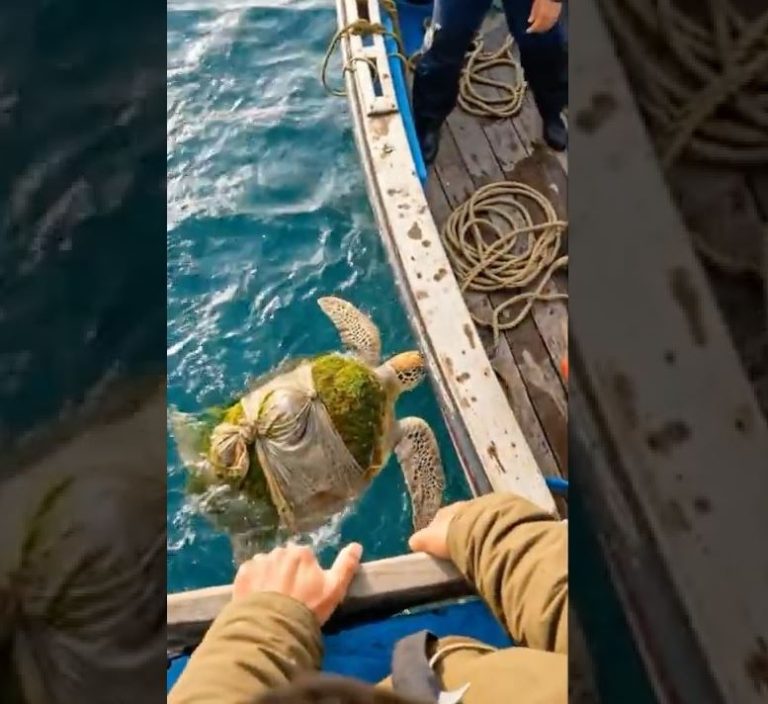
As the turtle surfaced, we could see the problem clearly — thick plastic had wrapped around its body, digging into its skin, restricting its movement, and preventing it from diving properly. The material looked like part of a torn fishing net mixed with discarded packaging.
It was a silent reminder of one of the ocean’s greatest threats.
Sea turtles, such as the Green sea turtle, often mistake floating plastic for food or become trapped in human waste drifting through the water. What appears harmless to us can be life-threatening to them, leading to exhaustion, injury, or slow starvation.
This turtle was fighting for its life.
Its large, dark eyes seemed to watch us carefully as we approached — not with fear, but with what felt like quiet desperation.
It was as if the ocean itself had placed the creature in our path.
We moved gently, speaking in calm voices, trying not to frighten it. One of us leaned over the edge of the boat and carefully secured the turtle to prevent it from drifting away.
Up close, the damage was heartbreaking.
The plastic had cut deep grooves into the turtle’s skin. Its front flipper struggled weakly against the tight bands, and parts of the net had tangled around its neck and shell. Each movement caused visible strain.
There was no time to hesitate.
We grabbed a small knife.
The first cut was the hardest.
The plastic was tough and tightly wound, hardened by saltwater and sun. We worked slowly, carefully ensuring we would not harm the turtle. Every movement required patience — one wrong motion could cause injury.
The turtle remained surprisingly still, as if sensing that we were trying to help.
Bit by bit, the plastic loosened.
One strand fell away.
Then another.
With each piece removed, the turtle’s movements became slightly stronger, its breathing steadier. The tension in its body slowly faded as the burden that had trapped it for so long was lifted.
Time seemed to stand still.
The world shrank to a simple purpose — free this creature.
Finally, the last piece of plastic was cut away.
The turtle rested briefly at the surface, floating beside the boat. For a moment, it did not move, as if gathering strength after its ordeal.
Then something remarkable happened.
With a powerful stroke of its freed flippers, the turtle dove beneath the water, circling the boat once before swimming toward the open sea. Sunlight shimmered across its shell as it disappeared into the vast blue depths.
A wave of emotion swept over us — relief, joy, and a deep sense of connection to the natural world.
It was the most satisfying feeling imaginable.
We had given a life a second chance.
As the ocean returned to its peaceful rhythm, we sat quietly, reflecting on what had just happened. The experience was more than a rescue — it was a powerful reminder of the fragile balance between human activity and marine life.
Every year, millions of tons of plastic enter the world’s oceans, threatening countless species. Animals become trapped, ecosystems are damaged, and the consequences ripple across the planet.
Yet in that single moment, we had seen how individual action can make a difference.
One small effort.
One saved life.
One powerful impact.
We began to see the ocean differently — not just as a place of beauty, but as a living system in need of protection. We became more mindful of our own actions, reducing waste, supporting conservation efforts, and sharing the story with others to raise awareness.