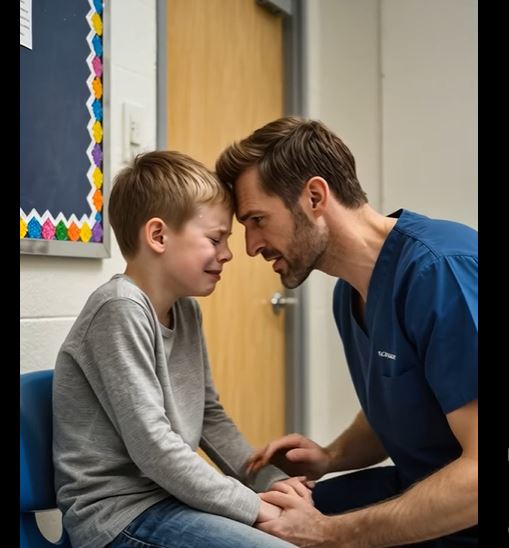
I got a call from the school nurse about my son, and something in her voice made my stomach twist. It was calm — too calm — the kind of calm that hides something serious, something heavy, something you can feel before you even understand it.
“Mrs. Carter,” she said gently, “I think it would be best if you came to the school right away.”
My heart dropped.
“Is he hurt?” I asked, already grabbing my keys, my hands trembling.
There was a pause on the other end. Just a second — but long enough to fill me with dread.
“He’s stable,” she said carefully. “But we need you here.”
Stable.
That word echoed in my mind as I rushed out of the house, barely remembering to lock the door. The drive to the school was a blur of red lights, pounding heartbeat, and terrifying thoughts I couldn’t stop. My son, Daniel, was only ten. Just that morning he had complained about a math test and asked for pancakes. Nothing had seemed wrong.
Nothing at all.
By the time I reached the school parking lot, my hands were shaking so badly I struggled to turn off the engine. I hurried inside, the familiar hallways suddenly feeling cold and unfamiliar.
The nurse’s office door was slightly open.
When I stepped in, Daniel sat on the examination bed, pale and quiet, his small shoulders slumped forward. A blanket was wrapped around him, and the nurse stood nearby, watching him closely.
The moment he saw me, his eyes filled with tears.
“Mom…”
I rushed to him, pulling him into my arms. His body felt weak against mine.
“What happened?” I whispered urgently, turning to the nurse.
She hesitated, choosing her words carefully.
“He collapsed during recess,” she explained. “He said he felt dizzy, then he fainted. His pulse was irregular for a few minutes, but it stabilized.”
The room seemed to spin.
“Collapsed?” I repeated, barely able to process the word.
The nurse nodded. “We called an ambulance as a precaution. The paramedics checked him and recommended further evaluation at the hospital.”
Daniel clung to my hand, his fingers cold.
“I’m sorry, Mom,” he whispered. “I just felt really tired.”
Tired.
Children were supposed to run endlessly, laugh loudly, live without fear. They weren’t supposed to collapse on playgrounds.
We went straight to the hospital.
The emergency room was a world of bright lights and constant motion. Machines beeped steadily, nurses moved quickly, and doctors spoke in urgent tones. Daniel was placed on a bed and connected to monitors while specialists asked endless questions.
Had he ever complained of chest pain?
Had there been dizziness before?
Any family history of heart problems?
Every question felt like a door opening to possibilities I wasn’t ready to face.
Hours passed as they ran tests — blood work, scans, heart monitoring. I sat beside him, holding his hand, pretending to be strong while fear consumed me from the inside.
Finally, a doctor entered the room.
His expression was serious, compassionate — the kind of expression that prepares you for difficult truths.
“We’ve found an abnormality in Daniel’s heart rhythm,” he explained gently. “It appears he has a congenital condition that hasn’t been detected until now.”
My breath caught.
“What does that mean?”
“It means he was born with it,” the doctor said. “In some cases, symptoms don’t appear until later in childhood.”
The words struck like thunder.
Born with it.
All these years, something had been silently hidden inside my child’s body.
“Can it be treated?” I asked, my voice barely steady.
He nodded. “Yes. But it requires careful monitoring and possibly surgery. The important thing is that we discovered it before something more serious happened.”
Before something more serious.
I understood what he wasn’t saying.
The following weeks became a whirlwind of hospital visits, specialist appointments, and sleepless nights. Our lives changed overnight. Daniel could no longer play sports freely. He needed medication, regular tests, and constant supervision.
Yet through it all, he remained brave.
Sometimes I would find him quietly drawing pictures of superheroes with hearts glowing in their chests. When I asked why, he would smile.
“Because strong hearts can be fixed,” he said.
His courage humbled me.
But there was something else — something the doctors couldn’t fully explain. Daniel’s condition had likely existed for years, yet no routine checkup had ever revealed it. No warning signs had appeared.
Until that day.
One evening, while reviewing his medical records, a cardiologist asked an unexpected question.