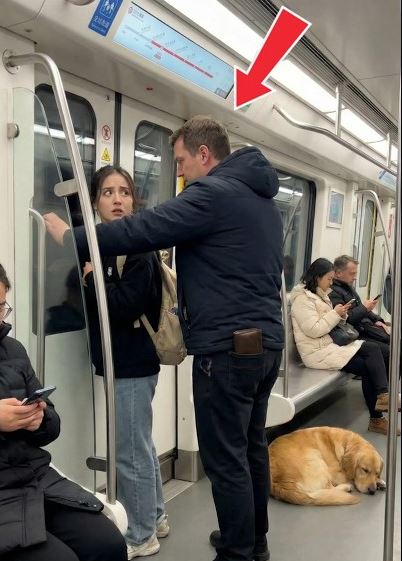
In the bustling theater of city life, we often encounter people who believe they are the lead actors and everyone else is just an extra. These individuals walk with a sense of entitlement, thinking their mood, their time, and their actions are more important than the dignity of those around them. But the world has a silent way of keeping score. This is the story of a rainy Tuesday, a street corner, and a man who learned that “walking away” doesn’t mean the story is over.

The afternoon was grey and damp. Leo, a man in his late thirties who prided himself on his “tough” persona, was in a rush. He was angry at his boss, angry at the traffic, and angry at the world. As he strode down the sidewalk, he collided with a young girl who was carrying a tray of coffee for her office.
The collision wasn’t accidental—it was avoidable. But Leo didn’t move an inch to let her pass. The coffee spilled across her coat and the pavement. Instead of apologizing, Leo’s frustration boiled over. He didn’t just shout; he reached out and shoved her aside, his hand catching her shoulder with unnecessary force.
“Watch where you’re going!” Leo barked. He didn’t look back to see if she was okay. He didn’t care that she was shivering and shaken. He turned his back and walked away coldly, his boots clicking rhythmically on the wet asphalt. He felt a twisted sense of power, a feeling that he had “won” the encounter.
But Karma was already waiting at the next intersection.
As Leo reached the corner, a large, black SUV pulled up to the curb, blocking his path. Leo, still fueled by his earlier aggression, went to shout at the driver. “Hey! Move this thing! I’m walking here!”
The window rolled down. It wasn’t a driver who stepped out. It was a man in a crisp, dark suit—a man with shoulders twice the size of Leo’s and a gaze that felt like a cold shower. Behind him, two other men stepped out. They weren’t looking for a fight; they were looking for justice.
One of the men held up a badge. “Sir, we’re with the local transit authority security. We just saw what you did back there on the camera.”
Leo’s face went from red to a ghostly white. “It… it was an accident. She ran into me.”
“The high-definition footage says otherwise,” the officer said calmly. “And the girl you just shoved? She’s the daughter of a local magistrate who happens to be a very big advocate for street safety and respect.”
But the “Karma” didn’t stop there. As Leo tried to argue his way out, his phone rang. It was his boss—the same man he had been angry with all morning.
“Leo, don’t bother coming in,” his boss’s voice was cold. “I’m standing right here at the window of the cafe. I saw how you treated that girl. If that’s how you represent yourself in public, you’re not someone I want representing my company. You’re fired.”
In the span of sixty seconds, Leo had lost his composure, his job, and his dignity. The girl he had walked away from was now being helped by passersby, while Leo stood on a rainy corner, surrounded by officers, facing a reality check he never saw coming.
This story went viral because it taps into a universal human desire for “Social Balance.” We all see small acts of cruelty every day—someone being rude to a waiter, someone cutting in line, someone being a bully. When we see a video where the bully finally hits a wall, it provides a sense of relief. It reinforces the idea that we are all accountable for how we treat others.
Psychologists note that “Instant Karma” stories serve as modern-day parables. They remind us that our character is not what we do when we are happy; it’s what we do when we are stressed, angry, or think no one is watching. Leo thought he was alone on that street, but in a world of cameras and community, no one is ever truly alone.