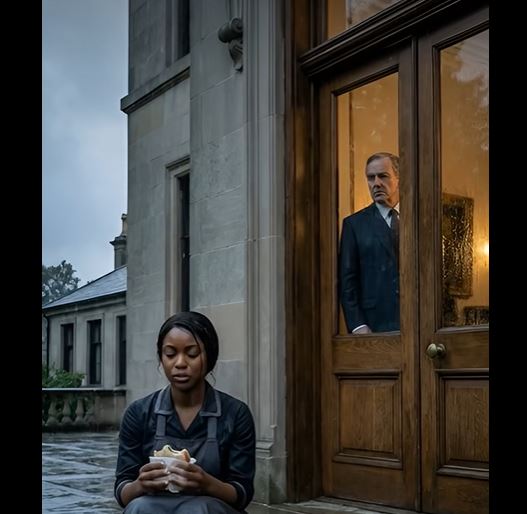
The government office was quiet in the way only bureaucratic places can be—sterile, fluorescent-lit, and drained of personality. A digital screen flickered above the counter, calling numbers that echoed hollowly through the room. People sat hunched in plastic chairs, clutching folders filled with documents meant to prove who they were.
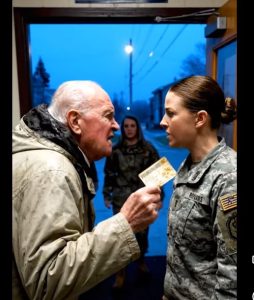
When his number was called, the old man stood slowly.
He moved with care, not weakness—each step deliberate, as if he respected the weight of time itself. His coat was worn but clean, its seams telling stories of decades of use. In his hand, he carried no folder, no envelope, no plastic sleeve full of papers. Just a small leather pouch, darkened by age and softened by years of touch.
The clerk barely looked up.
“Next. ID, please.”
A Request Without Meaning
The clerk was young, efficient, and tired. To her, this was just another face, another transaction, another name to be verified and processed. She tapped her keyboard, eyes fixed on the screen.
“I need a new identification card,” the old man said calmly.
She nodded. “Old ID? Birth certificate? Passport?”
The old man hesitated—not because he didn’t understand, but because the words carried no weight for him. He reached into his coat and slowly opened the leather pouch.
“I don’t have those anymore,” he said. “But I brought this.”
The clerk sighed quietly, already preparing to explain policy. “Sir, I need official documents. Government-issued. Something valid.”
He nodded, unoffended. “I understand.”
Then he placed the contents of the pouch gently on the counter.
Something Much Older
It wasn’t an ID card. It wasn’t a document.
It was a medal.
Bronze, heavy, scratched by time. Attached to a faded ribbon whose colors had long surrendered to the years. Alongside it lay a black-and-white photograph—creased, fragile, but still clear enough to see a young man standing in uniform, eyes sharp, posture proud.
“That’s me,” the old man said softly.
The clerk finally looked up.
She frowned, confused. “Sir… I can’t accept this.”
“I know,” he replied. “I didn’t bring it to be accepted. I brought it to be remembered.”
A Life Before Paperwork
The room seemed to slow.
The old man didn’t raise his voice. He didn’t ask for sympathy. He simply spoke, as if reciting something he had carried inside for a long time.
“I was born before this country had databases,” he said. “Before numbers followed us from cradle to grave. Back then, identity wasn’t a card. It was your word. Your work. Your service.”
The clerk shifted in her seat.
“I fought in a war that no longer fits neatly into textbooks,” he continued. “When bombs fell, no one asked for my ID. When men beside me died, no one checked their paperwork. We were known by our names, by the way we stood our ground.”
A few people in the waiting area began to listen.