The residents of Shady Oaks neighborhood woke up to a nightmare that wasn’t caused by a storm or a broken water main. The culprit was much smaller, wore fur coats, and had teeth that could cut through oak like butter.
A colony of beavers had moved into the local creek, and in just three nights, they had constructed a masterpiece of engineering: a six-foot-high dam that had turned the street into a lake.
“We tried breaking it down,” one homeowner lamented, pointing to the water lapping at his garage door. “But they’re faster than we are. We tear down a section at noon, and by sunrise, it’s twice as strong as before.”
The city council was ready to call in exterminators, but a young environmental engineer named Sarah stepped forward with a different plan. “You can’t fight a beaver with force,” she told the angry crowd. “They are biologically programmed to stop the sound of running water. If they hear a leak, they fix it. It’s an obsession.”
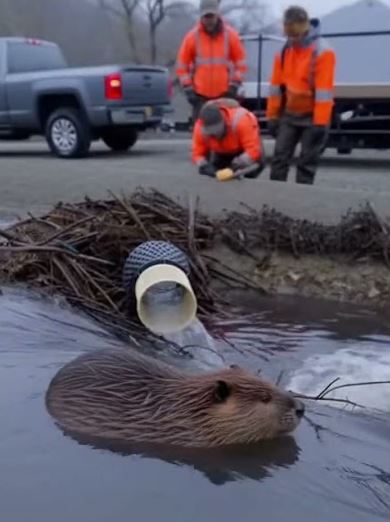
Sarah’s solution was a “Beaver Baffler”—a long, perforated PVC pipe system designed to outsmart one of nature’s greatest builders.
The next morning, Sarah and her team waded into the icy water. They didn’t destroy the dam; instead, they carefully carved a narrow notch through the center. As the water began to rush through, the sound triggered an immediate response from the woods. Three large beavers emerged, their tails slapping the water in alarm. They began frantically hauling mud and branches to plug the hole.
But Sarah was ready. She slid a twenty-foot pipe through the notch. One end of the pipe extended far out into the deep water of the pond, protected by a heavy wire cage to keep debris out. The other end pointed downstream, past the dam.
“The trick is the intake,” Sarah explained, as she secured the cage. “Because the water enters the pipe through tiny holes spread out over ten feet, there’s no suction force. There’s no ‘gurgle’ sound. To the beavers, the dam looks solid. They don’t hear the water escaping, so they don’t try to stop it.”
The beavers worked through the night, piling mud and sticks directly over Sarah’s pipe. They believed they had won. They felt the solid wall they had built and went back to their lodge, satisfied that their fortress was secure.
But underneath the mud, the “Baffler” was working silently. The water level in the pond began to drop, centimeter by centimeter. By the next afternoon, the flooded street was dry. The garage doors were safe, and the creek was flowing normally again.
The neighborhood was stunned. They had expected a violent conflict, but what they got was a silent truce. The beavers got to keep their pond and their home, which provided a vital habitat for local birds and fish, and the humans got to keep their basements dry.
“It’s about coexistence,” Sarah said, watching the beavers swim peacefully in the now-controlled pond. “We didn’t have to remove them. We just had to understand their language. Their language is the sound of water, and we just turned the volume down.”
The “Beaver Baffler” became a local legend. It was a reminder that sometimes, the best way to solve a problem isn’t with a sledgehammer, but with a simple pipe and a little bit of respect for the original engineers of the wild. The neighborhood remained dry, the beavers remained busy, and for the first time in years, the only sound at night was the peaceful rustle of the wind through the trees.