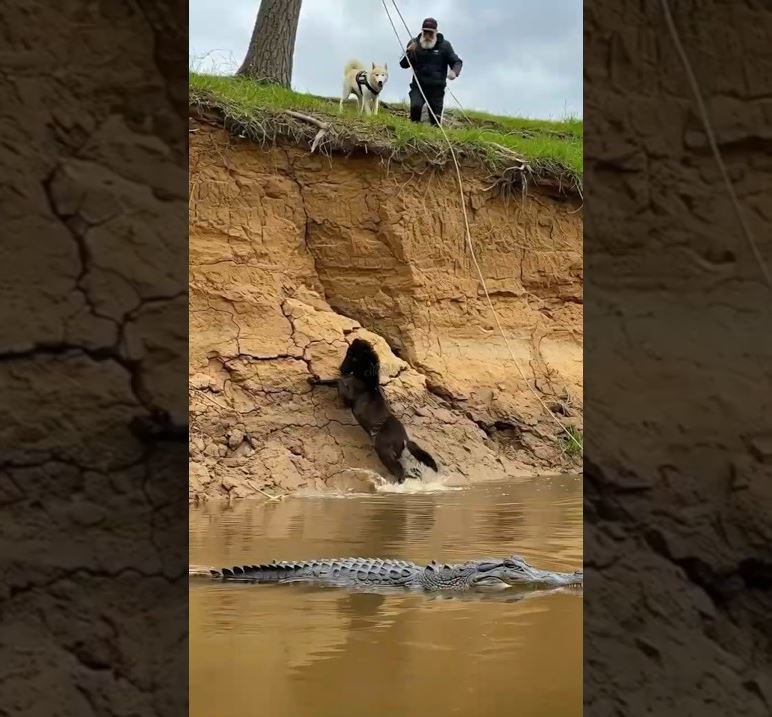
It wasn’t loud—not at first—but it was wrong. A strained, panicked whinny carried on the wind, thin and broken, the kind of sound that didn’t belong in a peaceful countryside morning. Luna, a three-year-old border collie with sharp eyes and sharper instincts, lifted her head immediately. Her ears twitched. Her body stiffened.
Something was wrong.
Luna had lived her whole life on the edge of a quiet rural town, where mornings smelled like dew and hay and the days passed slowly. She knew the rhythms of the land—the tractors starting at dawn, the birds scattering at dusk, the gentle snorts of horses from nearby fields. But this sound was different. It carried fear.
She bolted toward the fence, barking urgently.
“Easy, girl,” her owner called from the porch. “What is it?”
But Luna didn’t stop. She ran along the fence line, barking again and again, her gaze fixed on the far end of the meadow where the land dipped toward a shallow ravine. Her owner followed her eyes but saw nothing unusual. Still, Luna’s distress was impossible to ignore.
She jumped, pawed, and whined—then did something unusual.
She turned and ran toward the road.
Luna had never done that before.
Moments later, a pickup truck slowed as it approached the property. The driver, a middle-aged man named Samuel Carter, noticed the dog pacing at the roadside, barking but not aggressively—pleadingly. Luna ran a few steps down the road, then turned back, as if asking him to follow.
Samuel frowned and pulled over.
“Well, what’s got you so worked up?” he asked gently, stepping out of the truck.
Luna didn’t hesitate. She ran toward the meadow again, stopping every few yards to look back, making sure he was coming.
Something in her urgency made Samuel listen.
He followed.
As they crossed the field, the sound grew clearer. A small horse—a young foal—had slipped into the ravine during the night. Its legs were tangled awkwardly, one trapped beneath its body. Mud clung to its sides, and its breathing was shallow and frantic. Its mother stood above, pacing helplessly, snorting and stamping the ground in panic.
Samuel’s heart sank.
The foal couldn’t have been more than a few weeks old.
“Easy… easy now,” he murmured, approaching slowly so as not to startle the mare. He assessed the situation quickly. The foal was exhausted, dehydrated, and clearly injured—but still alive.
Luna stood beside him, silent now, her job done.
Samuel knew he couldn’t lift the foal alone. One wrong move could cause serious injury. He pulled out his phone and called for help—first the local veterinarian, then a neighbor with farm equipment. While waiting, he did what he could: keeping the mare calm, speaking softly, shielding the foal from the sun.
The veterinarian arrived within minutes, followed by two neighbors. Together, they worked carefully, using straps and boards to support the foal’s body. Luna watched intently, tail low, eyes alert, as if standing guard.
When they finally freed the foal and lifted it onto solid ground, the little horse trembled but stayed conscious. The vet examined its legs and smiled with relief.
“No breaks,” she said. “Bruised, exhausted—but this one’s a fighter.”
The mare nuzzled her baby, nickering softly. Samuel exhaled, only then realizing how tense his body had been.
If Luna hadn’t noticed.
If she hadn’t insisted.
If she hadn’t chosen him.
The foal would not have survived the day.
Word spread quickly through the small community. People came by to check on the little horse, now resting safely in a warm stall. Children brought carrots. Neighbors shook Samuel’s hand. But everyone looked at Luna with a kind of awe.