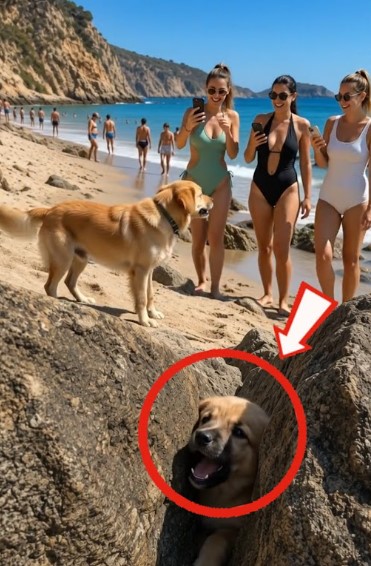
At first, the beach looked completely ordinary, with waves moving gently along the shoreline and people going about their day.
Then a beach cleaner noticed something unusual between a group of large rocks: a small puppy was unable to find its way back to the open sand.
The cleaner stopped immediately, realizing that the young dog needed a careful approach.
The puppy was positioned in a narrow space between the rocks, looking around as it tried to find a comfortable route out.
Its small size allowed it to fit into an area that was difficult for a person to reach easily. The cleaner watched for a moment before deciding how to help without frightening the puppy.
Beach environments can contain many natural obstacles, especially around rocky shorelines.
Small animals may explore these areas out of curiosity and sometimes find themselves in spaces that are difficult to leave.
For a young puppy, unfamiliar rocks, moving water, and changing tides can make even a short distance feel challenging.
The cleaner first checked the surroundings.
The goal was to make sure the puppy was away from the water’s immediate edge and that there was enough room to work safely.
Instead of reaching in quickly, the cleaner approached slowly and spoke gently to the puppy.
The little dog looked toward the cleaner but remained cautious. It appeared interested in the person while also being uncertain about what was happening.
The cleaner understood that sudden movements could make the puppy move farther between the rocks, so patience became the most useful tool.
For several moments, the cleaner searched for a practical route.
Moving the rocks was not an option, and reaching directly into the narrow space could have frightened the puppy.
The safest solution was to find a way to encourage the dog toward the opening rather than trying to pull it out forcefully.
The cleaner carefully adjusted their position and created more space around the puppy.
A calm voice helped keep the animal focused while the person slowly guided it toward the wider part of the rocky area.
The puppy watched closely, appearing to understand that the person was trying to help.
Little by little, the puppy moved forward. Its paws reached a wider section of the rocks, giving it more room to turn around.
The cleaner continued waiting rather than rushing the process, allowing the young dog to make each movement on its own.
The moment required patience because the puppy was small and the rocks were uneven.

One quick movement could have caused the dog to become nervous and retreat again. By remaining calm, the cleaner gave the puppy enough confidence to continue toward the open beach.
Eventually, the puppy reached the edge of the rocky section. The cleaner stayed nearby and allowed it to step onto the sand without being grabbed immediately.
Once the puppy was on open ground, it paused and looked around at its surroundings.
The cleaner then checked the puppy carefully from a safe and gentle distance.
There was no obvious sign that it needed anything beyond reassurance and a secure place to stay. The person also looked around the beach to determine whether the puppy’s owner might be nearby.
The experience highlights the importance of paying attention in busy outdoor environments.
A small puppy can easily become difficult to see between rocks, especially when people are focused on the water or beach activities.
Someone who regularly works along the shoreline may notice details that others overlook.
It also demonstrates why patience matters when helping young animals.
Puppies can be curious, nervous, and unpredictable when they find themselves in unfamiliar surroundings. Allowing them to move at their own pace often creates a calmer experience than trying to rush them.
The beach cleaner’s quick decision to stop was particularly important.
Continuing with the usual work would have been easy, but taking a moment to investigate the unusual sound or movement led to the discovery of the puppy.
Awareness turned an ordinary workday into a meaningful act of care.
Once the puppy was safely on the sand, the cleaner kept it away from the rocky area while looking for additional assistance.
If an owner could not be located, contacting local animal services would be an appropriate next step.
Tiny Puppy Was Found Between the Rocks on a Busy Beach pic.twitter.com/c9cOF5z18s
— Animal Rescue Stories (@AnimalStory5) August 17, 2026
What should you do if you find an animal/person in this situation?
Check the area for hazards and keep the puppy away from water or unstable rocks. If you cannot safely reach it, contact local animal services or a trained professional.
Should you try to help the animal/person yourself?
Only assist if the puppy can be reached safely without climbing unstable rocks or entering dangerous water. Never put yourself at risk; professional help is the better option when conditions are difficult.