
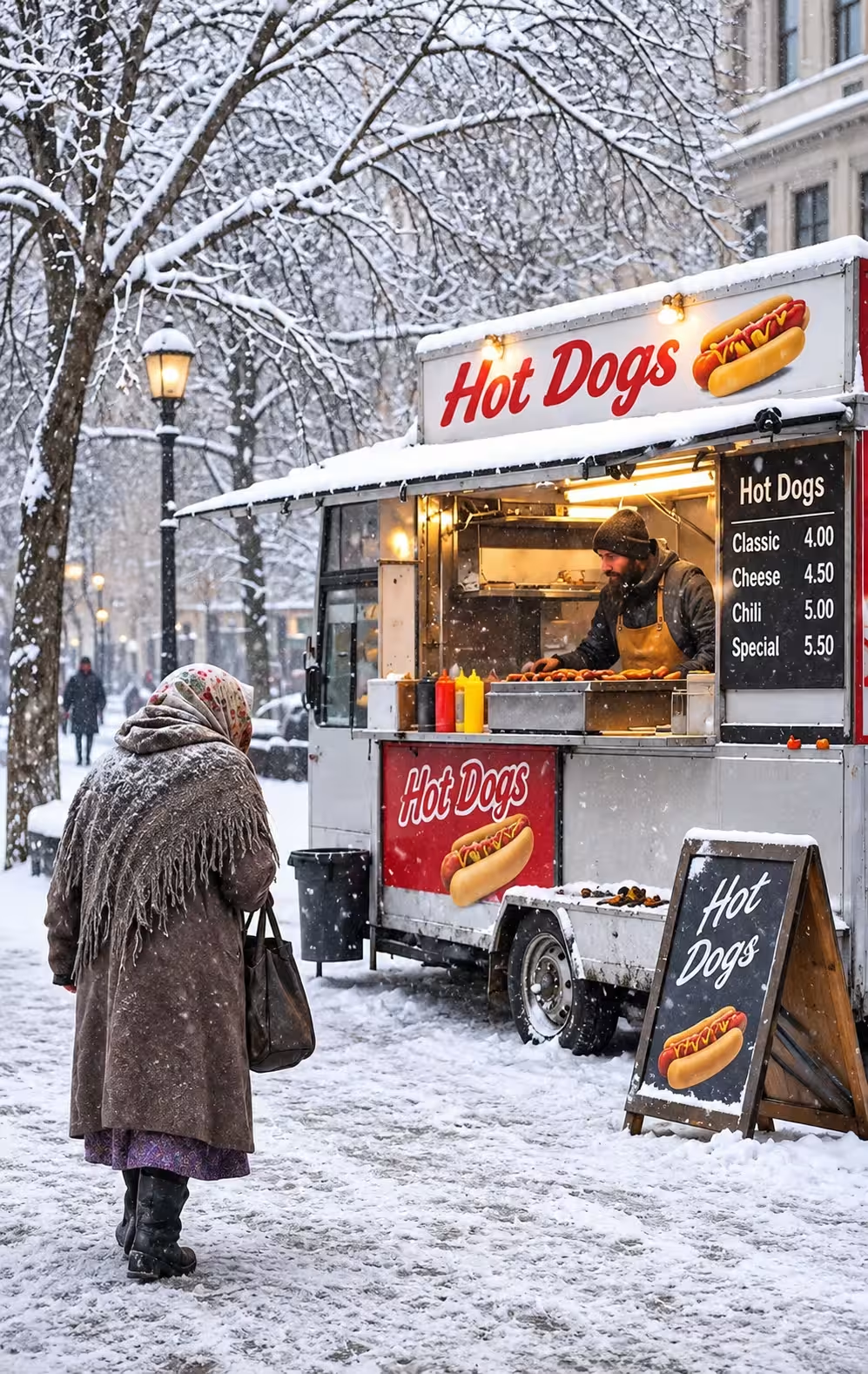
The elderly woman stopped beside the hot dog cart, brushing fresh snow from the shoulders of her worn winter coat.
Seventy-eight-year-old Margaret Wilson had been walking through the neighborhood when the smell of warm food caught her attention.
She approached the vendor and quietly asked whether he had anything inexpensive enough for her remaining change.
The vendor, Daniel Harris, looked toward the small collection of coins resting in her gloved hand.
Before he could answer, Margaret explained that she had not eaten since early morning.
Snow continued falling as she waited beside the steaming cart.
A customer approaching from the opposite sidewalk noticed their conversation.
He stopped nearby, ordered two hot dogs and warm drinks, and gently asked Margaret whether she would share lunch with him.
A Difficult Winter Morning
Margaret had lived alone in a small apartment for nearly twelve years.
After retiring from her position as a school cafeteria worker, she maintained a modest routine.
She enjoyed visiting the library, speaking with neighbors, and taking short walks when the weather permitted.
However, the winter months had become increasingly difficult.
Higher heating expenses had reduced the money available for groceries and other necessities.
Margaret carefully planned her weekly shopping, often choosing inexpensive meals that could last several days.
That morning, she had visited a neighborhood assistance office to ask about available support.
The appointment had taken longer than expected, and she missed her usual lunchtime.
By early afternoon, snow had begun covering the sidewalks.
Margaret pulled her scarf closer and started walking toward home.
Her legs felt tired, and the cold air made the journey uncomfortable.
Near the corner of Maple Street, she noticed a hot dog cart beneath a red umbrella.
Warm steam rose from the cooking surface.
Margaret stopped, considering whether she could afford something to eat.
A Small Food Cart on a Snowy Corner
Daniel had operated his food cart near the shopping district for almost six years.
He arrived each morning before the nearby offices opened.
During winter, he served hot dogs, soup, coffee, and other simple refreshments.
Regular customers appreciated his friendly manner and reasonable prices.
That afternoon, business had slowed because of the snowfall.
Daniel was preparing to cover part of his equipment when Margaret approached.
He greeted her and asked what she would like.
Margaret examined the menu displayed beside the cart.
She opened her small purse and counted the coins inside.
After a moment, she asked whether he had anything available for less than the listed price.
Daniel noticed her hesitation and asked what she preferred.
Margaret explained that she had enough money for a small portion but not a complete meal.
She appeared embarrassed by the conversation.
Daniel assured her that she was welcome to take her time.
He began preparing a hot dog, intending to offer it at no charge.
Before he could explain, another customer approached the cart.
A Customer Notices the Conversation
The new customer was forty-two-year-old Michael Turner, a local maintenance supervisor.
He had been working at a nearby office building throughout the morning.
After finishing an inspection, he decided to purchase lunch before returning to work.
As he approached the cart, he noticed Margaret standing quietly beside the menu.
Daniel greeted Michael, who had visited the cart several times before.
Michael heard Margaret mention that she did not have enough money for a full meal.
He did not interrupt or ask personal questions.
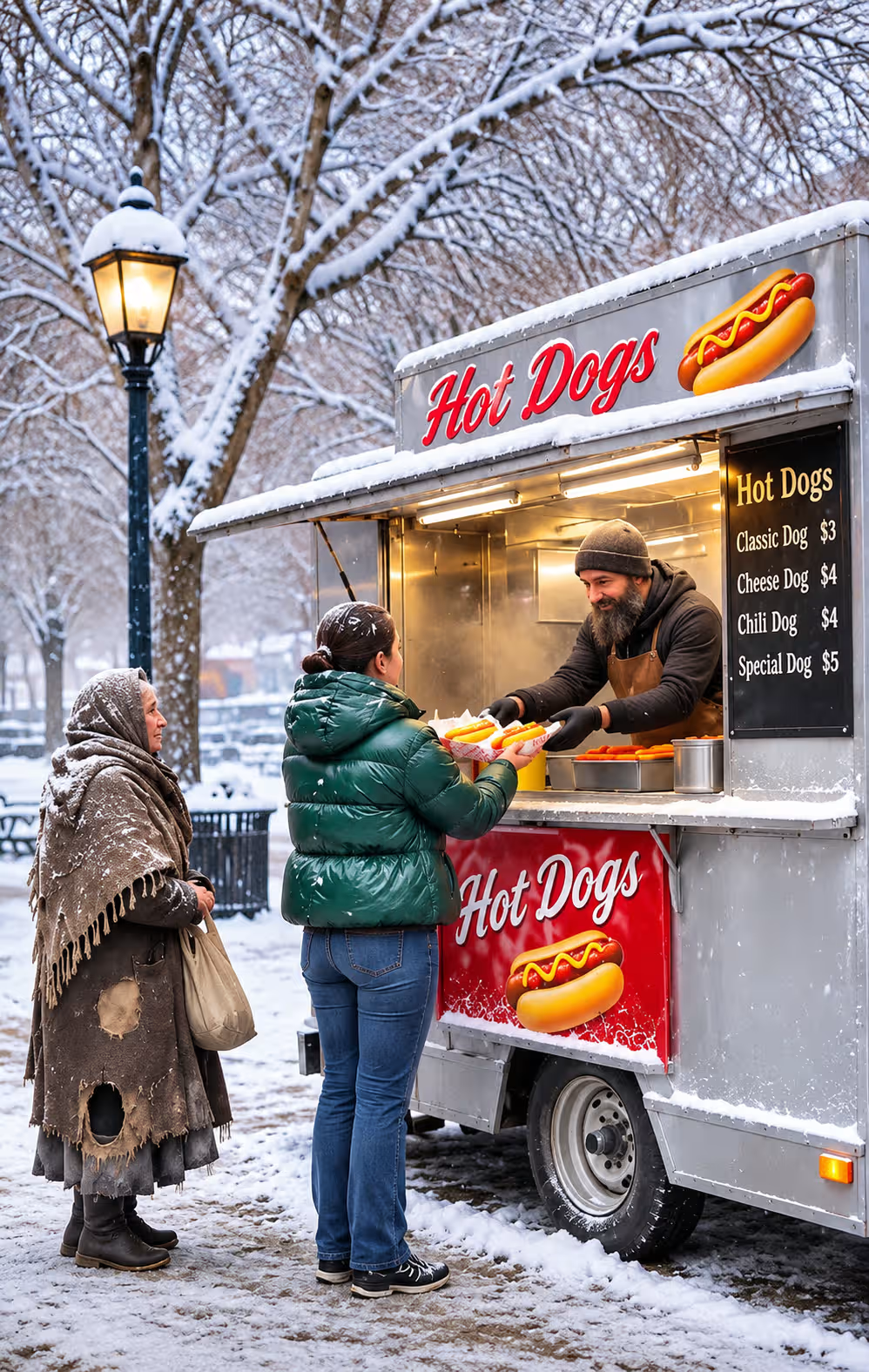
Instead, he looked at the menu and ordered two hot dogs and two warm drinks.
Daniel began preparing the order while Michael turned toward Margaret.
He introduced himself and asked whether she would like to join him for lunch.
Margaret looked surprised by the invitation.
She explained that she had only intended to purchase something small.
Michael smiled and said he would appreciate having company during his break.
Margaret hesitated briefly before accepting.
Daniel placed the food in paper trays and handed them to Michael.
Sharing a Meal Beneath the Winter Shelter
Michael carried the trays toward a covered seating area beside the nearby community building.
Margaret followed slowly, grateful to escape the falling snow.
The shelter contained a wooden bench protected from the wind.
Michael cleared a little snow from the seat before inviting her to sit.
He handed Margaret a hot dog and a cup of warm tea.
She thanked him and carefully removed her gloves.
For several minutes, they ate quietly while watching pedestrians pass along the street.
Michael asked whether Margaret lived nearby.
She explained that her apartment was only a few blocks away.
Their conversation gradually turned toward the neighborhood’s changing businesses.
Margaret remembered when the shopping district contained a small cinema and an old bakery.
Michael listened with interest as she described the streets from decades earlier.
She spoke warmly about her years working at the local elementary school.
Michael mentioned that his own children attended a nearby school.
They discovered that Margaret had once worked alongside one of his children’s teachers.
The unexpected connection made both of them smile.

A Conversation About Everyday Challenges
As they finished eating, Michael asked whether Margaret had somewhere warm to spend the afternoon.
She explained that she planned to return home after visiting the assistance office.
Michael listened without pressing her for private details.
Margaret mentioned that rising household expenses had made budgeting difficult.
She had recently applied for additional support but was waiting for an appointment.
Michael asked whether she knew about the neighborhood community center.
The center offered warm indoor seating, affordable meals, and information about local services.
Margaret had heard of the building but had never visited.
Michael explained that it was located near the public library.
He offered to show her the entrance if she wanted to stop there.
Margaret accepted, saying she would appreciate learning about the available programs.
Before leaving, they returned to Daniel’s cart.
Margaret thanked him for his kindness and patience.
Daniel gave her a small card containing the cart’s opening hours.
He explained that she could always ask about the day’s affordable meal options.
Michael thanked Daniel for preparing their lunch.
Together, they walked carefully toward the community center.
A Warm Welcome Beyond the Snowy Street
The community center stood only a short distance from the food cart.
Michael accompanied Margaret to the entrance and held the door open.
Inside, a staff member greeted them and explained the center’s services.
Margaret learned about its weekly community lunches and winter assistance programs.
The staff member also offered to help her arrange a follow-up appointment.
Michael waited while Margaret received the information she needed.
Afterward, she thanked him for taking time away from his afternoon.
Michael assured her that he had enjoyed their conversation.
He explained that sharing lunch had been a pleasant break from his workday.
Margaret smiled and said the meal had meant more than he realized.
Several days later, she returned to the center for a community lunch.
She met other residents and began attending a weekly social gathering.
In this fictional story, an elderly woman approached a hot dog vendor on a snowy street.
A customer noticed her situation and invited her to share a warm meal.
Their conversation led her toward community services and new social connections.
The encounter showed how a thoughtful gesture could offer both immediate comfort and practical assistance.
Margaret continued visiting the neighborhood, occasionally stopping to greet Daniel at his cart.
Whenever snow began falling over Maple Street, Margaret remembered the afternoon when a stranger shared his lunch with her, turning a cold and lonely day into a reminder that kindness could still be found in the simplest moments.