When a dog sees its owner who has just come back from military service, the reaction is often immediate, overwhelming, and deeply emotional, revealing a bond that words can hardly describe. Dogs do not understand deployments, calendars, or the reasons their humans disappear for long periods. They only know absence, longing, and the hope that the person they love will return. When that hope suddenly becomes reality, instinct takes over in the most powerful way.
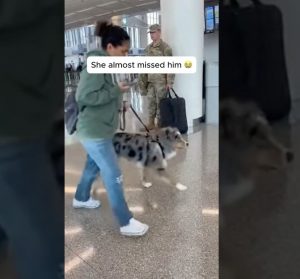
At first, many dogs freeze. Their bodies stiffen, ears lift, and their eyes lock onto the familiar figure walking toward them. It is a moment of disbelief, as if their minds are trying to confirm what their hearts already know. The scent reaches them before anything else—the unmistakable smell of their owner that no uniform, distance, or time can erase. That recognition triggers an explosion of emotion. Tails begin to wag wildly, bodies shake with excitement, and high-pitched whines or joyful barks burst out uncontrollably.
Within seconds, hesitation disappears. Dogs run full speed toward their returning owner, often sliding on floors or tripping over their own paws in their urgency. Some leap straight into their owner’s arms, wrapping paws around shoulders or pressing their heads into chests as if afraid that letting go might make the person vanish again. Others circle repeatedly, unable to decide whether to jump, lick, cry, or simply stare in disbelief. Every reaction carries the same message: you’re home, and you were missed.
Many dogs show physical signs of emotional overload. They cry, whimper, or even scream in excitement, sounds that are rarely heard in any other situation. Some collapse at their owner’s feet, overwhelmed, while others bring toys, shoes, or random objects as offerings, desperate to reconnect in the only ways they know. Their bodies stay pressed close, following every movement, refusing to be separated even for a moment.
What makes these reunions especially powerful is the contrast between the dog’s unwavering loyalty and the long uncertainty of military service. For months or years, the dog waited through routines that felt incomplete—listening for familiar footsteps that never came, sleeping by doors, windows, or bus stops, and reacting to every sound that resembled their owner’s return. The reunion validates that waiting, turning patience into joy.
For the returning service member, the dog’s reaction is often the most emotionally grounding part of coming home. Amid ceremonies, crowds, and celebrations, the dog’s response is pure and uncomplicated. There are no questions, no explanations required—just unconditional love. Many soldiers say their dog’s embrace was the moment it truly felt like they were home.
After the initial excitement, dogs often become unusually calm but clingy. They sit pressed against their owner, rest their heads on familiar knees, or sleep closer than ever before. It’s as if they are making up for lost time, reassuring themselves that the separation is truly over. This behavior can last for days or even weeks, a quiet aftershock of joy and relief.
These reunions often go viral not because they are dramatic, but because they are honest. They remind people of something deeply human: the need to belong, to be remembered, and to be welcomed without condition. Dogs don’t measure time the way people do. To them, whether it has been a week or a year doesn’t matter. What matters is that their person is back—and in that moment, nothing else in the world exists.
When a dog sees its owner return from military service, it is not just a reunion. It is proof that loyalty survives distance, that love doesn’t fade with time, and that sometimes the purest expression of joy comes on four legs, with a wagging tail and a heart that never stopped waiting.