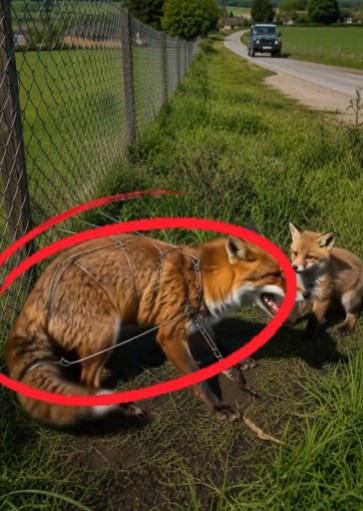
The mother fox was moving carefully through the quiet woodland when she suddenly noticed a wolf nearby.
Her attention immediately shifted toward her young, who was close to the edge of the vegetation.
The mother stopped and watched the larger animal while keeping her little one within sight.
For a few seconds, everything seemed completely still.
Then the wolf moved closer.
The mother fox quickly changed direction, staying close to her young and carefully watching the wolf’s movements.
She appeared to understand that the situation could change quickly, and her instinct was to remain between the unfamiliar animal and her little one.
The encounter took place in a natural landscape where foxes and wolves can sometimes travel through overlapping areas.
Forest edges, open fields and thick vegetation provide routes for many wild animals, and unexpected meetings can happen while animals search for food or move through their territories.
The mother fox had been traveling with her young when she noticed the wolf.
Her first response was to stop.
She looked toward the wolf and then back toward the young fox.
The youngster remained nearby, following its mother’s movements. The mother stayed alert and began moving slowly toward thicker vegetation.
The wolf continued in their direction.
The mother fox changed her position again, keeping the young animal close.
For a moment, the two adult animals remained several steps apart. Neither moved quickly. The mother fox continued watching while the young fox stayed behind her.
Then the wolf moved forward.
The mother immediately guided her young toward the cover of the surrounding vegetation.
The young fox followed.
The mother moved farther into the brush, using the natural landscape to create more distance. Her movements were careful rather than rushed, and she continued checking behind her as the young fox followed
The wolf remained in the area.
The mother fox continued deeper into the vegetation.
For several moments, the young fox was difficult to see among the grass and branches. The mother stayed nearby, using the thick cover to make movement more difficult to follow.
The wolf eventually changed direction.
The mother fox remained still until there was more distance.
Then she continued through the woodland.
The young fox followed close behind.
The encounter highlighted the importance of natural cover for smaller animals. Thick vegetation, fallen branches and uneven terrain can provide valuable places for foxes and their young to move through when larger animals are nearby.
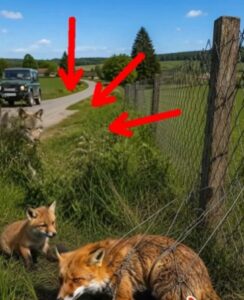
For a young fox, staying close to its mother is an important part of learning how to navigate the environment.
Fox kits gradually learn where to travel, how to search for food and how to respond to unfamiliar animals. Their mothers provide guidance throughout this early period.
The mother fox in this encounter demonstrated that awareness.
She noticed the wolf early.
She kept her young within sight.
And she used the surrounding environment to create distance.
The wolf eventually continued along another route.
Once the larger animal had moved away, the mother fox remained with her young for some time before continuing through the woodland.
The youngster stayed close.
The pair eventually disappeared into the thicker vegetation.
The landscape became quiet again.
Wildlife encounters like this can appear dramatic when seen from a distance, but animals are constantly responding to changes in their environment.
Their behavior is shaped by instinct, territory, food availability and the need to care for young animals.
Wolves are highly social predators that can travel through large territories, while foxes generally occupy smaller areas and rely heavily on their agility and ability to use cover.
When their paths cross, both species may respond according to the circumstances of the encounter.
People should never attempt to interfere with such interactions.
Approaching a wolf or fox with young nearby can create unnecessary risks. Even a seemingly calm wild animal can react quickly when it feels that its space or young are being approached.
The safest way to observe wildlife is from a considerable distance.
If an animal genuinely needs assistance, trained wildlife professionals should be contacted rather than attempting to intervene directly.
In this case, the mother fox and her young were able to move through the woodland naturally.
Wolf Encounters a Fox and Comes Close to Her Baby pic.twitter.com/TGx249wS2J
— Animal Rescue Stories (@AnimalStory5) August 12, 2026
What should you do if you find an animal/person in this situation?
Keep a safe distance and never approach wolves, foxes or their young. If you believe a wild animal genuinely needs assistance, contact a qualified wildlife professional for guidance.
Should you try to help the animal/person yourself?
No. Do not attempt to separate or physically handle wild animals. Observe from a safe location and allow trained wildlife professionals to determine whether intervention is necessary.