The mother bird never stopped trying.
Her bright yellow feathers fluttered desperately as she struggled against a narrow gap in an old wire fence. Every attempt to pull free only left her wings more tangled, while soft chirping echoed from a nearby nest hidden among the bushes.
Her chicks were waiting.
But she couldn’t reach them.
The tiny cries grew louder with every passing minute.
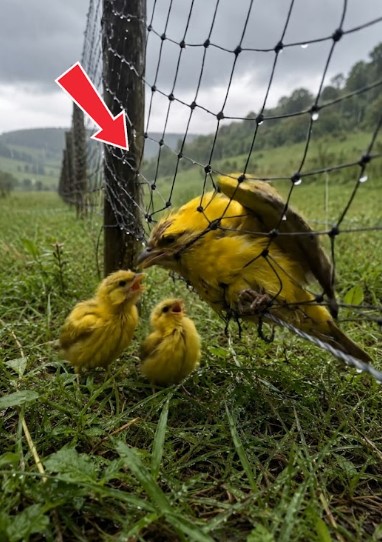
Most people walking along the quiet country path never noticed the frightened bird trapped beside the fence.
Then one woman heard the unusual chorus of chirping.
She stopped.
Looking around, she followed the sound until she spotted the small yellow bird caught between two strands of wire.
The mother bird flapped weakly, exhausted after struggling for so long.
Only a few metres away, three hungry chicks stretched their tiny necks from the nest, calling for the parent that couldn’t return.
The woman immediately realised the bird needed help.
Knowing sudden movements could frighten the bird even more, she approached slowly and spoke in a gentle voice.
The little bird remained surprisingly calm.
Almost as if it sensed someone had come to help.
The woman contacted a local wildlife rescue volunteer for advice before carefully examining the fence.
Following the instructions she received, she gently held the loose section of wire apart while making sure not to touch the bird’s delicate wings.
The opening widened just enough.
For a brief moment, the mother bird remained still.
Then, with one quick flutter, she slipped free.
Instead of flying away, she landed on a nearby branch.
She rested for only a few seconds.
Then she flew straight toward the nest.
The hungry chicks immediately greeted her with excited chirps.
Watching the family reunite brought a smile to everyone nearby.
The wildlife volunteer soon arrived and checked the area to ensure the bird had not suffered any injuries.
Fortunately, the mother bird appeared healthy.
She had simply been exhausted after becoming trapped for several hours.
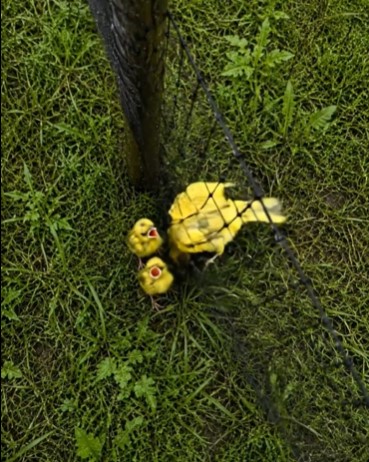
The volunteer also inspected the damaged fence and found several sharp sections of loose wire that could endanger other birds and small animals.
With permission from the property owner, the hazardous wire was repaired that same afternoon.
Simple maintenance, the volunteer explained, can prevent many wildlife accidents before they happen.
The woman stayed for a while, quietly watching from a distance.
The mother bird continued caring for her chicks as though nothing had happened.
She made several trips between nearby trees and the nest, returning each time with food for her growing family.
The chicks quickly settled down, safe once again beneath their mother’s care.
The rescue became a reminder that even the smallest animals can face unexpected dangers created by damaged fences and discarded materials.
Taking a moment to notice something unusual can sometimes save a life.
Before leaving, the woman collected a few pieces of litter scattered along the walking path and made sure nothing else nearby posed a risk to wildlife.
Sometimes preventing the next emergency is just as meaningful as responding to the first.
As evening settled over the countryside, birdsong filled the air once again.
The damaged fence had been repaired.
The nest remained peaceful.
High among the branches, the mother yellow bird tucked her chicks safely beneath her wings as the sun slowly disappeared beyond the trees.
One ordinary walk had become an unforgettable act of compassion.
The woman never expected recognition.
She simply chose to stop.
And because she did, a tiny family was together again where it belonged.
Woman Helps Mother Yellow Bird Stuck in a Fence Beside Her Chicks pic.twitter.com/s00DkfIbTR
— Animal Rescue Stories (@AnimalStory5) July 25, 2026
What should you do if you find a bird trapped in a fence?
If you find a bird caught in a fence, approach slowly and avoid sudden movements. If it can be freed safely without causing injury, do so gently. If the bird appears injured or remains trapped, contact a local wildlife rescue organisation for assistance.
Can you rescue a wild bird yourself?
Yes, if the situation is safe and the bird can be released without causing further harm. Handle the bird as little as possible, and if it shows signs of injury or cannot fly after being freed, seek help from a wildlife rehabilitator or veterinarian.