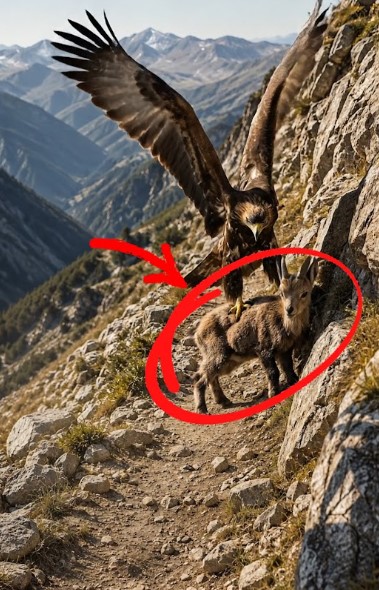
One small movement on the mountain was enough to change the entire scene.
A young ibex was making its way across a steep rocky cliff when an eagle appeared overhead, creating an unexpected encounter high above the ground.
With little flat space available, every step became important as the two animals reacted to one another.
The ibex remained close to the rocky surface, carefully navigating the uneven terrain.
Its young age made the scene especially interesting because mountain slopes require remarkable balance and awareness.
Above it, the eagle continued circling and watching the area from the open sky.
Mountain cliffs are challenging environments even for animals that are naturally adapted to them.
Ibex have specialized hooves that help them maintain balance on steep surfaces, allowing them to travel across terrain that would be difficult for many other species.
Eagles, meanwhile, are highly adapted to life in the air, using their excellent vision and powerful wings to observe large areas from above.
The young ibex continued moving along the cliff while the eagle remained nearby.
The bird’s presence changed the atmosphere, and the ibex became more attentive to what was happening overhead.
Rather than moving randomly, it appeared to focus on maintaining a stable position on the rock.
The eagle gradually moved closer to the cliff. Its wings carried it smoothly through the air, while the ibex adjusted its position below.
The narrow ledges gave the young animal limited room to change direction, making its natural balance particularly important.
For anyone witnessing the scene, the safest choice would be to remain far away.
Mountain wildlife should never be approached, especially when animals are near steep drops. Even a small disturbance could cause an animal to move unexpectedly on unstable terrain.
The ibex paused briefly as the eagle passed overhead. Its body remained close to the rock, and it appeared to be assessing the changing position of the bird.
The eagle continued observing, demonstrating the natural awareness that predators rely on when moving through mountainous habitats.
As the encounter continued, the ibex shifted toward another section of the cliff. Its movements were careful and deliberate.
Each hoof found a small area of rock before the animal transferred its weight and continued.
The eagle remained part of the scene, moving through the air above the mountain.
The contrast between the two animals was striking: one depended on powerful wings and open space, while the other relied on extraordinary balance and sure footing.
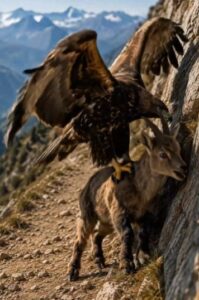
The young ibex eventually reached a more secure section of rock.
The change in position gave it additional room and allowed it to continue moving across the mountain. The eagle adjusted its flight path, creating more distance between itself and the ibex.
The encounter highlights the fascinating ways different animals survive in difficult environments.
Ibex are built for steep mountains, where their balance and agility help them travel across narrow rocky surfaces.
Eagles use a completely different set of abilities, relying on flight, vision, and precise movement.
Moments like this also remind us that wildlife encounters are rarely predictable.
An eagle may appear suddenly above a mountain slope, while a young ibex may find itself navigating terrain where there are few easy routes.
Each animal responds according to instincts developed over generations.
The rocky environment played a major role throughout the encounter.
The cliff provided the ibex with natural surfaces where it could maintain its footing, but it also limited the animal’s choices. Moving too quickly or losing balance could have created unnecessary risks.
The eagle, in contrast, had the freedom of the open air.
It could circle, change direction, and observe the cliff from different angles. This difference in movement made the interaction particularly fascinating to watch.
The ibex continued along the mountain after reaching the more secure area.
It appeared to settle into its surroundings, using its natural abilities to navigate the rocks. The eagle gradually moved farther away, and the immediate interaction became less intense.
Responsible wildlife observation is especially important in mountainous regions.
People should never attempt to approach an ibex on a cliff or move closer to an eagle for a better view.
Binoculars, designated viewing areas, and professional guides allow people to appreciate these moments without disturbing the animals.
The encounter also demonstrates why young wildlife should be given plenty of space.
Young Ibex Encounters an Eagle on a Mountain Cliff pic.twitter.com/4AVee3u9k0
— Animal Rescue Stories (@AnimalStory5) August 16, 2026
What should you do if you find an animal/person in this situation?
Keep a wide distance from wildlife on mountain cliffs and never approach the edge for a closer view. Allow the animals to move naturally without disturbance.
Should you try to help the animal/person yourself?
No. Avoid intervening in natural wildlife encounters, especially on steep terrain. If an animal appears genuinely unable to move safely, contact trained wildlife professionals rather than approaching it yourself.