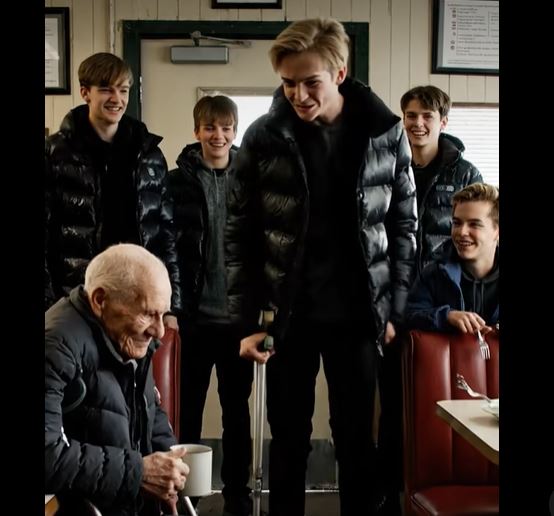
The diner sat on the edge of the highway like it had for decades, a place where truckers stopped for coffee, locals gathered for gossip, and strangers crossed paths without ever learning each other’s names. The neon sign flickered slightly, and inside, the air smelled of fried eggs, grease, and strong black coffee. It was early afternoon, and the place was half full—just noisy enough to feel alive, just quiet enough for voices to carry.
At a small table near the window sat an older man in a wheelchair. His jacket was worn but clean, his posture straight despite the obvious strain it caused him. One of his legs ended below the knee, replaced by a prosthetic that had seen better days. His hands shook slightly as he lifted his coffee cup, not from fear, but from nerve damage that never healed after the war. His name was Thomas Hale, a disabled war veteran who had learned long ago to exist quietly in a world that preferred not to look at him too closely.
At first, no one paid much attention. That was usually how it went. But then a group of younger men entered the diner—loud, confident, and already laughing before they even sat down. They wore expensive jackets and the careless expressions of people who had never been told “no” in their lives. One of them noticed Thomas almost immediately.
Thomas stiffened. He kept his eyes on the table, pretending he hadn’t heard. He had heard worse before. In airports. In parking lots. On buses. People who didn’t know what it meant to lose pieces of yourself for a country that barely remembered your name.
One of the men leaned back in his chair. “I bet he tells everyone he’s a hero,” he said with a smirk. “Probably tripped getting out of bed.”
The laughter erupted again. A few other diners shifted uncomfortably, but no one spoke up. Silence, as Thomas knew well, was easier than confrontation. He took another sip of coffee, his jaw tight, his eyes distant.
A quiet man stepped inside, dressed simply in a dark jacket and worn boots. At his side walked a large dog—calm, alert, and disciplined. The dog’s fur was a mix of black and gray, his movements controlled, purposeful. This was not a pet that barked at shadows or pulled on a leash. This was a working dog.
The man didn’t say anything at first. He scanned the room, ordered coffee, and took a seat near the back. But the dog didn’t lie down. He sat upright, ears forward, eyes locked on the group of laughing men.
“Look at him,” one of them said, pointing openly now. “Can’t even stand up for himself.”
That was when the dog let out a low, controlled growl—not loud, not aggressive, but unmistakable. The sound cut through the diner like a blade. Conversations stopped. Forks paused mid-air.
“That’s enough,” he said. His voice wasn’t raised, but it carried weight. The kind of weight that comes from experience, not anger.
The group turned toward him, surprised. One of them scoffed. “What’s your problem?”
The man took a step forward, the dog moving perfectly in sync beside him. “My problem,” he said calmly, “is watching grown men laugh at someone who gave more than they ever will.”
The quiet man looked at Thomas then, really looked at him—the prosthetic, the tremor in his hands, the eyes of someone who had seen things no joke could ever touch.
The quiet man paused. “Someone who served,” he said simply. “Someone who came home with scars you can’t see. And this dog?” He rested a hand on the animal’s head. “He pulled three men out of an ambush under fire.”
The dog took a step forward—not threatening, just present. His eyes never left the group. The men shifted uneasily. Confidence drained from their faces as reality replaced arrogance.
“You think that wheelchair makes him weak?” the man continued. “That leg he lost saved the man next to him. That shaking hand carried wounded soldiers when medics couldn’t reach them.”
Thomas looked up for the first time. His eyes met the quiet man’s, and something unspoken passed between them—recognition, respect, understanding.
They didn’t argue. Chairs scraped awkwardly as they backed away, suddenly eager to disappear. When the door closed behind them, the tension seemed to drain from the room all at once.
Around them, other diners began to smile, some offering nods of respect, others quietly paying for Thomas’s meal. The atmosphere had changed—not just for him, but for everyone who had witnessed what courage actually looked like.