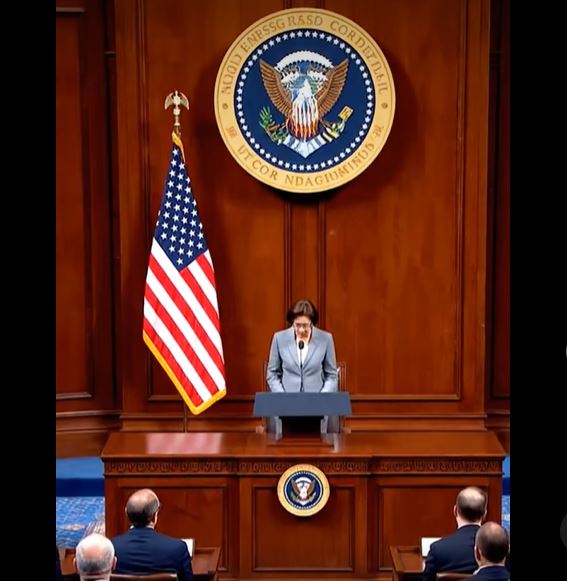
The courtroom in Norfolk was already buzzing before the judge even entered. Wooden benches creaked as people shifted in their seats, whispers traveling from one row to the next like quiet sparks. Lawyers organized files, the clerk reviewed paperwork, and at the center of it all sat a woman no one seemed to take seriously. She wore a simple navy jacket, her hair neatly tied back, her hands folded calmly on the table in front of her. To most people in that room, she didn’t look like she belonged there.
Her name was Eleanor Brooks.
The opposing counsel glanced at her with barely concealed disdain. A few spectators leaned toward each other, murmuring words like “fake,” “unqualified,” and “this won’t take long.” Even some of the jurors exchanged skeptical looks. Eleanor noticed it all, but her face remained steady. She had learned long ago that judgment often arrived before understanding—and that silence could be a powerful ally.
The case itself was serious. A powerful development company stood accused of falsifying documents and forcing elderly homeowners out of their properties under deceptive contracts. Millions of dollars were involved. Reputations were on the line. And Eleanor Brooks, according to the rumors spreading through the courtroom, was nothing more than a fraud who had somehow slipped into a case far beyond her abilities.
No one knew her story.
Years earlier, Eleanor had been a legal assistant, not a lawyer. She had spent decades behind the scenes, organizing evidence, proofreading filings, and watching trials unfold from the shadows. She learned the law the hard way—through long nights, handwritten notes, and quiet observation. When her husband died suddenly, leaving her with debt and a teenage daughter, she went back to school in her forties. Law school classmates underestimated her. Professors questioned her stamina. But Eleanor persisted, fueled by something deeper than ambition: a belief that justice should not belong only to the powerful.
When the judge finally entered, the room fell silent. The case was called, and the lead attorney for the development company stood first. He was polished, confident, and well-known. His opening statement was smooth, filled with legal jargon and rehearsed certainty. He painted his clients as innovators unfairly targeted by “misinterpretation” and “emotional exaggeration.”
She stood slowly, adjusted her jacket, and walked to the center of the courtroom. The silence was thick, almost uncomfortable. Some spectators leaned forward, expecting her to stumble, to confirm their assumptions.
Eleanor began quietly, her voice calm but clear. She didn’t rush. She didn’t posture. Instead, she told a story. She spoke about an elderly couple who had lived in their home for forty-three years, who trusted the paperwork placed in front of them because it came with promises and polished smiles. She described the confusion, the fine print, the signatures obtained under pressure.
She projected documents onto the screen—emails, internal memos, altered contracts. One by one, she laid out evidence that contradicted every claim the opposing counsel had just made. Her voice never rose, but her words carried weight. Each sentence was precise, deliberate, impossible to dismiss.
When cross-examination began, the development company’s senior executive took the stand. He smiled confidently at first, answering questions with rehearsed ease. Eleanor approached slowly, her notes neatly arranged.
“Mr. Caldwell,” she asked, “can you confirm this email was sent from your corporate account on March 14th?”
“Yes,” he replied.
“And can you explain why this version of the contract differs from the one provided to the homeowners—specifically in the section regarding relocation compensation?”
“Earlier,” Eleanor repeated calmly. “Yet this ‘earlier draft’ was signed after the homeowners were told the terms were final. Can you explain that?”
The room felt tighter now, as if the walls themselves were listening.
One by one, Eleanor dismantled the narrative the defense had built. She exposed timelines that didn’t match, signatures that were rushed, and testimonies that contradicted internal records. She never mocked. Never accused without proof. She simply let the truth speak.
By the time closing arguments arrived, the perception of Eleanor Brooks had shifted completely.
“This case is not about intelligence or power,” she said. “It’s about trust. And what happens when those with resources assume no one will look closely enough to hold them accountable.”
Gasps filled the courtroom. Some spectators applauded before being quickly silenced. The elderly homeowners wept quietly, holding each other’s hands. The defense attorneys avoided eye contact as they packed their files.
Eleanor sat still, eyes closed for a moment, breathing deeply.
than a verdict had been decided—that experience matters, that quiet determination carries power, and that justice doesn’t always arrive with noise.