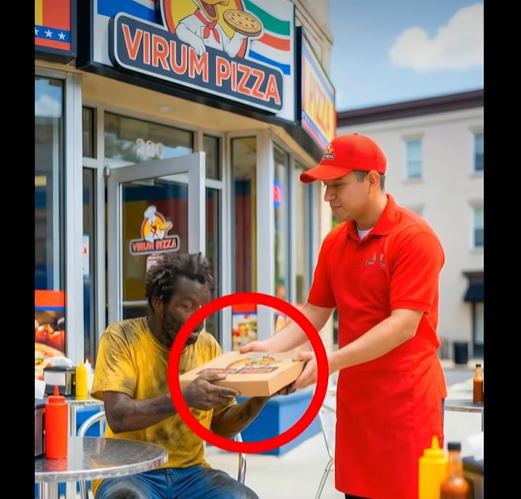
The restaurant was busiest at noon, when hunger made people impatient and small mistakes feel bigger than they really were. Orders piled up on the counter, plates clattered in the kitchen, and the smell of melted cheese and baked dough hung thick in the air. It was the kind of place that prided itself on speed and image—clean tables, smiling staff, and customers who paid without asking questions.
Near the door, a man stood quietly.
He looked tired. His jacket was thin, his shoes worn down at the heels, and his hands were rough, the hands of someone who worked outdoors or wherever work could be found. He didn’t interrupt anyone. He waited his turn, eyes scanning the menu like he was doing math in his head.
When he finally reached the counter, his voice was calm but hesitant.
“Excuse me,” he said to the waiter. “How much is a slice of cheese pizza?”
The waiter, a young man named Elias, answered without hesitation. “Three fifty.”
The man nodded slowly. He reached into his pocket and pulled out a few coins and a crumpled bill. He counted carefully, then looked up with a faint, apologetic smile.
“I’m a little short,” he said. “I haven’t eaten since yesterday. Would it be possible to get just half a slice?”
Elias felt something tighten in his chest.
He glanced at the register, then at the man’s hands, then toward the dining area where customers laughed and scrolled on their phones, barely noticing the world around them.
“Wait here,” Elias said quietly.
Before the man could respond, Elias rang up a slice of pizza and paid for it himself. He placed the hot slice on a plate, added a cup of water, and slid it across the counter.
“Please,” Elias said. “Eat.”
The man stared at the plate as if it might disappear. “I didn’t ask you to do that,” he said softly.
“I know,” Elias replied. “But you needed it.”
The man’s eyes filled with tears he tried hard not to show. “Thank you,” he whispered.
That should have been the end of it.
It wasn’t.
“Elias.”
The manager’s voice cut through the noise like a blade.
He was standing a few steps away, arms crossed, face tight with irritation. He had seen the exchange.
“What do you think you’re doing?” the manager demanded.
“I bought him a slice,” Elias answered honestly. “He was hungry.”
The manager laughed, loud enough for nearby tables to hear. “With whose permission?”
“With mine,” Elias said. “I paid for it.”
“That’s not the point,” the manager snapped. “This is a business, not a charity kitchen. People like him scare customers away.”
The hungry man lowered his head, his shoulders curling inward.
“I’m sorry,” he murmured. “I can leave.”
Elias stepped slightly in front of him without realizing it. “He’s not bothering anyone,” he said. “He’s just eating.”
The manager’s face reddened. “You don’t decide who belongs here. I do. And if you want to keep your job, you won’t do this again.”
The room grew uncomfortable. Forks paused midair. Conversations dulled.
The man with the pizza stood slowly. “Please don’t argue because of me,” he said. “I appreciate the food. Truly.”
He turned to Elias. “You’re a good man.”
Then he looked at the manager.
“May I ask you something?” the man said calmly.
The manager scoffed. “This should be good.”
“What do you value more,” the man asked, “appearance or character?”
The manager rolled his eyes. “I value profit.”
The man nodded thoughtfully. He reached into his jacket, not for money, but for a wallet. From it, he removed a card and placed it gently on the counter.
“Then you should know,” he said, “that you’re speaking to the person who owns this restaurant.”
“That,” the owner said, “is leadership.”
He looked back at the manager. “You embarrassed an employee for showing kindness and humiliated a customer for being poor. Effective immediately, you are no longer managing this restaurant.”
A hush fell over the room.
The owner then faced Elias again. “I’d like you to take over as acting manager. Starting today.”
Elias’s eyes widened. “Me?”
“Yes,” the owner said. “Because skills can be taught. Character cannot.”
The hungry man sat back down, finishing his slice with shaking hands. When he stood to leave, the owner stopped him and pressed a voucher into his palm.
“Come back anytime,” he said. “You’ll always be welcome here.”
The man nodded, overwhelmed. “I will. Thank you.”
As the door closed behind him, the restaurant slowly returned to life—but something had shifted. People looked at Elias differently. Softer. With respect.