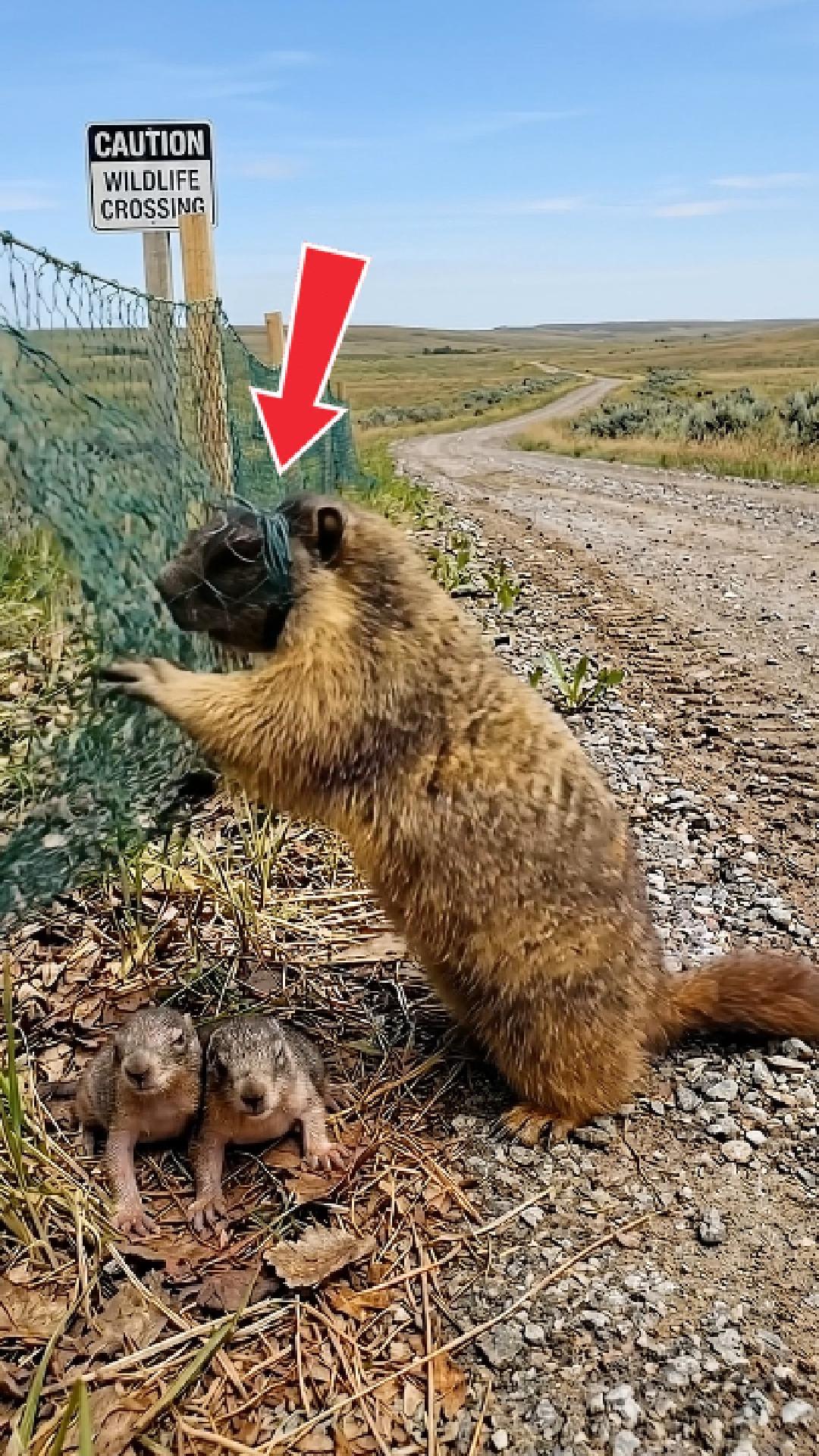
The mountain air was cool and thin, carrying the sharp scent of stone, grass, and distant pine. High above the valley, where rocky slopes rolled into uneven ridges, the landscape was quiet except for the whistle of wind slipping through cracks in the cliffs.
It was a place where animals lived carefully, always alert, always moving with purpose.
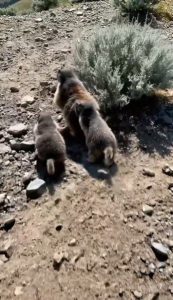
Among the scattered boulders near an old wooden fence, a wild marmot was foraging.
It moved in short, quick bursts, stopping often to sniff the ground and nibble at patches of alpine grass. Marmots are naturally cautious animals, and this one was no different. Every few seconds it lifted its head, scanning the surroundings for predators or sudden movement.
The fence nearby was old and partially collapsed, likely left behind from years of grazing livestock in the mountains. Some of its wooden posts had fallen, and sections of wire had become twisted and half-buried in grass and soil.
As the marmot explored near the base of the fence, it slipped between two loose posts.
At first, it seemed like a harmless gap.
But as it tried to pass through, its body brushed against a hidden loop of rusted wire tangled in the grass. In an instant, the wire tightened around its midsection and hind leg.
The marmot froze.
Then it pulled back sharply.
The wire did not release.
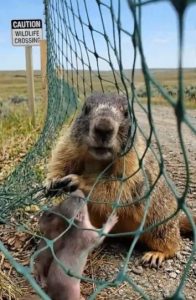
Instead, it held firm, dragging slightly against the wooden post as the animal struggled. The more it twisted and kicked, the more tangled it became. What had seemed like a simple opening in the fence was now a trap.
The marmot let out sharp alarm calls.
It tried to bite at the wire, but its small teeth could do nothing against the rusted metal. It attempted to push forward, then backward, but every movement only tightened the loop further.
Within moments, panic set in.
The marmot began darting in short, frantic movements, but the fence restricted its range completely. It was now stuck at an awkward angle, half in the grass, half against the wooden structure, unable to free itself.
The alarm calls echoed across the rocky slope.
Far above the valley trail, a hiker stopped when he heard the unusual sound.
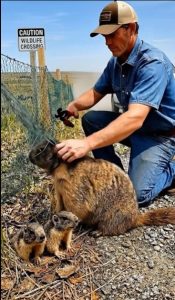
At first, he thought it might be a bird or another marmot calling normally. But the repetition and urgency made him pause. He followed the sound carefully until he spotted movement near the fence.
When he approached slowly, the situation became clear.
A marmot was trapped in rusted wire, struggling against an old fence that had clearly become a hazard over time.
The hiker crouched at a distance.
He knew marmots are extremely sensitive to sudden movement and noise, and that panic could make the situation worse. The animal was already stressed, breathing quickly and pulling repeatedly at the wire.
He spoke softly, not expecting it to understand, but to steady the moment.
“Hey… easy. I’m here to help.”
The marmot reacted by freezing briefly, then struggling again, unsure whether the approaching figure was a threat.
The hiker carefully removed his backpack and searched for a tool that could help. He found a small pair of pliers and a multitool knife—enough to cut or loosen the wire without getting too close.
He slowly shifted position, keeping his movements deliberate and calm.
Step by step, he approached the fence.
The marmot tensed each time he moved, but exhaustion was beginning to slow its frantic resistance. It could no longer struggle with the same intensity as before.
The hiker knelt and examined the wire.
It was tightly looped but not deeply embedded. That was good—it meant the animal was not seriously injured yet, only trapped.
He carefully inserted the pliers between the wire and the wooden post, testing where pressure could be released first. The metal resisted, but he avoided pulling directly on the marmot.
Instead, he focused on loosening the structure.
A small twist.
A slight bend.
The wire creaked faintly.
The marmot flinched but remained in place, watching closely.
The hiker paused, giving it a moment to settle before continuing. Then he adjusted the angle and tried again, slowly widening the loop just enough to reduce tension.
After several careful attempts, the wire began to slacken.
The marmot felt it immediately.
It shifted cautiously, testing whether it could move. The tension was still there, but weaker now.
The hiker continued working, focusing on the final tight section. With one last controlled motion, he lifted and twisted the wire just enough to open a gap.
Wild Marmot in Trouble Near a Fence pic.twitter.com/YymL8geIn0
— Animal Rescue Stories (@AnimalStory5) May 14, 2026
“Okay… try now,” he said quietly.
The marmot hesitated for a second.
Then it pulled backward sharply.
This time, it came free.