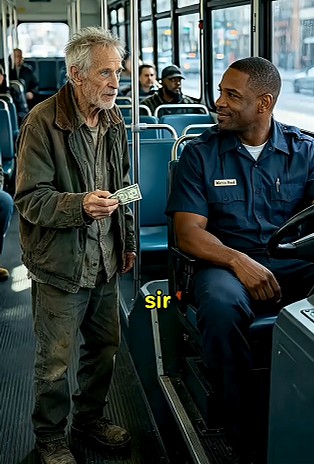
“Sir, I only have one dollar.”
The elderly man stood beside the fare box with his hand open, revealing a single wrinkled bill.
His gray coat looked too thin for the freezing December morning, and the cold had turned the tips of his fingers red.
“Is there any way I can still ride?” he asked. “I need to get across town.”
Marcus Reed looked at the digital clock above the windshield.
It was 7:42 in the morning, and his bus was already running several minutes behind schedule.
The regular fare was two dollars and fifty cents.
Marcus knew company policy. Drivers were not supposed to let anyone ride without paying the full amount.
But he also noticed the elderly man’s worn shoes, his trembling hands, and the way he kept glancing nervously toward the passengers behind him.
“That’s okay, sir,” Marcus said. “Put the dollar in and take a seat near the back.”
The man looked up in surprise.
“You’re sure?”
“I’m sure. Go ahead and sit somewhere warm.”
The man carefully placed his dollar into the fare box.
Before he could move away, a passenger seated near the front let out an impatient laugh.
“Are you serious?” the passenger said. “If he can’t afford the fare, he shouldn’t be on the bus.”
A woman beside him shook her head.
“Some of us have real jobs to get to,” she added. “We don’t have time to wait while people ask for free rides.”
A few other passengers laughed quietly.
The elderly man’s face turned red.
He reached toward the fare box as though he wanted to take his dollar back, even though the bill had already disappeared inside.
“I’m sorry,” he said. “I didn’t mean to bother anyone.”
Marcus watched the man lower his head.
It was not the first time Marcus had seen someone struggle to pay the fare.
During his eight years as a city bus driver, he had transported nurses returning from overnight shifts, parents carrying sleeping children, veterans traveling to medical appointments, and workers counting coins in their palms.
Most passengers paid without a problem.
Some simply needed a little patience.
“You’re not bothering anyone,” Marcus said.
The passenger near the front leaned forward.
“He’s holding up the entire bus.”
“We’ve been stopped for less than a minute,” Marcus replied.
“It’s still a waste of everyone’s time.”
Marcus looked into the large mirror above his seat.
Several people were staring at the elderly man.
Some appeared uncomfortable, but no one said anything.
Marcus closed the bus doors but did not pull away from the curb.
“Everyone, please listen,” he announced.
The conversation inside the bus stopped.
“The gentleman paid what he had. He has been respectful, and he is not causing a problem.”
The first passenger rolled his eyes.
“So this is a charity bus now?”
Marcus remained calm.
“No. It’s public transportation, and everyone riding it deserves to be treated with dignity.”
The woman beside the passenger laughed again.
“Just drive the bus.”
Marcus turned in his seat.
“The people who were laughing at him have two choices. You can apologize, or you can step off the bus and wait for the next one.”
The passenger stared at him.
“What did you just say?”
“You heard me.”
“You’re asking paying customers to leave because of someone who didn’t even pay the full fare?”
“I’m asking you to leave because this bus carries people, not cruelty.”
The bus became completely silent.
The elderly man looked at Marcus as though no one had ever defended him before.
The angry passenger stood and grabbed his briefcase.
“A driver like you will never get promoted,” he said.
Marcus opened the front door.
“If this job allows me to protect people who are being humiliated, I’ll always be proud of it.”
The man and the woman stepped off the bus.
Marcus waited until they were safely on the sidewalk before closing the door.
He then looked toward the elderly passenger.
“You’re safe here, sir. Please take a seat.”
The man slowly walked toward an empty seat beside the window.
“Thank you, young man,” he said. “Most people look right through me.”
Marcus released the parking brake.
“Not on my bus.”
The passengers remained unusually quiet as the bus continued along Harbor Avenue.
At the next stop, a nurse wearing blue scrubs moved to the seat beside the elderly man.
She offered him a pair of hand warmers from her coat pocket.
A teenage student gave him an unopened bottle of water.
Another passenger walked to the front and placed two dollars beside Marcus.
“For the next person who comes up short,” he said.
Marcus smiled but kept his eyes on the road.
One act of kindness had changed the mood of the entire bus.
Twenty minutes later, the elderly man pulled the stop cord.
He walked toward the front as the bus approached the central library.
Before getting off, he paused beside Marcus.
“What is your name?” he asked.
“Marcus Reed.”
The man repeated it carefully.
“Marcus Reed,” he said. “I won’t forget that.”
Marcus nodded.
“Take care of yourself, sir.”
The man stepped onto the sidewalk and stood there until the bus disappeared around the corner.
For the rest of his shift, Marcus wondered whether he had made a serious mistake.
He knew the passengers he had removed could file a complaint.
His supervisor had warned drivers that unauthorized passengers and service delays could result in disciplinary action.
Marcus had a mortgage, a wife, and a nine-year-old daughter depending on his income.
Still, every time he remembered the elderly man’s embarrassed expression, he knew he would make the same choice again.
The following morning, Marcus arrived at the transportation depot shortly before six.
His supervisor, Mr. Collins, was waiting beside the employee entrance.
“Marcus, don’t begin your route yet,” he said. “Someone wants to speak with you upstairs.”
Marcus felt his stomach tighten.
“Is this about what happened yesterday?”
Mr. Collins did not answer.
He simply led Marcus to a conference room on the second floor.
Inside, three company executives were seated around a long wooden table.
At the head of the table sat the elderly man from the bus.
He was no longer wearing the thin gray coat.
Instead, he wore a dark suit with a silver tie.
His hair was neatly combed, and a leather folder rested in front of him.
Marcus stopped in the doorway.
“Sir?”
The elderly man stood.
“Good morning, Marcus.”
Marcus looked from him to the executives.
“Is this about the complaint?”
The man gestured toward an empty chair.
“Please sit down.”
Marcus remained standing.
“Before anyone says anything, I want to explain. The gentleman was one dollar and fifty cents short. I know I broke the fare policy, but he was freezing and only needed to get across town.”
Mr. Collins glanced down at the table.
“I’m sorry, Marcus,” he said. “You’re being removed from your bus driver position.”
Marcus felt as if the floor had dropped beneath him.
“Removed?”
He thought about his family and all the bills waiting at home.
“Sir, I understand the policy, but I didn’t take money from the company. I was prepared to pay the difference myself.”
“You’re right,” the elderly man said. “You did not do anything wrong.”
Marcus looked at him in confusion.
The man opened the leather folder.
“That is why you are being offered a new position as the company’s general manager of passenger services.”
Marcus stared at him.
“General manager?”
“The position includes leadership training, a significant salary increase, and responsibility for driver conduct and passenger care across the entire city network.”
Marcus slowly sat down.
“I don’t understand.”
The elderly man extended his hand.
“My name is Samuel Whitmore. I founded this transportation company thirty-two years ago.”
Marcus shook his hand, still unsure whether he had heard correctly.
Samuel explained that he had recently received several complaints about passengers being treated disrespectfully.
Reports and statistics had not shown him what was truly happening on the buses, so he decided to experience the service personally.
He wore an old coat, carried only a single dollar, and boarded different routes to see how employees would react.
Some drivers ignored him.
One told him to get off before he could finish speaking.
Marcus had been the only driver who treated him like a person rather than a problem.
“You did not know who I was,” Samuel said. “You had nothing to gain by helping me.”
Marcus looked across the table.
“I thought you needed help.”
“And you were willing to risk your job to make sure I was not publicly humiliated.”
Samuel pushed the employment agreement toward him.
“You didn’t protect a wealthy company owner yesterday. You protected a human being.”
Marcus looked down at the new job title printed at the top of the page.
“I’ve never worked in management.”
“Management can be taught,” Samuel replied. “Character is much harder to teach.”
Marcus thought about the single dollar disappearing into the fare box.
It had seemed insignificant at the time.
Now that small decision was changing his family’s future.
“So kindness really does come back,” Marcus said.
Samuel smiled.
“Sometimes it does. But only when someone is brave enough to give it first.”
Marcus accepted the position.
During his first month, he introduced a passenger assistance program that allowed drivers to issue emergency ride passes to anyone stranded without enough money.
He also created new training sessions focused on patience, dignity, and respectful communication.
Near the entrance of every bus depot, Marcus placed a simple message for employees to read before beginning their routes:
Every passenger is carrying a story you may never hear. Treat them accordingly.
Marcus never forgot the freezing morning when an elderly man boarded his bus with only one dollar.
And Samuel never forgot the driver who treated him with dignity before knowing his name, his position, or the influence he carried.
Because the true measure of kindness is not how we treat people who can reward us.
It is how we treat them when we believe they have nothing to give us in return.