The donkey had given up struggling.
Standing beside a quiet country road, the gentle animal remained completely still as black plastic netting wrapped tightly around its legs and body. Every attempt to pull free only made the tangled mesh tighter.
It was exhausted.
The nearby field was only a few steps away.
But the donkey couldn’t reach it.
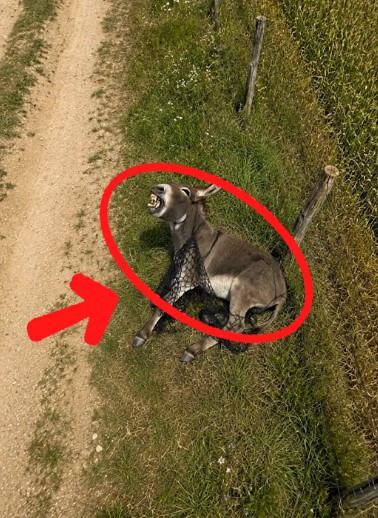
Cyclists and passing cars travelled along the road throughout the morning.
Most never noticed the dark bundle beside the grass.
Then one cyclist slowed down.
At first, it looked like abandoned netting caught in a bush.
But as the rider passed, the black mesh shifted ever so slightly.
Something underneath was alive.
The cyclist immediately stopped and leaned the bicycle against a nearby fence before walking carefully toward the roadside.
Hidden beneath the tangled netting stood a frightened donkey.
Its ears twitched as it watched the stranger approach.
The animal tried to lift one leg but couldn’t.
The net had become tightly wrapped around its hooves and body, leaving it unable to move.
The cyclist remained calm and spoke softly, hoping not to frighten the exhausted animal.
After contacting a local animal rescue service, the cyclist followed their advice while waiting for help.
Fortunately, a small pair of safety scissors was tucked inside the bicycle repair kit.
With guidance from the rescue team, the cyclist carefully began cutting away the outer layers of the black netting.
Every cut was slow.
Every movement was deliberate.
The donkey stayed remarkably calm, almost as if it understood someone was finally helping.
Minute by minute, the tangled mesh loosened.
The final strand slipped away.
For a few moments, the donkey remained perfectly still.
Then it cautiously stretched one front leg.
Next came the other.
After taking several careful steps, the animal walked free from the pile of discarded netting.
The cyclist smiled with relief.
Soon afterward, animal rescue volunteers arrived to examine the donkey.
Apart from minor scrapes and signs of exhaustion, the animal appeared healthy.
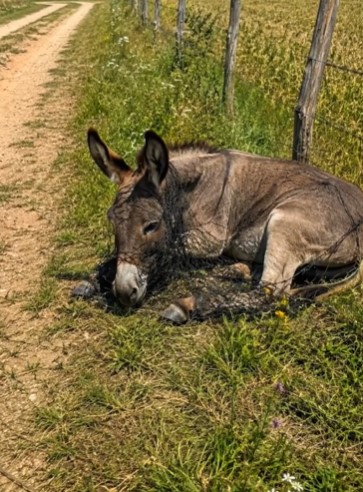
Fresh water was provided while the rescue team checked that no hidden injuries remained.
The donkey quickly regained its strength.
Not long afterwards, its owner arrived after hearing about the rescue from nearby residents.
Grateful for the cyclist’s quick actions, the owner safely guided the donkey back to its pasture.
Before leaving, the rescue team collected the discarded black netting and searched the surrounding roadside for additional debris.
They explained that abandoned mesh, ropes, and plastic materials can become dangerous traps for farm animals and wildlife alike.
Removing them helps prevent future emergencies.
The cyclist also spent a few extra minutes helping clean the roadside.
Sometimes preventing the next rescue is just as important as completing the first.
As the afternoon breeze swept across the countryside, the road returned to its peaceful rhythm.
The dangerous netting was gone.
The donkey was safely home.
The cyclist climbed back onto the bicycle and continued the journey, knowing one unexpected stop had completely changed the outcome for an animal in need.
Sometimes the greatest acts of kindness aren’t planned.
They happen because someone notices what everyone else overlooks.
One cyclist.
One trapped donkey.
One decision to stop.
And one life given another chance to walk freely again.
Cyclist Stops to Help Donkey Caught in Black Netting pic.twitter.com/4TGceWRf1z
— Animal Rescue Stories (@AnimalStory5) July 25, 2026
What should you do if you find a donkey tangled in netting?
If you discover a donkey caught in netting or another entanglement, stay calm and keep the animal as relaxed as possible. Contact the owner or local animal rescue services, and only attempt to remove the material if it can be done safely without causing injury.
Can you rescue a trapped donkey yourself?
Yes, if the situation is safe and the donkey is calm. Use caution when cutting away netting or rope, and avoid sudden movements that could frighten the animal. If the donkey appears injured or highly distressed, wait for trained professionals to complete the rescue safely.