Nicole stood just outside the entrance of the private school, one hand resting lightly on the strap of her bag as the afternoon pickup rush gathered around her. Parents were pulling up in polished SUVs, students were spilling out through the front doors in neat uniforms, and staff members moved up and down the walkway making sure everything stayed organized. The school building behind her looked exactly like the kind of place people imagined when they heard the words elite private academy—clean stone architecture, trimmed hedges, wide glass doors, and an atmosphere that seemed to suggest order, achievement, and expectation all at once.
Nicole had arrived a few minutes early.
She preferred it that way.
Her son Ethan usually came out smiling, backpack half-zipped, already talking before he reached her, and she liked being there waiting for him rather than making him search for her in the crowd. She had also planned to go back inside after pickup for a short meeting with the principal, but for the moment she was simply standing quietly near the entrance, watching the school day dissolve into the usual stream of students, cars, and conversation.
A woman in formal office attire stepped out through the doors and noticed her almost immediately.
She had a sharp posture, a school badge clipped neatly near her shoulder, and the kind of expression that suggested she was used to monitoring things closely. She walked directly toward Nicole with polite efficiency.
“Ma’am, staff pickup is around the back.”
Nicole looked at her calmly.
“I’m not staff.”
For a brief second, the woman hesitated, though not enough to soften the skepticism in her face.
“Oh,” she said. “Who are you waiting for?”
“My son.”
The woman’s eyes moved over Nicole again, as if trying to reorganize the conclusion she had already reached.
“Students must be released to family.”
Nicole nodded once.
“I am family.”
The woman gave a tight professional smile.
“I’ll need identification.”
“That’s fine.”
Nicole began reaching calmly toward her bag, but the woman kept speaking before she could pull anything out.
“We have strict security here.”
“I understand.”
“People sometimes come without authorization.”
Nicole paused with her hand still near the zipper of her bag and looked at the woman more directly.
“Do you think that’s what I’m doing?”
For the first time, the administrator seemed slightly uncomfortable.
The question was simple, but it stripped away the polite wording and exposed what had actually been happening since she approached. She had not been asking neutral questions. She had been working backward from an assumption.
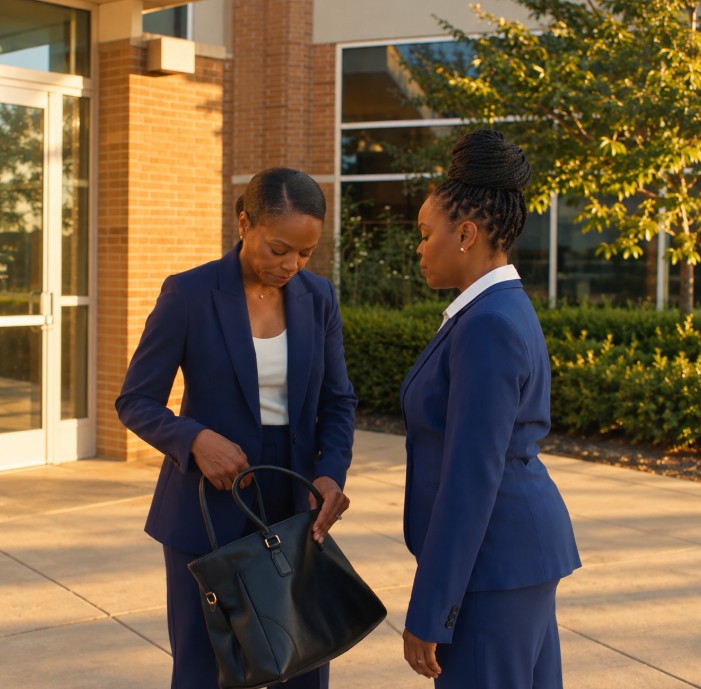
There was a brief silence between them, filled only by the sounds of the school afternoon—the closing of car doors, footsteps on the pavement, students laughing in clusters, and a distant bell somewhere inside the building.
The administrator straightened herself.
“We just have to be careful.”
Nicole held her gaze.
“There’s nothing wrong with being careful.”
The woman said nothing to that. She only seemed to become more rigid, as though Nicole’s composure was somehow making the exchange harder for her to control.
Nicole could have ended the conversation quickly by handing over identification and letting the moment pass. But there was something in the woman’s tone that made the issue feel larger than procedure. It was the certainty with which she had first approached her. The ease with which she had decided who Nicole probably was before asking the most basic question.
Nicole knew that tone.
She had heard versions of it in offices, at conferences, in lobbies, in waiting rooms, and in places where people believed professionalism covered whatever assumptions they had made about the person standing in front of them.
Before either of them spoke again, the front doors opened and a teenage boy stepped outside with quick, easy energy.
“Mom!”
Nicole turned immediately, and her entire expression changed.
“Hey, sweetheart.”
Ethan came straight toward her, his backpack slung over one shoulder, his face open and cheerful. Then he noticed the administrator standing there and the unfinished tension in the air.
“Why are you still out here?” he asked.
Nicole gave him a small smile.
“We were clearing something up.”
Ethan glanced from his mother to the administrator and back again. He wasn’t a child anymore. He was old enough to read a room, and smart enough to understand when something had happened that no one was saying out loud.
Before he could ask anything else, another voice entered the moment.
“Dr. Carter, good afternoon.”
Nicole turned and saw Principal James walking toward them from inside the building. He was a polished man with a calm, reassuring presence, the kind school leaders practiced after years of balancing parents, donors, students, faculty, and difficult conversations. He smiled as he approached, then looked at Ethan.
“Ready to steal your mother for a few minutes?”
Ethan grinned.
“If I’m allowed to come too.”
Principal James laughed softly, then noticed the expression on Ms. Turner’s face.
She looked startled.
“Dr. Carter?” she repeated.
Principal James looked at her, then back at Nicole, clearly sensing that he had stepped into the end of a conversation he had not heard.
“Yes,” he said. “Dr. Nicole Carter.”
There was a pause.
Then he added, with the kind of matter-of-fact tone that made the information land even harder, “She funded our new science program.”
Ms. Turner’s face changed instantly.
The skepticism was gone.
So was the quiet authority she had been using moments earlier.
Ethan looked at his mother, not because he was surprised, but because he already knew what came next whenever people suddenly changed the way they treated someone after learning a title or accomplishment.
Nicole did not look pleased.
She only looked steady.
“That shouldn’t change how I’m treated,” she said.
No one spoke for a moment.
The sentence settled over all of them with more force than if she had raised her voice.
Principal James glanced at Ms. Turner, then back at Nicole, clearly understanding more than he had a second earlier.
“Your meeting is ready,” he said gently.
Ethan brightened.
“Can I come?”
Nicole smiled at him.
“Of course.”
Then she turned briefly toward Ms. Turner.
“Security matters,” she said. “So does respect.”
With that, she rested a hand lightly at Ethan’s back, and the three of them began walking toward the entrance.
But long before they reached Principal James’s office, the weight of the moment had already settled over everyone involved.
Nicole had not mentioned it to Ethan before because she didn’t want his first feeling after school to be anger. She didn’t want him carrying that kind of heaviness if she could help it. But once they were inside, walking through the cool polished hallway, he looked up at her.
“She thought you weren’t supposed to be there, didn’t she?”
Nicole gave him a small glance.
“She made an assumption.”
“Because of how you looked?”
Nicole smiled faintly, though there was no humor in it.
“More because she thought she already knew who I was.”
Ethan shook his head.
“That’s ridiculous.”
“It happens more than you think.”
He frowned.
“But she changed the second Mr. James said who you were.”
Nicole pushed open the office door and waited for Ethan and Principal James to step in before following them.
“That’s what bothered me most,” she said.
Principal James closed the door behind them, his expression thoughtful.
“Dr. Carter, I want to apologize for that.”
Nicole sat down, setting her bag beside the chair.
“I appreciate that.”
“I mean it,” he said. “That’s not what this school stands for.”
Nicole crossed one leg over the other and looked at him calmly.
“Then it’s important that the school doesn’t only stand for something in brochures and speeches. It has to stand for it in small moments too.”
Principal James nodded slowly.
He knew she was right.
The science program she had funded was one of the school’s proudest new projects. It had created scholarships, upgraded lab equipment, and opened opportunities for students who had never had access to that level of academic support before. The board admired her. Faculty respected her. Parents had heard her name in meetings. But that was not the point, and Nicole had made that clear in one sentence outside.
If respect only appeared after status was revealed, then it was not really respect at all.
It was reaction.
Ethan sat beside his mother, quieter now.
He had grown up watching her carry herself with that kind of calm. He had seen people underestimate her before. He had also seen how she responded—never loud, never desperate to prove herself, never scrambling for approval. She simply remained who she was until the truth forced its own way into the room.
Principal James leaned forward slightly.
“I’ll speak with Ms. Turner.”
Nicole looked at him.
“I’m not interested in humiliating her.”
“Neither am I.”
“She was right about one thing,” Nicole said. “Security does matter. Children should be protected. Questions should be asked.”
Principal James nodded.
“But?”
Nicole’s eyes were steady.
“But there’s a difference between procedure and presumption.”
That line stayed in the room after she said it.
Ethan looked at his mother with the kind of quiet admiration teenage sons don’t always show in obvious ways, but feel all the same.
Principal James exhaled.
“That’s fair.”
Nicole reached over and lightly squeezed Ethan’s hand.
“When schools talk about preparing students for the future, they usually mean academics, discipline, opportunity. All of that matters. But the adults in the building are teaching things too, even when they don’t realize it.”
Principal James listened closely.
“If my son watches people treat others with suspicion first and dignity second,” she continued, “that teaches him something. If he sees people suddenly become respectful only after hearing a title, that teaches him something too.”
Ethan lowered his eyes for a moment, then looked back up.
“I already learned something,” he said.
Nicole smiled at him.
“What’s that?”
“That you can tell the truth without yelling.”
This time she laughed softly.
“That’s a useful lesson.”
Principal James smiled too, though his expression remained thoughtful.
The meeting itself went well. They discussed the science program, expansion plans for the following semester, student participation, and a mentorship initiative Nicole had been considering for months. Ethan listened with interest, occasionally asking questions of his own, especially when the conversation turned toward robotics and engineering opportunities. By the time the meeting ended, the tension from outside had faded, but not disappeared entirely. It remained present in the background, not as a fresh wound, but as a reminder.
When Nicole and Ethan returned to the front entrance, Ms. Turner was there.
She was standing a little apart from the main pickup flow now, her posture more restrained than before.
As Nicole approached, Ms. Turner stepped forward.
“Dr. Carter?”
Nicole stopped.
“Yes?”
“I owe you an apology.”
Nicole said nothing, giving her space to continue.
“I approached you with an assumption,” Ms. Turner said. “I told myself I was only enforcing school policy, but that’s not the whole truth. I could have handled that very differently.”
Nicole looked at her for a moment.
“Yes,” she said. “You could have.”
Ms. Turner swallowed.
“I’m sorry.”
There was no dramatic emotion in her voice, no speech meant to make herself feel better. Just discomfort, honesty, and the awkwardness of someone who had finally seen her own behavior clearly.
Nicole nodded once.
“Thank you for saying that.”
Ms. Turner glanced at Ethan.
“I’m sorry if that interaction made you uncomfortable too.”
Ethan looked at his mother briefly before answering.
“It’s okay.”
Nicole knew he was being gracious, not dismissive.
Ms. Turner managed a small, embarrassed smile.
“I’ll do better.”
Nicole adjusted the strap of her bag.
“That matters more than being embarrassed.”
Ms. Turner nodded.
Nicole then softened slightly.
“Protecting students is important. No one is arguing that.”
“I know.”
“But when you ask questions, ask them in a way that leaves room for the other person’s dignity.”
Ms. Turner looked down for a second, then back up.
“I understand.”
Nicole believed she probably did.
As she and Ethan walked back toward the parking area, the late afternoon sun had begun to settle into that softer golden light that made everything look quieter than it had an hour before. Students were nearly all gone now. The rush of pickups was ending. A few teachers crossed the lot carrying bags and folders. Somewhere behind them, the school doors opened and closed again.
Ethan walked beside his mother in thoughtful silence until they reached the car.
Then he asked, “Does stuff like that still bother you?”
Nicole unlocked the doors and rested one hand on the roof before answering.
“Yes,” she said honestly. “It does.”
He seemed relieved by the answer.
“I thought maybe you’d say you were used to it.”
“I am used to it,” she said. “That doesn’t mean it stops mattering.”
Ethan nodded slowly.
“That makes sense.”
Nicole looked at him.
“The important thing is not to let moments like that decide who you become.”
He gave her a curious look.
“What do you mean?”
“I mean you don’t answer disrespect by becoming disrespectful. You notice it. You understand it. You respond to it clearly. But you don’t let it turn you into someone smaller.”
Ethan smiled a little.
“That sounds like something you’d say in one of your lectures.”
She laughed.
“Maybe.”
He opened the passenger door, then paused.
“For what it’s worth, I’m glad you said something.”
Nicole met his eyes.
“For what it’s worth, I’m glad you were watching.”
He got in, and she walked around to the driver’s side.
As they pulled away from the school, Ethan looked back once through the window at the entrance they had just left. He had arrived there that afternoon thinking only about pickup, homework, and whatever they might eat for dinner. He left with something more important than that.
He had seen his mother challenged, doubted, and quietly judged before anyone knew her title.
He had seen respect withheld until authority made it convenient.
And he had seen his mother refuse to let any of that change her voice, her posture, or her principles.
Inside the school, Ms. Turner would probably remember that afternoon for a long time.
So would Principal James.
Because what happened near the entrance had not really been about a misunderstanding over pickup.
It had been about the difference between caution and suspicion.
Between professionalism and prejudice.
Between recognizing policy and forgetting humanity.
And if the school truly wanted to teach excellence, then perhaps that lesson mattered just as much as anything happening inside its classrooms.
Nicole drove on with one hand steady on the wheel and her son beside her, knowing that some of the most important lessons children learn are not taught from textbooks, whiteboards, or carefully planned programs.
Sometimes they learn them by watching how a person holds their dignity when someone else tries, even briefly, to take it away.