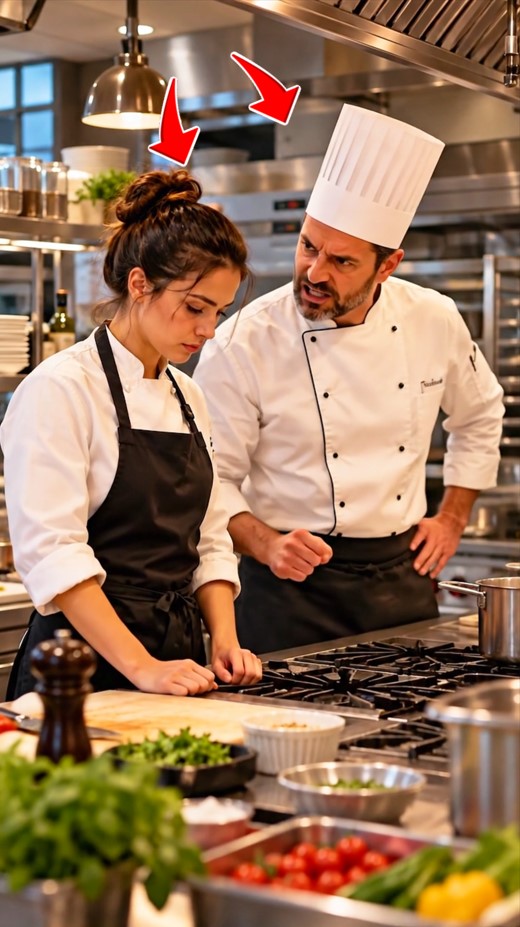
A Kitchen Where Respect Was in Short Supply
The dinner rush had barely begun when Head Chef Richard Hayes started criticizing Emma Collins in front of the entire kitchen staff.
Emma was one of the restaurant’s most dedicated chefs, arriving early, staying late, and taking pride in every plate she prepared.
Yet Richard treated her as though she had never earned her place in the kitchen.
He interrupted her explanations, dismissed her suggestions, and regularly assigned her the most exhausting tasks while giving his favorite employees the best opportunities.
That evening, Emma had prepared a special dish for an important restaurant review, carefully balancing the flavors and presentation.
Richard barely looked at it before pushing the plate aside.
“You’re here to follow instructions, not pretend you’re running this kitchen,” he snapped.
Several employees lowered their eyes.
Emma took a slow breath, fighting the humiliation that had become an increasingly familiar part of her job.
She had worked too hard to reach this position to walk away without a fight.
The Head Chef’s Favorite Target
Richard Hayes had managed the kitchen at the prestigious Willow Creek Restaurant for nearly eight years.
He was respected for his technical skills, but his temper had made working under him increasingly difficult.
He believed that pressure produced excellence, and he used that belief to justify shouting at employees whenever something failed to meet his expectations.
However, his treatment of Emma went beyond ordinary criticism.
When another chef made a mistake, Richard often corrected it quietly and offered advice.
When Emma made even a minor error, he announced it to the entire kitchen.
He frequently reassigned her preparations to less experienced employees, then blamed her when the results were inconsistent.
If she suggested a better method, he called her inexperienced.
If she followed his instructions exactly, he accused her of lacking initiative.
Emma had graduated from a respected culinary program and spent six years building her career in professional kitchens.
She had joined Willow Creek hoping to learn from one of the region’s most accomplished chefs.
Instead, she found herself constantly defending her competence.
One afternoon, she asked Richard why she had been excluded from a meeting about the restaurant’s new seasonal menu.
“Because I need people who can handle responsibility,” he replied without looking up.
Emma reminded him that she had developed several dishes currently featured on the restaurant’s menu.
Richard closed his notebook.
“Don’t confuse being useful with being indispensable.”
The comment stung, but Emma returned to her station without arguing.
She had bills to pay, a career to protect, and no intention of letting his attitude determine her future.
Still, she began keeping records of her menu contributions and the responsibilities she was assigned.
She didn’t know when she might need them.
She only knew that something about the situation was wrong.

A Special Assignment Becomes Another Humiliation
Two weeks later, the restaurant’s owner, Margaret Bennett, announced that an influential food critic would visit for a private tasting.
The critic would evaluate the restaurant’s new menu before deciding whether to feature it in a major dining publication.
Richard immediately took control of the preparations.
He selected his most trusted sous-chef, James, to oversee the main course and assigned Emma responsibility for a seasonal vegetable dish.
Emma had already spent several weeks developing a recipe using roasted squash, fresh herbs, toasted hazelnuts, and a carefully reduced sauce.
The dish was simple in appearance but required precise timing and balance.
Richard initially approved it during a staff tasting.
But when Emma presented the final version the day before the critic’s arrival, he abruptly changed his position.
“This is too ordinary,” he declared.
Emma explained that the dish was designed to complement the richer main course without overwhelming it.
Richard dismissed her explanation.
“You’re making excuses because you can’t create something memorable.”
He ordered her to replace the sauce and change the presentation before service ended.
Emma complied, even though the requested changes weakened the balance she had worked so hard to achieve.
Later that evening, she discovered that Richard had presented her original recipe to the owner as one of his own menu concepts.
When Emma quietly raised the issue, Richard’s expression hardened.
“Recipes belong to the restaurant,” he said. “You should be grateful your work is being used.”
“I’m not asking for special treatment,” Emma replied. “I’m asking for my contribution to be acknowledged.”
Richard stepped closer to the preparation counter.
“Then perhaps you should find a kitchen where recognition matters more than results.”
Emma looked at him, realizing that he expected her to retreat.
Instead, she returned to her station and completed her work.
She would not create a scene before the important tasting.
But she would no longer pretend his behavior was acceptable.

The Restaurant Owner Notices the Difference
The following afternoon, Margaret Bennett arrived early to inspect the preparations.
She had built Willow Creek from a small neighborhood restaurant into a respected dining destination.
Although she trusted Richard’s culinary judgment, she also believed that a successful kitchen depended on teamwork and professional respect.
During her inspection, she tasted the vegetable dish Emma had developed.
She paused after the first bite.
The roasted squash was tender without becoming mushy, the herbs added freshness, and the toasted hazelnuts provided a pleasant contrast.
“Who developed this combination?” Margaret asked.
Richard answered before Emma could speak.
“It was a team effort. I refined the concept.”
Margaret nodded, then turned toward Emma.
“Did you work on this dish?”
“Yes,” Emma replied. “I developed the original recipe and adjusted it after our first tasting.”
Richard interrupted.
“Emma has a tendency to become attached to her ideas.”
Margaret looked at him.
“That wasn’t what I asked.”
The kitchen fell silent.
Emma explained the ingredients, the cooking method, and the reasoning behind the dish’s place on the menu.
Her explanation was clear, practical, and confident.
Margaret asked several detailed questions.
Emma answered each one without hesitation.
For the first time, someone in authority was evaluating her work directly rather than relying entirely on Richard’s opinion.
Margaret tasted the dish again.
“This is thoughtful cooking,” she said. “I want it served exactly as it was presented to me.”
Richard’s jaw tightened.
He claimed the restaurant needed consistency and that changes should come through him.
Margaret agreed that consistency mattered.
Then she reminded him that the restaurant’s reputation depended on the quality of its food, not on who received credit for creating it.
She instructed the kitchen to preserve Emma’s recipe for the tasting.
Before leaving, Margaret requested a private conversation with Emma after service.
Emma returned to work with cautious hope.
She had finally been heard, but she knew Richard would not welcome what had happened.

The Tasting Takes an Unexpected Turn
That evening, the restaurant’s dining room was prepared for the private tasting.
The critic, Daniel Foster, arrived with a notebook and a reputation for asking detailed questions about the food he reviewed.
Margaret welcomed him personally before Richard presented the opening dishes.
The first courses were well received.
James delivered the main course with the precision expected of an experienced sous-chef.
Then Emma’s vegetable dish reached the table.
Daniel studied its presentation before taking a bite.
He tasted it again, then asked Richard who had developed the recipe.
Richard began describing the restaurant’s seasonal philosophy.
Daniel politely interrupted.
“I understand the concept, Chef, but I’m asking about the person who created this particular combination.”
Richard glanced toward Emma, who stood near the service counter.
“Emma worked on the preparation,” he said. “I supervised the final development.”
Margaret immediately recognized the familiar pattern.
She stepped into the conversation.
“Emma developed the original recipe. Her work is the reason this dish is on tonight’s menu.”
Richard’s face reddened.
He attempted to explain that all kitchen work passed through his supervision.
Daniel listened before asking Emma to describe her approach.
She explained how the sweetness of the squash was balanced by the herbs and toasted nuts, and why she had avoided a heavier sauce.
Daniel smiled.
“That’s exactly what I was looking for. The dish has its own identity without competing with the main course.”
Emma thanked him and returned to her station.
Richard remained silent for several moments.
The tasting continued, and the critic praised the kitchen’s overall quality.
Yet the most memorable conversation of the evening had exposed something Richard could no longer easily dismiss.
Emma possessed the skill and judgment he had repeatedly denied her.
More importantly, the owner and a respected critic had now seen it for themselves.
Head Chef Treats a Female Chef Unfairly in the Kitchen https://t.co/bmHkOLNqq9
— Animal Rescue Stories (@AnimalStory5) October 17, 2026
A New Standard for the Kitchen
The changes did not transform Willow Creek overnight.
Richard remained reserved, and the atmosphere between him and Emma was uncomfortable for several weeks.
However, the new procedures made it harder to dismiss contributions or assign blame without explanation.
Recipe development was documented, feedback was delivered more professionally, and kitchen meetings included employees whose work had previously been overlooked.
Emma began developing her two new dishes.
She tested ingredients, collected feedback from colleagues, and adjusted the recipes after each tasting.
This time, Richard reviewed her work without publicly belittling her.
He still challenged her decisions, and Emma still made occasional mistakes.
The difference was that criticism became specific and useful instead of personal.
Several months later, Margaret announced the restaurant’s updated seasonal menu.
Two of Emma’s creations were included, with her name listed among the chefs responsible for their development.
The recognition mattered, but the change in the kitchen mattered more.
Other employees began offering ideas without fearing immediate ridicule.
James admitted that he had sometimes remained silent when Richard treated Emma unfairly because he worried about becoming the next target.
Emma appreciated his honesty, although she reminded him that speaking up could have helped sooner.
Eventually, Richard requested a private conversation with her.
He admitted that his approach had damaged trust and that he had been wrong to dismiss her contributions.
His apology was brief and awkward, but Emma accepted it without pretending that everything had instantly been forgotten.
“All I ever wanted was the chance to do my job fairly,” she told him.
Richard nodded.
From that point forward, their working relationship remained professional, and Emma continued building her reputation through consistent work.
She had not won her place by humiliating someone else or forcing the kitchen to choose sides.
She had earned recognition by maintaining her standards even when someone tried to make her doubt herself.
Emma’s greatest victory was not proving the arrogant head chef wrong, but helping create a kitchen where talent could finally speak louder than fear.