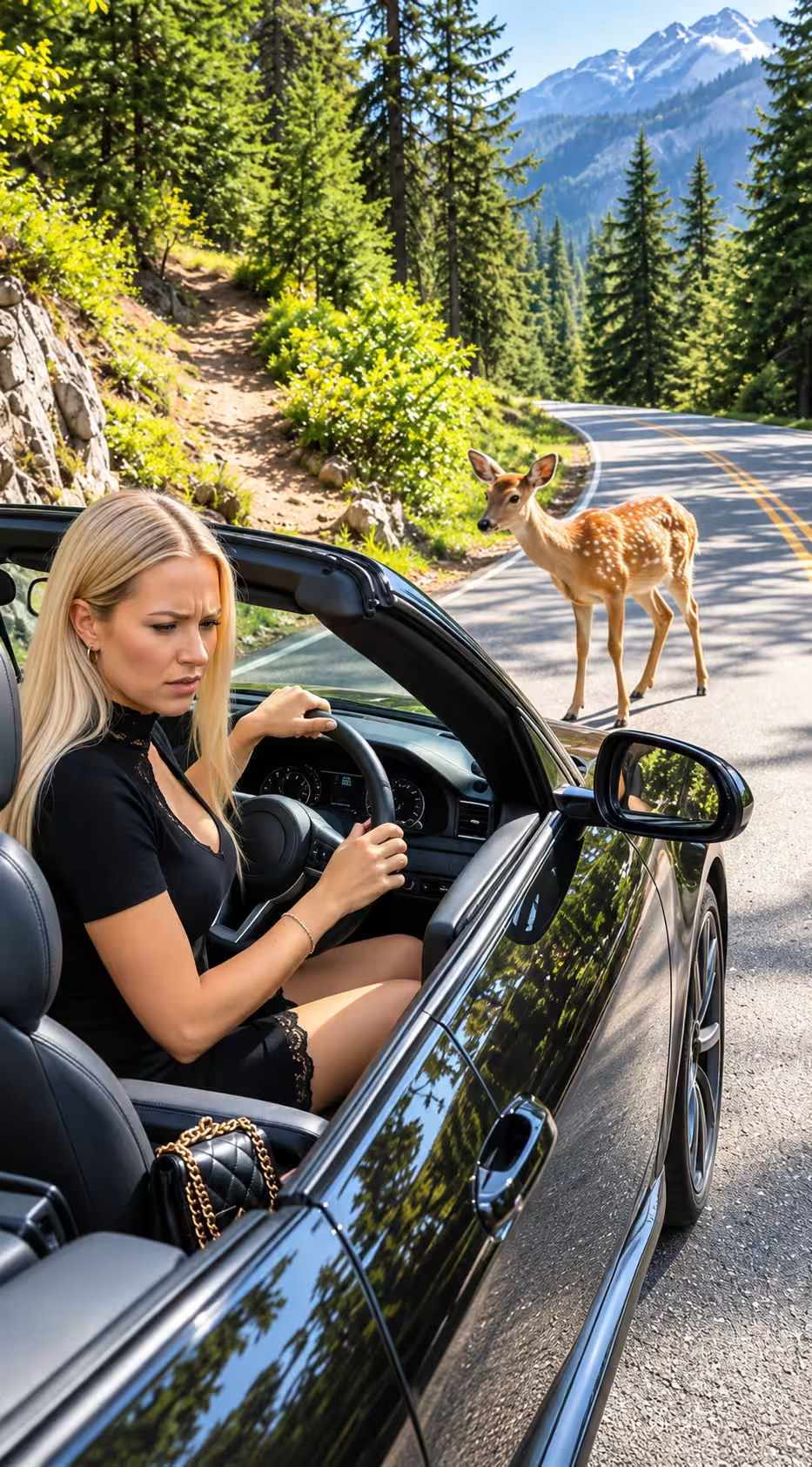
The deer appeared beside the mountain road just as the woman slowed her vehicle near a sharp bend.
Thirty-five-year-old Emma Collins noticed the animal standing unusually close to the pavement.
Instead of disappearing into the trees, the deer remained beside the roadside barrier.
Emma stopped in a safe parking area and watched from her vehicle.
The animal moved toward a narrow opening in the forest, then paused and looked back.
Something about its repeated movements caught Emma’s attention.
After carefully assessing the surroundings, she stepped onto the marked woodland path.
The deer moved ahead, disappearing briefly between the trees before becoming visible again.
Several minutes later, Emma heard an unfamiliar sound coming from a cluster of fallen branches.
Another deer was struggling beneath the tangled wood.
Emma reached for her phone as footsteps approached from farther along the trail.
A man appeared between the trees, carrying a small equipment bag.
A Peaceful Drive Through the Mountains
Emma had planned a quiet weekend trip to the mountain region.
She worked as a graphic designer and enjoyed photographing natural landscapes during her free time.
The mountain road crossed a protected forest known for its wildlife and scenic viewpoints.
That morning, low clouds covered the distant peaks while sunlight filtered through the trees.
Emma drove slowly, stopping occasionally at designated viewpoints to take photographs.
She had already photographed a narrow waterfall and several rocky hillsides.
As she continued uphill, the road curved around a densely wooded slope.
A roadside sign warned drivers to watch for deer crossing the area.
Emma reduced her speed and carefully followed the bend.
She noticed movement near the edge of the forest.
A deer stood beside the road, watching the passing vehicles.
Emma initially expected it to retreat into the trees.
However, the animal remained near the roadside.
It took several steps toward the forest before turning its head.
Emma noticed that it appeared restless.
She decided to stop at a nearby parking area and observe from a safe distance.
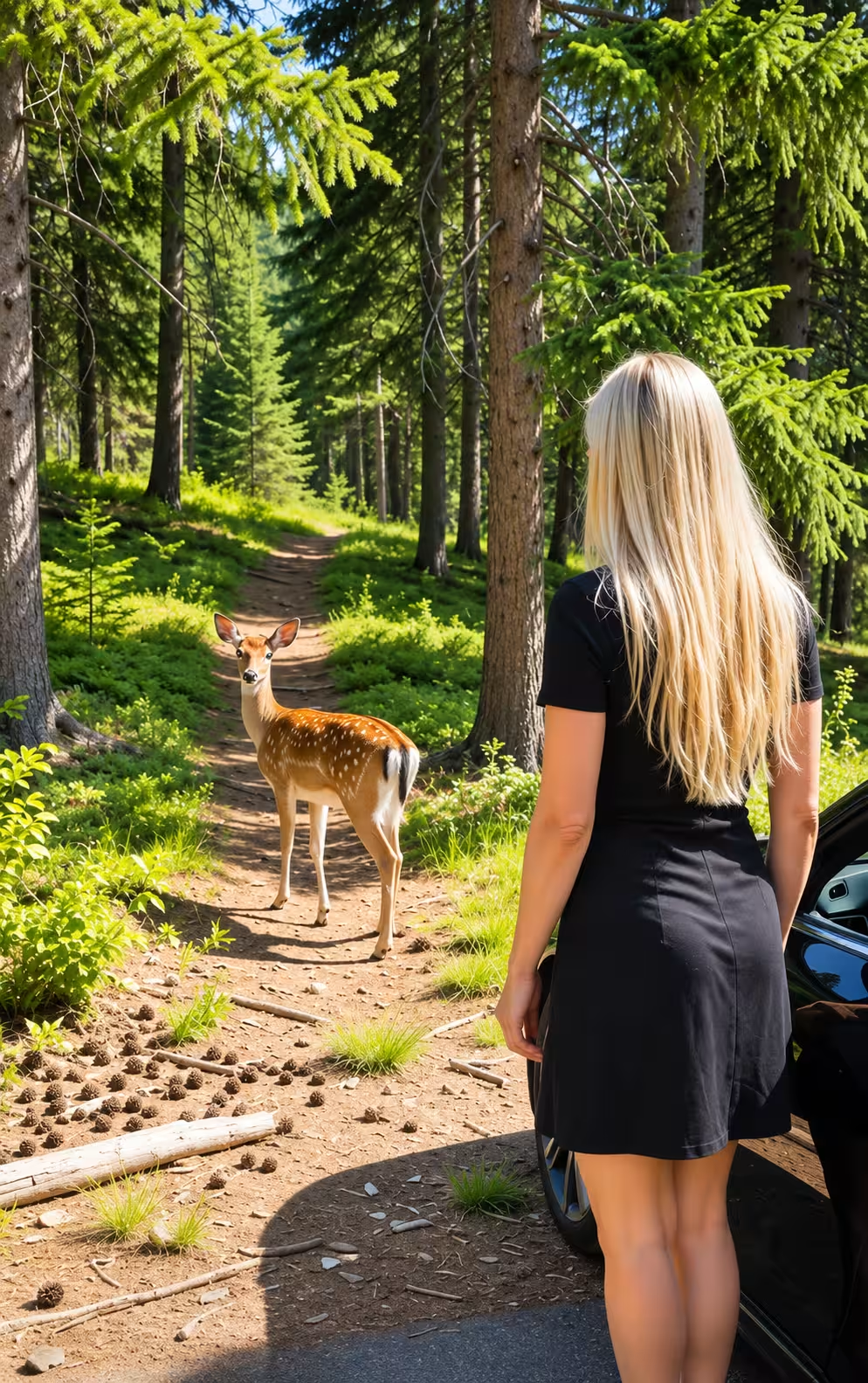
A Deer Moves Toward the Forest
Emma parked her vehicle and switched off the engine.
The deer stood near a narrow path leading into the forest.
She remained inside her vehicle for several moments, watching its movements.
The animal walked toward the trees, then stopped near a fallen log.
Emma wondered whether something had disturbed it.
She noticed a small information board marking a public walking trail.
After checking the path, she stepped outside and kept her distance.
The deer moved farther into the woodland.
Emma followed the marked trail rather than approaching the animal directly.
She understood that wild deer could become frightened by sudden movements.
The forest was quiet except for birds calling above the canopy.
Emma occasionally glimpsed the deer between the trunks.
Its movements seemed hesitant, although she could not determine why.
After several minutes, she heard rustling from a lower section of the hillside.
The deer stopped near a group of fallen branches.
Emma remained on the trail and listened.
A faint movement came from beneath the tangled wood.
She realized that another animal might be trapped nearby.
Another Deer Lies Among Fallen Branches
Emma moved toward a clearer section of the path to examine the area.
Several branches had fallen across a shallow depression beside the trail.
Beneath them, a second deer lay awkwardly against the ground.
Its hindquarters appeared restricted by the tangled wood.
The animal struggled briefly before becoming still again.
Emma immediately recognized that approaching without assistance could be dangerous.
She stepped backward and called the regional wildlife response number.
The dispatcher asked for her location and a description of the situation.
Emma provided the trail marker number and explained what she could see.
She was advised to remain at a safe distance while help was arranged.
The first deer stood farther uphill, watching the surrounding forest.
Emma could not know whether the animals were related.
However, their presence in the same area had brought her attention to the problem.
She waited near the marked trail, keeping both animals in view.
A few minutes later, she heard footsteps approaching through the trees.
A man wearing a green field jacket emerged from the woodland.
He introduced himself as Daniel Harris, a reserve maintenance worker.
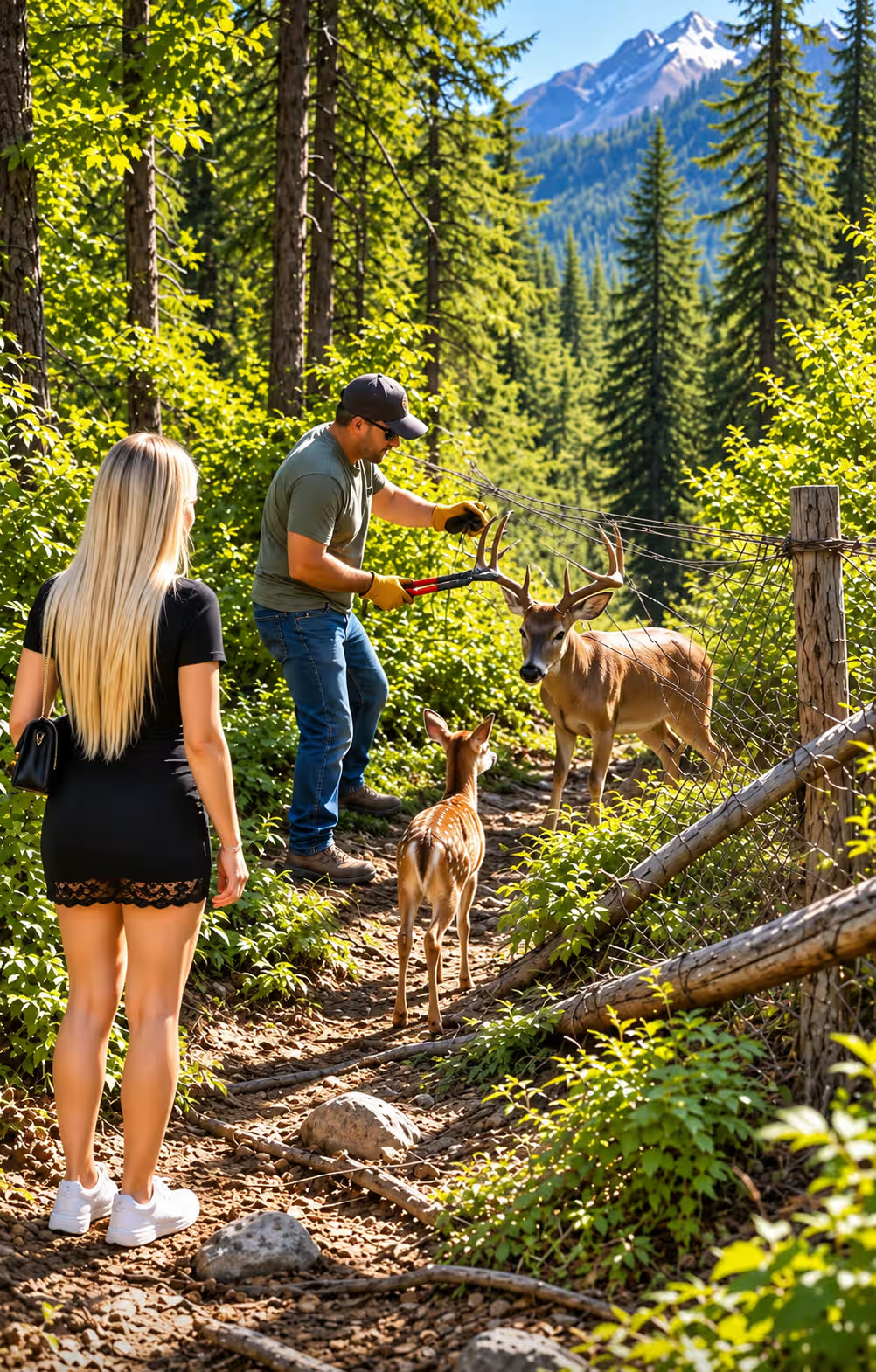
A Man Arrives and Helps Free the Trapped Deer
Daniel had been inspecting nearby trails when the wildlife dispatcher contacted him.
He carried protective gloves, a folding saw, and basic maintenance equipment.
Emma pointed toward the trapped deer and explained what she had observed.
Daniel stopped several yards away to assess the fallen branches.
He noticed that a heavy limb rested across smaller pieces of wood.
The deer appeared unable to move freely beneath the obstruction.
Daniel contacted the wildlife response team and described the situation.
A trained wildlife officer was already traveling toward their location.
Emma asked whether they should attempt to move the branches immediately.
Daniel explained that sudden movements could frighten or injure the animal.
He waited until the wildlife officer arrived and assessed the safest approach.
The officer, Rebecca Lewis, examined the deer and developed a careful removal plan.
Daniel used his equipment to cut a smaller branch away from the obstruction.
Rebecca monitored the animal while Emma remained farther along the trail.
Working slowly, Daniel shifted another loose branch away from the deer’s hindquarters.
The animal moved its legs as the pressure eased.
After the final obstruction was removed, the deer carefully rose to its feet.
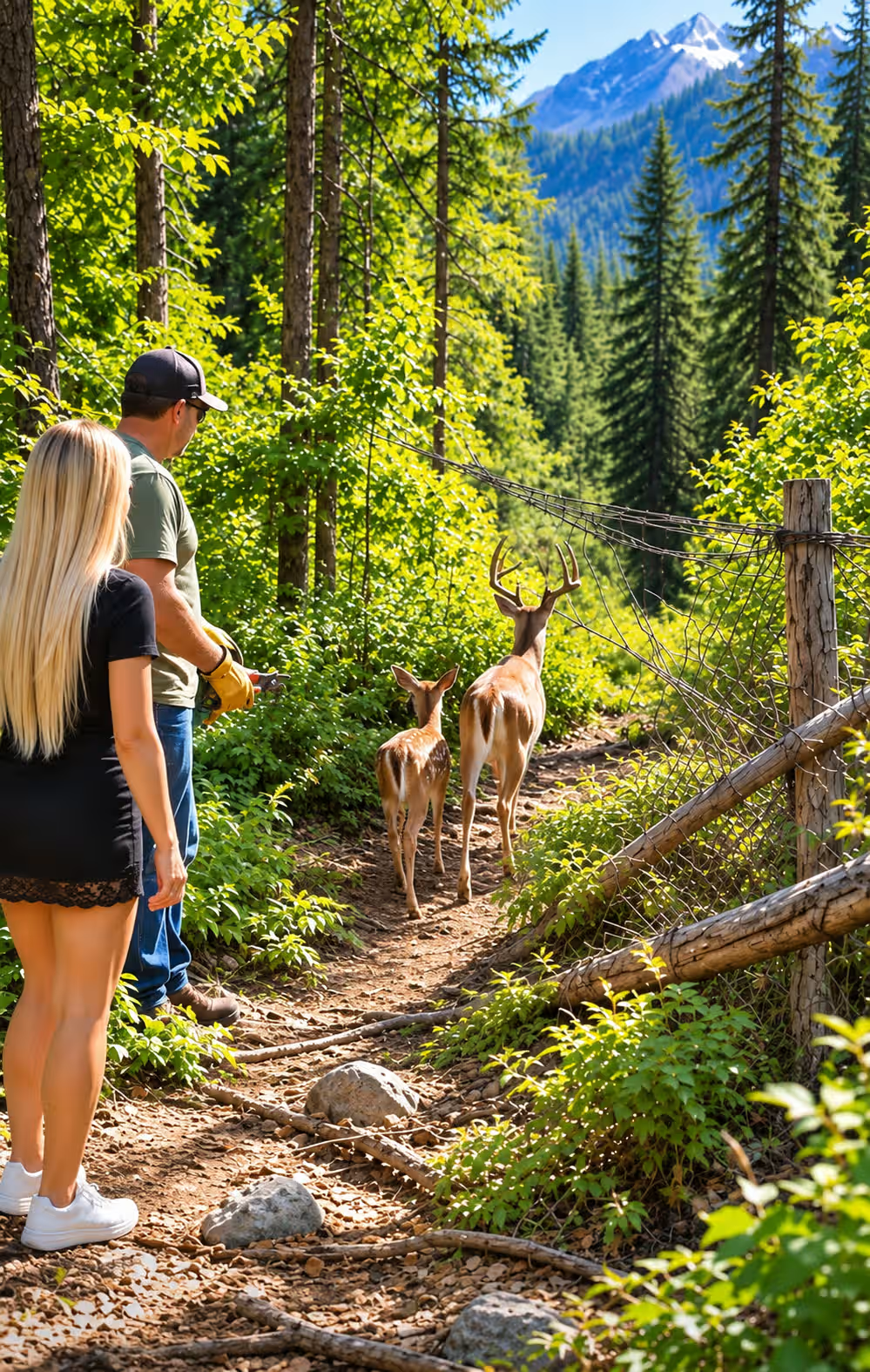
A Careful Check Before the Deer Returns
Rebecca asked everyone to remain still while the deer regained its balance.
The animal stood quietly for several moments.
It appeared alert and began testing its weight on each leg.
Rebecca observed its movements without attempting unnecessary contact.
The deer took several cautious steps toward the open forest.
Daniel moved away from the cleared area to provide more space.
Emma watched from the trail, relieved to see the animal standing.
The deer paused near a cluster of young trees.
It then walked slowly toward the thicker vegetation.
Rebecca continued observing until the animal disappeared from view.
She explained that its ability to walk was encouraging.
However, she could not rule out every possible injury from a brief observation.
The wildlife team would monitor the area for further signs of difficulty.
Daniel inspected the fallen branches and checked for additional hazards.
He moved smaller debris away from the walking path.
Rebecca documented the incident and recorded the location.
Emma thanked both responders for handling the situation carefully.
The first deer was no longer visible, having moved deeper into the forest.
A Mountain Journey With an Unexpected Meaning
Emma returned toward the road after the responders confirmed the trail was clear.
Daniel accompanied her to the main path before continuing his inspection.
She thanked him again for helping free the trapped animal.
Daniel explained that fallen branches were common after periods of strong wind.
He encouraged visitors to report wildlife emergencies rather than attempting risky rescues themselves.
Emma agreed and said she was grateful the response team had arrived quickly.
Back at her vehicle, she reviewed the photographs taken earlier that morning.
The mountain scenery looked peaceful, almost unchanged by the unexpected encounter.
She decided not to share the precise location of the deer online.
Instead, she planned to describe the importance of observing wildlife responsibly.
Later that afternoon, Emma visited the reserve’s information center.
She reported the encounter and thanked the staff for their assistance.
In this fictional story, a woman followed a marked forest path after noticing a deer beside a mountain road.
Her attention led to the discovery of another deer restricted by fallen branches.
A maintenance worker and wildlife officer carefully removed the obstruction, allowing the animal to stand.
The encounter reminded Emma that helping wildlife often required patience, distance, and trained assistance.
As she drove away through the mountains, Emma remembered the quiet moment when the trapped deer finally stood and walked toward the forest, free to continue its life among the trees.