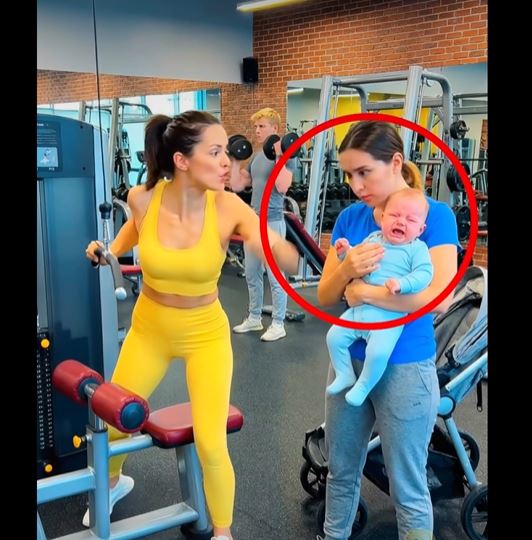
The gym was unusually crowded that afternoon. Music pulsed from the speakers, weights clanged against metal racks, and the steady rhythm of treadmills filled the air. For most people, it was just another workout. For Emma, it felt like a test she was barely holding together.
She stood near the stretching area, her baby strapped to her chest in a soft carrier. Sweat dotted her forehead—not just from exertion, but from anxiety. This was her first time back at the gym since giving birth, her first attempt to reclaim a small piece of herself after months of sleepless nights and constant responsibility. She had debated coming at all, worried about judgment, worried about exactly what was happening now.
Her baby suddenly began to cry.
At first it was a soft whimper, the kind Emma had learned to soothe quickly. She bounced gently, whispering reassurances, rocking side to side. But the cry grew louder, sharper, echoing off the walls. Heads turned. A few people glanced over with irritation, others with curiosity. One woman paused mid-rep and sighed loudly. A man near the squat rack shook his head and muttered something under his breath.
Emma’s heart sank.
“I’m sorry,” she whispered automatically, even though no one had said anything directly to her. Her hands trembled slightly as she tried to calm her baby, heat rushing to her face. She could feel the tension in the room building, an unspoken pressure telling her she didn’t belong there—that she should pack up and leave.
The baby cried harder.
Emma swallowed back tears. She considered heading for the exit, abandoning her workout altogether. The thought stung more than she expected. She wasn’t asking for special treatment. She just wanted a moment to breathe, to feel normal again.
That was when a calm voice cut through the noise.
“Hey,” a man said gently. “You’re doing great.”
Emma looked up, startled. The man stood a few feet away, tall but unassuming, dressed in plain workout clothes. He didn’t look annoyed or judgmental. His expression was relaxed, grounded, as if the crying hadn’t disrupted his world at all.
“If you’re okay with it,” he continued, keeping a respectful distance, “sometimes babies just need a different rhythm. May I try something?”
Emma hesitated. Every instinct as a mother made her protective, but something about his tone—steady, patient, non-intrusive—made her nod.
He knelt down slowly so he was at eye level with the baby, never touching, never rushing. He began to hum softly, a low, steady sound that almost blended with the music in the background. At the same time, he gently tapped the floor in a slow rhythm, like a heartbeat.
The baby’s cries faltered.
The room seemed to notice all at once. The weights stopped clanging. Conversations quieted. Even the music felt less intrusive somehow.
The man kept humming, eyes soft, movements deliberate. Emma felt her shoulders drop for the first time since the crying started. The baby’s breathing slowed. The cries softened into small hiccups, then stopped altogether. Tiny fingers curled against the fabric of the carrier.
Silence settled over the gym.
Not the awkward kind—but a peaceful one.
A woman nearby smiled. Someone else let out a quiet breath they hadn’t realized they were holding. The tension that had filled the space just minutes earlier dissolved, replaced by something warmer, gentler.
“There we go,” the man said softly, standing back up. “Sometimes they just need a pause.”
Emma felt tears well up, this time not from embarrassment, but relief. “Thank you,” she said quietly. “I didn’t know what to do anymore.”
He shrugged lightly. “You showed up. That already says a lot.”
He didn’t linger. He didn’t wait for praise or attention. He simply returned to his workout, leaving behind a room that felt subtly changed.
Emma finished her session that day—not perfectly, not without interruptions—but without shame. A few people nodded at her as they passed. One woman stopped to tell her, “You’re doing amazing, by the way.”
As Emma left the gym later, baby asleep against her chest, she realized something important had shifted inside her. Not just confidence, but perspective. The world didn’t always need fixing. Sometimes it just needed space. Sometimes it needed patience. Sometimes it needed one person to choose calm instead of frustration.
And sometimes, kindness was simply choosing to step in quietly, soothe what was hurting, and help everyone remember that we’re all human—doing our best, together.